Angie Nowhere
Anarchy in the U.K. and the U.S.A. and…
Winter 1977–1978
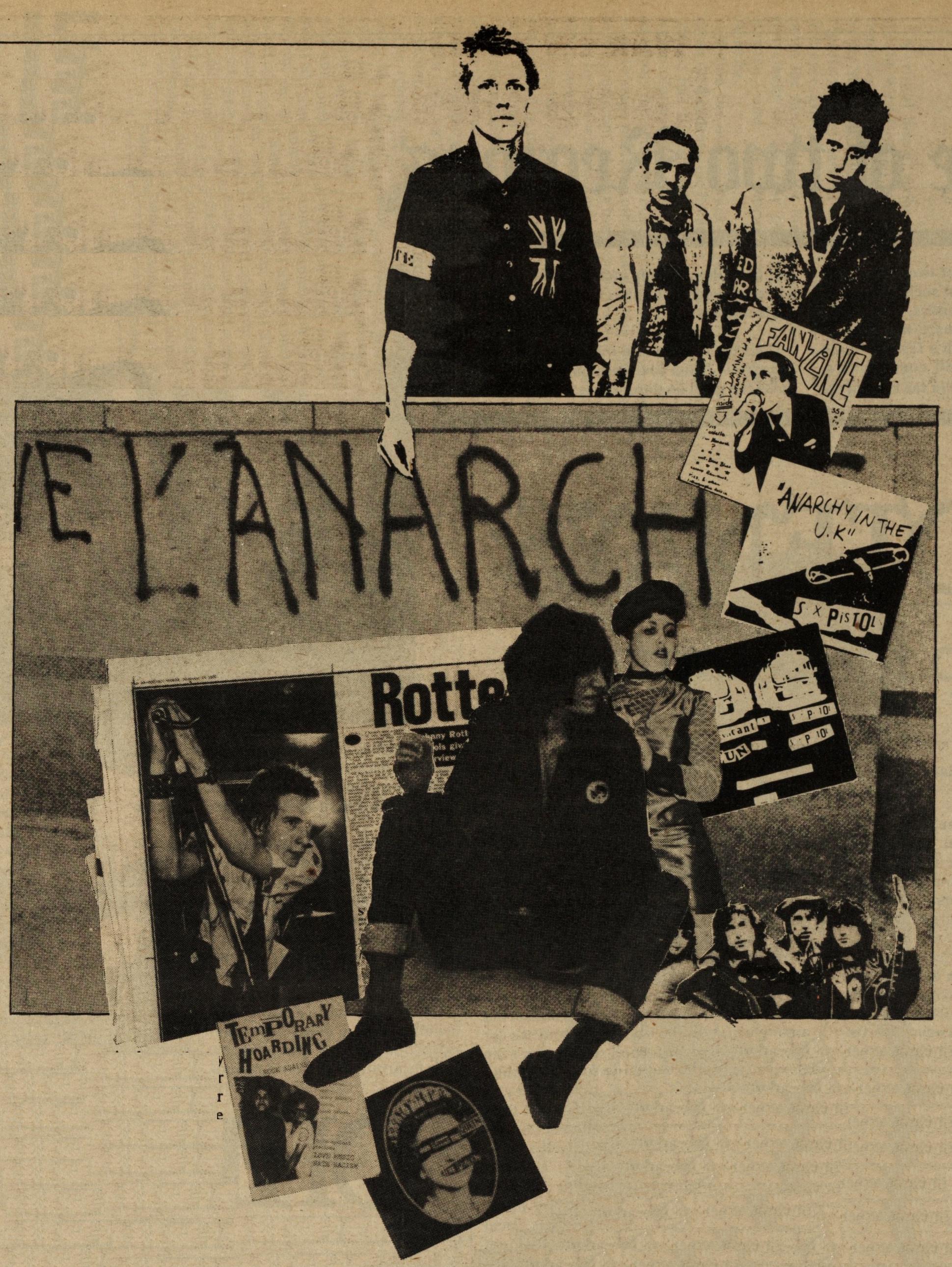
“I was more interested in being obnoxious than in singing”—Johnny Rotten of the Sex Pistols.
It sounds like hype and it smells like nihilism, but Britain’s New Wave of Punk Rock music has the feel of a genuine cultural insurgency.
Spikey hair, deliberately-ripped clothes, moronic stares and safety pins through the cheeks—all just a pose to offend and titillate.
The music itself is urgent, insistent and unpolished—a throwback to more primitive forms of rock. It has to be that way because its propelling force is the rage and frustration of young working class people who have been lied to, swindled and cast aside by the modern Welfare State.
Punk is supposed to be anti-everything. But really it chooses its targets with precision: institutionalized boredom, the dole queue, high-rise flats, TV. In short, the status quo.
And in a social order based on pitting one group against another, Punk knows which way to jump: turn on to Punk and turn off to racism.
Punk has no central command and no correct line. It’s a network of bands, scenes and individuals with common working class origins and common outlook inhabiting a nether-world of low-paid gigs where individualism ‘and musical virtuosity are no particular assets.
The ties that bind them are reflected in their song titles: “Police State” (by the Staines); “Boredom” (Buzzcocks); “White Riot” (Clash); Pretty Vacant” (Sex Pistols).
The first Punk group to gain notoriety is The Sex Pistols. Their manager talks anarchism, and they bring out their first single, “Anarchy in the U.K.”:
“There are many ways to get what you want / I use the best / I use the rest / I use anarchy / ’Cause I wanna bring you anarchy / It’s the only way to be.”
“Anarchy” is banned from the BBC, the Pistols call a television interviewer “a dirty fucker” on a national hookup, and they get terminated by two different recording companies. A follow-up single on Virgin Records, “God Save the Queen,” is similarly blackballed. It’s main lyric: “She ain’t no human being / They made you a moron / potential H-Bomb.”
Now the Pistols get banned by local councils from performing all over England, and they are victimized in a series of physical attacks by r royalist vigilantes. No longer able to perform under their own name because of the notoriety, and receiving a number of death threats, they go underground, appearing as a mystery group when on tour.
“I think the Sex Pistols are absolutely bloody revolting.. I felt unclean for 48 hours after I saw them”—Member of Parliament (Tory).
It’s not only the lackeys of the ruling class that can’t stomach Punk. A lot of radicals are put off by the sensationalism and the perverse code of decency. For instance, the New York-based Maoist newspaper The Guardian calls Punk a “cruel hoax” and a “social disease.” It says the Pistols look psychotic in their photos, and it psychoanalyses Punkers as depressed neurotics with no grounding in true oppression.
The Clash know different: “We’re a garage band / living in a garage land.” Their music derives from their social milieu, and it’s not about love and romance.
In their first album, called The Clash, they sing of the “Weekend” — a 48-hour reprieve from the weekday jail-on wheels. As Mark P. of Sniffing Glue says: “The Clash album is like a mirror. It reflects all the shit.”
Joe Strummer Clash elaborates:
“I don’t care whether anybody tries to change society as a result of what we’re doing, but I ain’t gonna let anyone stop me saying what I feel about it, because I know that society stinks. The Clash ain’t inciting anyone. We’re just reflecting the truth that we see. If our audiences are as angry as we are about it then maybe they’ll do something about it. But it’s their responsibility.” The Punks ridicule the hippies for having failed to change the world and for misunderstanding society. “They were so complacent,” says Rotten, “They let it all—the drug culture—flop around them. Yeah, man, peace and love. Don’t let anything affect you.
“We say bullshit! If it offends you, stop it. You’ve got to or else you just become apathetic and complacent yourself. You end up with a mortgage watching T.V. with 2.6 kids out in Suburbia— and that’s disgusting. All those hippies are becoming like that.”
And this from the Clash’s first album:
“Hate and war is the only thing we’ve got today / And if I close my eyes it will not go away. / We have to deal with it, it is our currency / I’m going to stay in the city, even when the house / falls down. I don’t dream of a holiday when hate and / war come around.”
“We say what we think, we do what we want and we play by nobody’s rules”—Tony James of Generation X.
With Punk crashing into the headlines, the music industry senses a windfall. But Punk bands resist. Johnny Rotten is defiant:
“I don’t like the star trip which they are trying to push me into. They don’t realise what they’re doing, they’re trying to turn me into another Rod Stewart... Won’t you get a surprise.”
Poly Styrene, who previously worked for Woolworths and is now the singer in an all-women’s band, has similar doubts about the music business: “Well, there are a lot of record people interested but I wouldn’t like to get into the position where I lose control.”
Concern for autonomy and a desire to avoid the pitfalls of early rock, which produced decadent super-stars, is prevalent amongst many bands. The idea is to write the songs, sing them, perform them yourselves and hopefully get them recorded on the smaller, new labels such as Deptford Fun City, Stiff, Illegal and Step Forward, all of which are now recording Punk artists and therefore taking a significant step away from the big business monopolies.
Punk musicians are short on money; they often live at home with their parents out of financial necessity. In The New W ave Magazine (a Punk fanzine), Dead Fingers, who produce and perform their own songs, declare they can live on $6 per day and $100 per gig.
Example: at a Rock Against Racism concert, the Buzzcocks are paid $150 to cover the expenses of the group, their manager and assorted roadies—more than half a dozen people in all. There’s no expense account for the cost of making the 300-mile round-trip.
Punk concerts are frequent and can cost as little as $2, offering a main band and usually at least two support groups. Which demonstrates the Punk consensus that there should be plenty of live music for supporters to participate in, either by forming their own band or by coming along to the gigs to “pogo” and “grapple” (both frenetic Punk dances).
The style of Punk music is reminiscent of early rock in terms of its raucous unpolished sound and heavy beat. Its most likely precursors were the New York Dolls, managed by Malcolm McClaren, who now manages the Sex Pistols.
Reggae music is a favorite amongst Punk Rockers, partly because of similar content. Both music styles take the form of an angry protest against living conditions and whereas Punk is a tirade against the urban jungle of the industrialized West and its obligatory boredom, Reggae concentrates on the appalling poverty and oppression in the Third World. (See The Open Road, No. 2, Spring ’77.)
Bob Marley’s “Them Belly Full (but we hungry)” is as explicitly rebellious as the Prefects’ (yet another New Wave band) “Birmingham’s a Shithole.” Don Letts, black DJ and also a Rastafarian stresses, “The reggae thing and the punk thing are just black and white version of the same thing.” As further reinforcement to this link, Bob Marley has recorded Lee Perry’s “Punky Reggae Party,” featuring the line “No boring old farts will be there / it’s a punky reggae party tonight.”
“Maybe we’ll call our next single ‘We hate the National Front’”—Steve Jones of the Sex Pistols.
Much to the despair of racists and fascists, Punks usually get along well with other ethnic groups, especially West Indians.
At first, the far right felt that the return to short hair and popular use of the swástica emblem T-shirts (which, incidentally, say “Destroy”) was promising for them. As well, an early lack of direction in Punk did produce some fascistic sympathisers, just as the rampant sexism seemed to reinforce the basic sexual dominance patterns compatible with right-wing ideology.
Rock Against Racism, a movement that has reacted positively to Punk, is largely a Trotskyist front, but it has helped Punk rockers target their true class enemies, instead of pitting them against black people. Gigs are organised to raise money for fines incurred in demonstrations against the National Front (a neo-nazi party). The Cimmerons, a reggae band, plays alongside the Punk group Generation X, and the climax of the evening is both bands jamming on stage shouting “Black and White... Unite.”
While many Punk groups, even the Sex Pistols at times, claim that they’re nonpolitical, all but a tiny minority express loathing for the ultra right, even though the media likes to link Punkers with the National Front. The media approach to Punk is to sensationalise stories about random vomitting over old ladies and to grossly exaggerate minor violent incidents; it has successfully manipulated Saturday afternoon fighting between the Punks and the Teds (supporters of early rock and roll who tend to be politically right-wing) by giving front page publicity to every minor occurrence.
“I really thought that people would recognize that what appears in the newspaper is bullshit, but they don’t!” complains Rotten. “That’s what shocks me about the general attitude of the public. They’re excessively stupid. Their whole lives are centred around what the Daily Mirror or Sun says.”
“I kick people because that’s what Punks are supposed to be like, isn’t it?”— Captain Sensible of the Damned.
For all its wholesome perverseness, there are some disturbing loose ends remaining in Punk. Violence can be a theatrical showstopper and a valid expression of anger, but too often it is unchannelled: bands fight among themselves, Punks in the audience beat up each other, the audience throws objects at the band (although this last is being increasingly discouraged).