Bertram Schaffner, M.D.
Father Land
A Study of Authoritarianism in the German Family
1948
Why We Speak of the German Family
The Indoctrination of the German Child
Fear of Authority, and Obsessive Traits
Cleanliness and Fear of Contamination
Choice of Political Affiliation
Is There Hope for German Youth?
The American Soldier as Educator
Appendix I: The Screening Center for German Licensees
Application of Tests: Some Typical Cases
Summary: Usefulness of the Tests
Appendix II: The “Incomplete Sentence” Test
Appendix III: The German Attitude Scale
Background as Revealed in the Psychiatric Interview
The “Incomplete Sentence” Test
Essay: My Feelings during the Nazi Period
Essay: The Collective Guilt of the German People
Story Told at the Social Session
Official Screening Center Report
Background as Revealed in the Psychiatric Interview
The “Incomplete Sentence” Test
Essay: My Feelings during the Nazi Period
Essay: The Collective Guilt of the German People
Story Told at the Social Session
Official Screening Center Report
Classification “Grey, Acceptable”
Background as Revealed in the Psychiatric Interview
The “Incomplete Sentence” Test
Essay: The Collective Guilt of the German People
Essay: My Feelings during the Nazi Period
Story Told at the Social Session
Official Screening Center Report
Classification “Grey, Unacceptable”
Background as Revealed in the Psychiatric Interview
The “Incomplete Sentence” Test
Official Screening Center Report
Background as Revealed in the Psychiatric Interview
The “Incomplete Sentence” Test
This is a pioneering work in the study of national psychology by the use of psychiatric and anthropological methods — a report on the contemporary German character which examines the familial origin of German authoritarianism.
The author, neuropsychiatrist assigned as U. S. member of the International Medical Commission to determine the fitness of Krupp to stand trial, also served with the Information Control Screening Division of the American Military Government in Germany, where he performed psychiatric examinations, and directed psychological tests, studies, and opinion surveys among the German people.
Father Land concentrates on answering the question: What makes Germany authoritarian? The author attempts to find the answer in the patterns of German culture as they are expressed in the German family.
In addition to his own skillful analyses and summaries of findings, Dr. Schaffner presents the text of questionnaires answered by the German applicants, five case histories typical of the five groups into which candidates were screened, and a description of the operation of the screening center. The material amply documents his conclusion that de-Nazification alone will not produce a democratic Germany, but that a complete re-education is needed, beginning in the family circle.
Title Page
Father Land
IN THE GERMAN FAMILY
by BERTRAM SCHAFFNER, M.D.
NEW YORK • COLUMBIA UNIVERSITY PRESS
1948
Copyright
COPYRIGHT 1948, COLUMBIA UNIVERSITY PRESS, NEW YORK
MANUFACTURED IN THE UNITED STATES OF AMERICA
Preface
During the recent war years the American people were faced with the knowledge that we did not know enough to estimate either the strengths or the weaknesses of our enemies, or the strengths and weaknesses of our Allies. We had abandoned, as untenable, old theories which assigned behavior to different national groups on the basis of “race” but this left us with no theory to account for the differences between the behavior of Germans and British, Japanese and Italians, Russians and French, as we encountered them. The formula so popular in the last war, that we warred with governments but not with peoples, had proved inadequate. Poignant experiences with our enemies and our allies reinforced the conviction of those who had to fight or cooperate that there were important differences between the members of different societies. This conviction was borne in upon us most strongly concerning the Japanese, of whose language and thoughts we knew nothing. When it came to the Germans, however, the whole question was confused by the many common elements in the American and German backgrounds, by the Americans who had lived and studied in Germany, making a surface adjustment to its life and coming away superficially convinced that the Germans were pretty much like ourselves, only neater, which parallels the sort of observation that the British are, of course, very much like us, only stiffer.
As it became necessary to try to estimate German intentions, to assess the strength of German morale, and to predict the course of German psychological resistance, groups of American scientists (psychiatrists, anthropologists, psychologists, and sociologists) pooled their considerable experience in their own fields with their very inadequate knowledge of Germany and attempted to work out a set of tentative hypotheses about German culture and the kinds of character structure in which German culture is embodied. Our data were scattered, consisting of early German films or later captured Nazi films, some literature, various sorts of contraband material, the memories of those who had been reared or educated in Germany, the experience of those who had lived and worked with Germans. Records from German history could be invoked, but these were always subject to the possibility that the Nazi regime had made some profound change in German culture about which we had no information. However, the need was pressing, both for wartime directives and postwar preparatory thinking. So from our very partial information about Germans, but our much more considerable knowledge about human behavior—in other cultures, among the abnormal, during childhood, under different sorts of social arrangements—we constructed various hypotheses about German character, some of which were published in summary form in the Round Table on “Germany after the War.”[1]
Then came the invasion, the occupation of Germany, and the opportunity for trained social scientists to test out some of these hypotheses on the spot, in actual field work among living Germans in contemporary Germany.
This book is one such effort, by a young psychiatrist. After the end of the war, while he was still in Germany in the early part of the occupation, he had glimpsed the possibility of combining the concepts of anthropology and psychiatry in approaching this problem of understanding the Germans. He came back to the United States in December, 1945, but returned to Germany in January, 1946, to carry out such studies. He made a systematic attack on the problem during his months as psychiatrist for the Screening Center established by the Information Control Division of Military Government (February through August, 1946).
It is a modest attempt to organize a selected body of data and bring it to bear upon one aspect of the hypothesis, that concerning German authoritarianism. Dr. Schaffner asks how we may understand the attitudes which the Germans display towards authority, attitudes different in kind from our own, and crucial to the future of governmental forms in Germany, and therefore crucial to the future of Europe and the world. Taking the hypothesis developed by psychiatrists and anthropologists, that early family life may be used as a key to the understanding of culturally regular character, he examines material on family life. He works as a scientist, taking an hypothesis and submitting it to the test of specified materials. He defines his task narrowly and keeps within the bounds that he has set.
Experience has shown us that understanding about peoples and among peoples can be promoted by the clear statement of some of the very simple distinctive themes which run through their lives, without an enormous paraphernalia of documentation from the library and the clinic. This is such a statement, giving to the lay reader briefly a set of working ideas about Germany, in terms of which the news of our occupation policy, the fate of German elections, the whole question of the future of Germany, should become clearer and more intelligible. If we see science as increasing men’s understanding and control over human affairs as well as over other natural phenomena, then one of the necessary tasks of the scientist is to state the steps in this, developing understanding in a form in which they can be used, not only by some remote specialist, but by all who must think and act in a rapidly changing world. Dr. Schaffner’s book is such a statement.
Margaret Mead
American Museum of Natural History
June, 1947
Foreword
In October, 1945, a small consultation center for the selection of German personnel was established in the United States Zone in Germany. It was part of the Information Control Division and was known as the ICD Screening Center. The details of its operation are described in the text of Dr. Schaffner’s book. The center was closed in August, 1946. During the period of its operation it offered a unique opportunity for psychiatric examination of Germans. Dr. Schaffner joined the staff in January, 1946, and shortly thereafter was the sole psychiatrist in attendance. The psychiatric studies were made in combination with the work of a political analyst and a psychologist. Besides the conferences, in which every case was discussed by members of the staff, there were numerous conversations with a large body of American investigators whose field work was embodied in the numerous reports. At the same time, there was access to the publications of the Information Control Division which contained firsthand reports of many aspects of German activities with special consideration of German public opinion. Dr. Schaffner made full use of the opportunity available to explore the German mentality, as this book clearly indicates. Before joining the staff, he was already familiar with the German scene through previous periods of work and study in Germany. Of the psychological tests that were employed at the information center, Dr. Schaffner made special use of the “incomplete sentences.” This particular test requires some explanation. A second revision was used, and the phraseology of the sentences was determined by experience during the interviews. When the final form had been worked out, the sentences were written in English and then translated into Oerman. After testing again in that form, several of them were rephrased. The final selections were made with certain criteria in mind: (1) An elaborate reply, however difficult the problem of scoring, was considered preferable to a straight Yes or No. Therefore, sentences were eliminated that yielded total agreement or disagreement, and those selected permitted replies sufficiently diverse to allow a spread into several classifications. (2) Diversity of replies was scorable in a roughly quantitative way. When the completions were too diverse for scoring, they were eliminated. (3) Test sentences were thrown out when it was found that they contained ambiguous words, or in general, did not have the same meaning to most of the people tested.
It was intended to develop a series of revisions for the purpose of eliminating weaker items, of building up parallel series, and of testing out new ideas.
Consider the incomplete sentence, “When a mother demonstrates affection for her children with kisses and hugging ...” It was found that the words “demonstration of affection” alone were too vague. They did not imply physical demonstration. The word “physical” could not be used because of the implications of something crass. To use the word “kisses” and leave out “hugging” would complicate matters, since a kiss on the forehead before the child goes to bed was a convention which did not necessarily indicate affection in a number of cases. The final forms were all worked out in this manner, often by a previous trial-and-error process.
It was learned through previous studies that physical demonstration of affection on the part of the mother is unusual in Germany after the years of infancy. In inquiries made as part of the psychiatric interviews of a group of known Nazis and anti-Nazis, it was found that there was a significant difference between the two groups in this regard. Maternal demonstration of affection occurred much more frequently in the anti-Nazi group. The sentence was phrased in a manner that was learned by experience to be most clearly understood. That German completion of this sentence is quite different from the American way can be tested out by the reader. It is unusual to get the type of reply the German gives so frequently, namely, that it is something to be condemned.
The sentence concerning the mother who interferes when the father is punishing his sons was derived from many interviews. It appeared that most German mothers, whether they agreed with the punishment or not, whether they regarded it as just or unjust, placidly accepted the fact without doing anything about it, even to discussing it afterward. Both Germans and Americans who completed the sentence agreed that it shouldn’t be done. However, the elaboration was different. The common American reply is to the effect that the mother should talk to the father about it later, that the parents should show a united front, and so on. The German’s reaction is much stronger. He appears to be outraged at the possible loss of paternal authority involved. He makes much more of an issue of the problem. This sentence was used for its provocative value, to get an elaboration that would reveal the stress placed on authority. It is rather a difficult test to score; nevertheless, as Dr. Schaffner’s findings reveal, there are a number of Germans who respond to this question quite differently from others.
The incomplete sentence, “When a man expresses his political opinions his wife should . ..” was designed to stimulate responses that would give some indication as to the male German’s attitude toward women. It was designed primarily for that purpose.
Some critics may argue that these sentences were “loaded.” They were. They were “loaded” to bring out a variety of attitudes; in fact all of them educed a variety of responses. These responses could be measured against each other and against findings in the other numerous investigations. In utilizing the results of this particular test, Dr. Schaffner selected one of a number that allowed the use of a statistical method. The replies, however, were consistent with many other findings.
This book, it is hoped, will stimulate further psychiatric investigations on this topic. The study of national psychology is in its early beginnings. Dr. Schaffner’s contribution at this time is sorely needed. In the formulation of programs of policies for winning the peace, which, in the case of Germany, is expressed in the words “denazify and demilitarize,” the primary requirement is an understanding of the psychology of the German people. The modification of that psychology is the main task of Military Government.
David M. Levy, M.D.
New York
September, 1947
Acknowledgments
I wish to express my deep gratitude to Dr. Richard Brickner and the other members of the Round Table Conference on “Germany after the War.” Dr. Brickner’s psychiatric approach to the problem of German national character originally aroused my interest in this study; through his efforts I was able to return to Germany to do the field-work here reported. Dr. Margaret Mead was very helpful in pointing out anthropological aspects of the analysis of a culture. I was fortunate in being asked by Dr. David M. Levy to work with him in the Information Control Division Screening Center, which he had set up in Germany. This provided the opportunity to make psychiatric studies on a rewarding and instructive group of Germans. While I was at the Screening Center, I had the benefit of Dr. Levy’s wide experience in the scientific investigation of human behavior.
Bertram Schaffner, m.d. New York
February, 1948
Why Are Germans German?
How does a German become German? How does a child, born into the world without preconceived ideas about the land of his birth, develop the emotional and intellectual patterns which stamp him so clearly and characteristically as a member of the German people, once he has grown to maturity? This is the recurring, insistent question today for those who are working in Germany, and a question which we must answer before we can proceed with any reformation or reeducation of Germans.
How a German becomes a German is not the only question to be answered. There are a hundred others. For example, we should like to know why, despite all their superficial variations, Germans are basically so much alike, so homogeneous? Why isn’t Germany a nation of “individualists,” like its neighbor France? Why did its people, in a world that was striving toward freedom and relaxation of restrictions, reject those freedoms and prefer a highly organized, rigid form of government? How could so many of them enthusiastically support the most extreme dictatorship in modern history? How will they react to the proposed experiment in democratic government? Can a democratic government ever take root among Germans as we know them? What is the clue to the development of their character? Is the complex of reaction-patterns which we label German merely the product of indigenous newspaper, radio, and political propaganda? Is it the end result of supervised, standardized education in the public schools? Where and at what age does German indoctrination begin?
The writer, being a psychiatrist, has naturally concentrated his study on individuals, but he could not limit it to the individual German. The study of any human being involves an examination of background, social environment, and the whole family constellation—father, mother, grandparents, brothers and sisters, neighbors—from the time of his earliest experiences on. To that one must add acquaintance with his schooling, work, the books and newspapers that he reads, in short, the whole battery of cultural influences that play upon him. The study of one person automatically grows into the study of his family and all his interpersonal relations. The study of the family leads into a scrutiny of the neighborhood, then of the city, and then of the wider social structure. Unless one understands the relationships between the individual and all these groups and institutions, one is at a loss to understand the man and his behavior.
What makes the study of the German family so crucial is the remarkable parallel between the rules that govern it and the credos of national, political life. The parallelism and similarity cannot be merely coincidental. The policy of a German government, the behavior of the men who speak in its name, cannot be entirely unrelated to the whole body of doctrines and training on which that government rests. Values and principles which seem self-evident to the adult, and sufficient reason for him to support national policy, must have been inculcated very early in his life. A study of the German family tends to show that this is the case, as in all cultures; indoctrination begins in the child’s earliest training. The emotional potency of ideals is derived from the sanction given them in the first few years of life. The family prepares the child for its place in a social system; it is the family which is the “psychological agent of society.” The study of the development of the child therefore helps us to understand the mechanisms at work in the adult in the larger “family life” of the nation.
It is of course true that no people has developed into its modern form isolated or apart from the rest of mankind. But we are not examining the question of German character from the point of view of why it developed historically into what it is, but how a young German, born yesterday or today, is molded under present-day conditions to fit the traditional pattern. How is the specific cultural pattern transmitted from generation to generation? How does it persist so stubbornly; whence comes its remarkable continuity?
We must acknowledge the importance of the historical, geographic, and economic factors which leave their imprint on every culture over the centuries, but this study is concentrated on the psychological forces and interpersonal relations in the German family and German society, as they exist today, as they function to prepare the child for his role as an adult in the Fatherland.
We must know these factors before we can answer the next question: Where can we interrupt the circle of German education? At what stage in a young German’s life should we intervene in order to exert the greatest influence in changing the course of character-formation today? Shall we meet the citizen of tomorrow for the first time when he comes into school, or into the kindergarten? Is that too late in his life? Or should we meet his father and mother instead, while he is still an infant in arms, or perhaps even before he has been born? At what point can we make the most significant interruption of the psychological vicious circle, family-society, society-family?
No study is ever complete, and this one is no exception. It refers only in passing to certain romantic, anarchic, and mystical features of the German character. These are also rooted in the German family, but the techniques for observing and measuring them were not available when this study was made. Therefore this book follows the principal thread in German life, authoritarianism, from its starting point in the family, into the education of the children and the political life of the adult.
How This Study Was Made
In 1945, the Information Control Division (ICD) of the American Military Government in Germany began to search for an objective method of evaluating true political attitudes underlying the outward behavior of Germans. The job of the ICD was to eliminate the Nazis and the Nazi-minded from all the functions under ICD control—newspapers, magazines, publishing houses, as well as radio, theater, films, and music. There was an urgent need for a more reliable evaluation than was possible through necessarily brief personal interviews and reports from other Germans. The ICD also had to find and screen eligible persons to replace the Nazis who had been removed. Both these assignments required assessment not only of the past record of each individual but also his personal and social philosophy. The estimation of the extent to which the individual had or had not supported the Nazi regime, or had compromised himself or profited through the Nazi period, was made by members of the Intelligence Section of ICD on the basis of determinable facts. The subsequent evaluation of the man’s basic orientation, as well as other intangible factors such as political reliability, was left up to the individual ICD officers stationed in various communities.
To contribute an answer to this problem, the Information Control Division invited Dr. David M. Levy to come to Germany and carry out psychiatric studies. He arrived in the summer of 1945, and began a series of interviews to determine if possible those factors which played especially significant roles in the formation of political attitudes. These interviews were carried out at the Office of Strategic Services School at Bad Orb, with a group of Germans gathered from every part of the American Zone of Occupation for instruction in the use of the political questionnaire (Fragebogen) being distributed at that time by Military Government. As a result of these exploratory interviews, Dr. Levy concluded that certain recurrent conditions exerted great influence in determining cultural patterns and attitudes in the individual: the presence or absence of an authoritarian father, the presence or absence of demonstrated maternal affection, crossing of religious or national lines in the parents, position in the family as an only or favorite child, the extrafamilial influence of teachers or friends, foreign travel or specialized reading, and political or class loyalties. Certain other factors were included in Dr. Levy’s original formulation, but were later discarded as not having sufficient consistency.[2]
Dr. Levy then applied these criteria to the analysis of known Nazis and anti-Nazis. He found sufficient regularities in the incidence of the above-mentioned factors to justify their use as aids in the evaluation of particularly difficult or borderline cases coming under the scrutiny of ICD. Subsequently the ICD established a Screening Center, set up at Bad Orb in September, 1945, for the examination of German candidates for ICD licenses. A three-day program of interviews, tests, and specially planned situations was devised and organized by Dr. Levy, based upon preliminary studies of Germans, and on his previous experience in personnel selection in the United States.
The screening procedure at the Center was divided into two main categories: (1) an analysis of the past political activities of the potential licensee, carried out by an authority on recent (1920–1945) German political and economic history, and (2) a complete psychiatric study of the individual and his background. The first part included a test which provided especially valuable and revealing insights into political attitudes. Each candidate was asked to fill out incomplete sentences[3] on nationalism, pan-Germanism, National Socialism, militarism, religion, race. The questionnaire, however, was not limited to these areas of thought; it also included incomplete sentences on family life, the authority of fathers, the status of women, attitudes toward the younger generation, and freedom of expression. The political expert and the psychologist together carefully graded the completions of these sentences on a scale ranging from Nazi to democratic. The conjunction of political beliefs and familial values in one test afforded an excellent opportunity to observe parallels.
The psychiatric portion of the screening included measurement of intelligence, a Rorschach personality test, intensive psychiatric study, and close observation of individuals both singly and in group sessions,[4] and in relations with other Germans as well as with Americans.
At the end of the screening period, the findings were jointly summarized and evaluated by the psychiatrist, the political expert, and the psychologist, who made up the staff of the Screening Center. In this conference, the examiners aimed to assay both the individual’s political credo and his future reliability if placed in a responsible position in which he could exert either a beneficial or a destructive influence on German thought during the next two generations.[5]
It was anticipated that the candidates might show considerable resistance to psychiatric examination by Americans. That almost no resistance was encountered may possibly be explained by several considerations: (i) It was to the advantage of the Germans to cooperate, since they wished to obtain licenses through the Screening Center. (2) The methods used were an innovation in governmental techniques, and the candidates appeared to enjoy the whole atmosphere at the Center, especially the close association with representatives of the conquerers. (3) The men and women interviewed apparently found satisfaction in the opportunity to express themselves in their own language to sympathetic listeners, and generally talked at length and in great detail about their own emotional and intellectual development.
Though the candidates were chiefly from the middle and upper-middle class at the time that they were screened, they were not all of middle or upper-middle class origin. Among them were representatives of every social class; many had during their lifetimes worked up to their special professions and ranks. Since the emphasis in the psychiatric study was not placed primarily upon the present mode of life, but rather on an understanding of the familial, social, and intellectual atmosphere of the very early development, the material obtained in the interviews is derived from a wide class-range, though there is a slight preponderance of middle-class representation. Twenty percent of the candidates came from homes which are labeled “noble family” or “upper-class,” 42 percent from middle-class homes (public officials, professional and businessmen), and 38 percent from the lower classes—artisans, farmers, or unskilled laborers.
The overwhelming majority of those who were sent to the Center were living in the American Zone of Occupation or the American sector of Berlin. However, they were not all born in these two areas; they came from almost all parts of Germany. A very large number of the professional men and women had migrated to the American Zone shortly before or after the German capitulation. Our cases included men and women born and educated in these areas: Prussia, Bavaria, Silesia, Rhineland, Palatinate, Baden, Wurttemberg, and Hessen. There were none from Saxony.
In addition to the material derived from the studies and tests carried out at the Center, the Surveys Section of the Intelligence Branch of ICD carried out a similar study at our request, but using different methods. A questionnaire, requiring only Yes or No answers, had been prepared in 1944[6] for use in the Liberty Project among German prisoners of war detained in the United States. This questionnaire dealt with the same subjects as the ICD Screening Center studies. Under the carefully controlled conditions required in opinion surveys, it was given to approximately 2,000 Germans in Germany in the spring of 1946, in order to obtain a larger sampling of opinion than was possible within the relatively small scope of the Screening Center. Using the facilities of the ICD Surveys Section under the direction of Dr. Frederick W. Williams, formerly of Princeton University, the questions were asked of Germans of all ages and both sexes in the American Zone of Occupation and in the American sector of Berlin, of young Germans of both sexes from the ages of 17 to 27 in cities in Baden-Wurttemberg, and of students at the University of Marburg in Greater Hesse. Thus, opinions were sampled in northern, central, and southern Germany, and in both large and small communities.
During the period from May, 1945, to August, 1946, the writer attempted whenever possible to talk with representative members of the Hitler Youth and other young Germans. In addition to these relatively informal contacts, one Hitler jugend Scharfuehrer (staff-sergeant) was closely followed for a period of one year, in order to determine the course of his reactions to current events, political trends within his own group, and policies enunciated by the Occupation authorities. The details of his behavior and reactions were recorded.
From May, 1946, until my departure in August, 1946, I participated in numerous youth meetings officially sponsored by the American Military Government. The purpose of these meetings was to stimulate the younger generation of Germans to discuss and understand democratic principles, under the guidance of American personnel. These discussion groups afforded a good opportunity to become acquainted with the thinking processes of youths who had had only a Nazi education.
Not all the material in this book was obtained through the official studies carried out under the auspices of the Information Control Division, or during the postwar occupation period. A part of it was gleaned from my own varied, intimate contacts with German customs and families over a period of twenty-five years. The fact that I was born in an American community containing a large percentage of Americans of German descent, as well as first-generation immigrants, was helpful in this study. Moreover, my mother and all four of my grandparents were born in Germany. While on visits to my grandparents, I was a student in public schools in Germany in 1920, 1923, and 1925, during the early years of the Republic. Later I had close contact with exchange students in American universities, and from 1933 on, along with other Americans, had ample opportunity to study the problems of the refugees who were attempting to make their adjustment from German to American cultural patterns. In 1936 I had the fortune to revisit Germany and to see life there under the Nazis at firsthand. From March, 1945, I was on German soil again, with the U.S. Army, directly observing German reactions to destruction, defeat, and military occupation by foreign armies.
Why We Speak of the German Family
The description of German family life which follows is considered representative. It is not the only pattern that may be found, but that which is predominant and is traditional in the German cultural ideal. It is the common denominator which became clear during the psychiatric interviews, a composite which emerged from both interviews and from personal observation in numerous homes in all the social strata. It is supported by the most frequent responses given in the political attitudes tests, and by the statistical data collected from the survey of two thousand Germans of both sexes, all age groups, from both northern and southern Germany. This does not mean that it will hold true for every household, or that it will fit any one home in every detail, but that the general picture given here will coincide with the principles of personal relationships commonly accepted in German family life. It is a standard of reference, useful in measuring the degree to which individuals conform or deviate from the “norm.”
No attempt has been made to single out only those characteristics in which Germans differ from other nationals. That would be difficult, if not impossible, since the national culture is closely related to other European cultures, with many overlappings. Likewise, it is difficult for Americans to define the essential qualities that distinguish German culture from their own, because they see so many similarities that they tend to forget important areas of divergence. It is of course true that the large-scale waves of immigration in the last century left a distinct imprint on American culture. It would, however, diminish the accuracy of the whole picture of German culture if any traits were omitted merely because they have their counterparts in American or English life. The presence of resemblances to other cultures need not reduce the specificity of the entire picture. No single point in any culture can determine the end result in that culture. The reader should not be misled by the temptation to say, “This is true of us, too,” or “This is equally true of the French, but they don’t turn out to be Germans.” It is the difference in emphasis rather than the presence of certain predominant German values that is significant for other cultures. It is therefore important to note the similarities between cultures and to try to understand the effect of the varying degrees of emphasis in each.
Lest the reader object that the present analysis must be incomplete, or at best a distorted version based upon changes in family life brought about under the National Socialist regime, the following considerations should be borne in mind.
-
The cases from which the present material was gathered include men and women ranging from 19 to 70 years of age. This represents family constellations existing in 1870, in the first German Empire, the first World War, the Weimar Republic, and under National Socialism. From these data, it would appear that the basic premises of German family life show no significant difference during these seventy-six years, except for minor variations, such as resulted from the enforced absence of many fathers from their homes during the war periods 1914–1918 and 1939–1946.
There is little evidence that the Weimar Republic made any profound changes in the family life of most Germans. For example, the attempt to change the status of women by fostering their participation in public life after the first World War was not fully or widely accepted, even by the women themselves, and Hitler’s relegation of them to their pre-World War I status was generally hailed. German women today are reluctant to express themselves politically, or to accept the idea of equality with men.
-
It would be surprising indeed if any far-reaching changes had occurred in an established familial pattern within so short a period as seventy years, unless something as drastic as a thoroughgoing social revolution had taken place, specifically attempting to alter existing usages. Such a revolution has been conspicuously lacking in modern German history. As will appear later, it is difficult for Germans even to think in terms of revolution. The superficiality of the so-called “revolution” in 1918 is common knowledge; Hitler’s “revolution” was not directed at loosening the authoritarian pattern of German life, but at reviving and intensifying it on a larger scale than ever before.
-
There is little reason to expect notable changes in German family relationships without the pressure of some strong external influence. The tendency in parental training is to encourage the repetition of existing attitudes, not the evolution of newer, freer customs. The family provides for its own survival in traditional patterns. Subservience to established form is rewarded, deviation from it is punished. The nonconformist may even be banished from the family. Nonconformists do not tend to remain in Germany to work for a better life, but frequently emigrate to other countries to avoid the difficulties of fighting the established system, as witness the waves of emigration to the United States in 1848, 1870, and 1932–1939.
-
Even Hitler’s attempt to lessen the influence of parents over their children did not constitute the attack upon the structure of the German family which it was widely held to be. On the contrary, it was an extension of the principles of the home to the state, merely shifting parental authority from the actual parents of children to Hitler himself as the supreme parent of all Germans, children and their parents alike. The traditional German parent-child relationship was not disturbed. Even under the Nazi so-called “innovation,” the authority of the individual father was not undermined, provided he was a faithful follower of National Socialism. In this case, his authority over his own children was actually reenforced by Nazi sanction.
The German Father
Family life revolves around the figure of the father. He is omnipotent, omniscient, and omnipresent, as far as this is possible for a human being. He is the source of all the authority, all the security, and all the wisdom that his children expect to receive. Every other member of the family has lower status and lesser rights than his.
It is the father who issues orders and who expects them to be obeyed. In case of disputes or disobedience, it is the father who judges and decides the issues. In disputes between other members of his family, he is the last court of appeal. He considers his decisions final and binding upon his wife as well as his children. Demurral or disagreement is a slur upon his authority.
The father also serves as a model for his children. He is a Vorbild (an ideal) for them to follow. This imposes upon him the duty of living on the level of his own standards, and makes him a rather remote and lofty figure. A good deal of the time he is aware that he must act the part of an admirable father figure. He hopes that his eldest son will be particularly like him (in some areas, it is the youngest son), will follow his trade, stand for the same ideas, and carry on his way of life. But he really expects all his children to follow his example and to obey his regulations promptly and implicitly.
The German father lays so much stress upon respect for his authority that he actually may sacrifice other familial values in order to maintain it. The American father tends to assume the authoritative role because there is a need for some one “in charge” and he is usually the logical one to have such authority. However, he may defer to other members of the family who have more experience or greater claim to authority and he will still be loved as the father, without compromising his own status. His greatest concern is the welfare of his family, not the inviolability of his position as head of the family. The German father, on the other hand, fights to maintain his authority for its own sake and in order to assert and retain this role, may even force the family to accept decisions which are later proved unwise. He conceives himself as responsible for maintaining the tradition of abstract authority.
In return for the position which he commands in the family, he has a number of definite responsibilities: he must provide food, shelter, clothing, and education for his children. If he meets these responsibilities, he is a “good father.” Regardless of his personal traits, whether he is easy or hard to live with, he is considered a good father when he fulfills these primary obligations. It is not necessary that he be personally close to the members of the family, or that they share each other’s confidences. The father is actually somewhat afraid of lowering his status and authority by being “familiar” with his children. For him, the important thing is to provide the necessities of life, make the rules for the family’s behavior, provide the authority to enforce these rules, and supervise the education of the children. He considers his job well done when his children have grown up, are equipped with a trade and able to support themselves and their own families in turn.
For the remainder of his life, the father expects to be treated with gratitude and respect by his children, and in his old age, if necessary, to be supported by them. No matter how old his children may be, they must continue to defer to his judgment. He himself is as humble and yielding in his relation with his own father as he is domineering and strict toward his own children.
The German word expressing the traditional attitude toward one’s father is Ehrfurcht; it is usually translated as “respect,” but means, literally, “honor-fear.” It implies a far more deferential and awesome attitude toward the parent than simple respect. Ehrfurcht in strict usage is akin to reverence, and is often used to express the feeling for deity and high ideals. The German father’s conception is that he will be honored by obedience to his wishes and subservience to his ways; he regards it as only natural that his children should acknowledge his authority, that they should fear him and his punishment. How else is one to maintain and demonstrate one’s authority?
The attitude toward Ehrfurcht is revealed in the responses of mature Germans to the political attitudes tests at the ICD Screening Center. The candidates were asked to fill out the following incomplete sentence: If a father does not inspire respect (Ehrfurcht) in his son, .. . The completions ran as follows:
-
he is a poor father.
-
then the son won’t inspire any in his own son.
-
the son must seek others who can bestow upon him the gift of Ehrfurcht.
These completions bring out the great awareness of the specific responsibility of the father for the inculcation of attitudes in his offspring.
-
it is a fundamental error. The lack of Ehrfurcht is the origin of many misfortunes, especially in German developments in the last twenty years.
-
the son will miss something very beautiful.
The second completion expresses the warm satisfaction that a child feels after he has learned the rules of family life, and suggests the emotional problems of children before they have accepted the special father-child relationship implied in Ehrfurcht.
-
he cannot expect any regard from his son.
-
human society is strongly threatened. Respect for every human being is very important.
-
the son will grow up in spiritual nihilism, from which it is very difficult to rescue him.
-
he can’t demand any; but it is right that youth should have Ehrfurcht for parents again.
-
he has dangerously attacked their faith in any true authority whatsoever.
Number 10 shows the connection between the authority of the father in the home and the authority of all father-surrogates in German society: schoolteachers, policemen, public officials, military personnel, and leaders of the government in power, whether it be monarchy, republic, or a party dictatorship.
-
he doesn’t understand the minds of children, and a wall will be erected between them.
-
he works detrimentally and harms at least two generations.
-
his son will be useless to human society.
-
the family will go to pieces.
I did not have to go through a large number of cases to find these responses, which immediately convey something of the wide difference between the father-son relationship in Germany and that in the United States. These replies were actually 14 out of the first 17 records that I opened. The other 3, given below, are strikingly different, and were found to be minority responses. These minority conceptions of family relationships may have been modifications because of differing personal and political philosophies or specific experiences. But whatever their origin, they are deviants in the German picture, and not representative of a widely held point of view. The three are as follows:
-
perhaps he will succeed in becoming his friend, and can help him as such to find the sound path.
-
then it is his own fault for not being a good example to his son.
-
he shows that he lacks the true paternal authority, which rests upon goodness and spiritual superiority.
The emphasis in the last answer is the word “true,” indicating the contrast between goodness and spiritual authority, and the usual German authority, which is essentially a legalistic conception based upon superior power and position within the family.
Response 15 was given by an anti-Nazi musician. Number 16 is the reply of a socialist who spent twelve years in a concentration camp for his political beliefs, and Number 17 is the statement of a 30-year old soldier who spent two years as a prisoner in a PW camp in the United States, where he read widely in American literature and led discussion groups among fellow prisoners.
It is significant that 74 of the 96 responses to this incomplete sentence were replies embodying the predominant cultural pattern, regardless of the particular political affiliation of the individual. Only 22 of the whole group felt or implied that education without the inculcation of Ehrfurcht might actually benefit a child’s development. Only a few thought that failure to inspire Ehrfurcht might be the fault of the father himself. It should be emphasized that many of the replies showed awareness of a direct connection between authority within the home and authority in the larger aspects of the social system.
Eighty-three candidates were considered sufficiently innocent of Nazi political activities to be granted licenses to work in the information media controlled by the Military Government; of the 83, only 19 gave responses of the latter type, demonstrating the prevalence of traditional German premises even in those individuals who did not succumb to Nazi ideology.
The following statement employed in the survey of 2,000 Germans outside the Screening Center was most useful in measuring attitudes toward the question of the father’s authority: The word of the father has to be an inflexible law in the family.
Of the total group questioned, 73 percent approved, 25 percent disapproved, and only 2 percent had no opinion or gave no answer. In Berlin, 80 percent of those surveyed approved, while 20 percent disapproved. Youths in Baden-Wurttemberg, aged 17 to 27, gave exactly the same answers as the Berlin population. Consistently enough, the only variation was found in students at the University of Marburg. As a result of the denazification laws under which all students with Nazi records had been excluded from the University, this was not a representative German group. Moreover as men and women of college age, much concerned with the problem of establishing their own authority, they tended to have somewhat different views on the subject than the cross-section of the population. Marburg students answered Yes in 31 percent of the cases, and No in 65 percent.
Rebellion against the authority of the father is not expected in a normal family, nor is it considered a natural phenomenon of adolescence. In the political attitudes test, the majority of responses to the incomplete sentence, The opposition (Auflehnen)[7] of a young man against the will of his father is ... ran as follows:
-
not nice and appears to be a lack of Ehrfurcht, but may be necessary if the father is trying to force the son into an antiquated philosophy.
-
excusable in a few cases.
The latter is not a defense of opposition, but an admission that opposition, while undesirable, is occasionally forgivable if the father is not living up to accepted paternal standards.
-
healthy only up to a limited degree.
4.the result of poor training.
That is, the result of proper training is complete submission to authority.
-
very disagreeable to my way of thinking. I had a very happy childhood and learned a lot from my father, whom I respected profoundly.
-
to be rejected; he is and remains the father.
-
to be condemned.
-
the highly overrated “law of the generations” of recent times.
-
frequent and does not speak well for the father’s ability.
-
often a natural reaction against outworn principles, but is usually to be traced to foreign influences.
Response 10 implies that submission and obedience are German family traits, while opposition and revolt must be derived from sources outside the family system.
-
a lack of character.
-
to be judged from the standpoint of Ehrfurcht.
Ehrfurcht and opposition to one’s parents are incompatible.
-
a lack of filial piety.[8]
-
justified only if the father is incapable of understanding and directing the spiritual development of his son.
The next responses are less frequent, but occurred much more often among the group which refused to give in to National Socialism:
-
the result of looking for new ways, in order to do better than one’s antecedents.
-
the sign of beginning independence.
-
a law of nature.
-
based on the difference in generations, but should be held in check through loving teaching.
-
the natural behavior of youth.
-
the sign of the need for liberty and progress in each younger generation.
In case of rebellion or disobedience, the father believes in punishing promptly, vigorously, and justly. “Just” punishment may vary from a sharp rebuke, or an Ohrfeige (slap across the side of the head) to Prugel (thrashing), but it customarily involves the use of some form of corporal punishment. A father would not want to be considered soft or indecisive. To withhold punishment, or to delay it, is a sign of weakness, inconsistent with the ideals of fatherhood and manliness, virtues which a German father is most anxious to instill in his children. He believes in the proverb, “Spare the rod and spoil the child.” Because he himself is a good father, he feels his children’s wrongdoing is a personal affront to the effort he has put into their training; he reacts to their misbehavior with righteous anger, and believes in punishing quickly in righteous rage (der gerechte Zorn). One candidate related the following incident from his childhood:
When we were young, we had terrific respect for our father. We feared him more than we loved him. One time he told me to jump off a wood-pile where I was playing. I didn’t do it right away, so he called out to me again to jump. This time I did, but I sprained my foot when I fell. When my father came over to me, he slapped my face. He was strict; he loved us but he could not show it. I imagine it was his male modesty. The grandchildren were the only ones he could show love to.
On this question of corporal punishment, the responses in the political attitudes test reveal prevailing opinion in favor of not sparing the rod. The sentence, If the father uses no corporal punishment on his children ... , was completed in 60 percent of all cases with answers consistent with the major cultural pattern. Of the men who were cleared politically, 57 percent gave answers of this type, while of those who were refused licenses on political grounds 77 percent favored corporal punishment. Among the majority of such responses were the following:
-
he will make his children soft.
That is, corporal punishment is a deliberate method used to develop in the child the toughness which is part of the German manly ideal.
-
the child will punish the father some day.
-
he fails to do his duty while the children are small.
-
he is not interested in his children.
Response 4 was a very frequent answer.
-
he may lose authority. Corporal punishment must be used up to a certain limit.
Respect for authority is seen to be based upon experience of superior force rather than of desirable personal or intellectual qualities in the father.
-
once in a while he might perhaps be successful.
-
then the mother should not use it either.
Number 7 is a restatement of the usage that the father and mother should always be in agreement.
-
he will usually be making a mistake.
-
the children will consider him weak and not respect him.
-
he has, or should have, some good reason for not using it. Maybe he can achieve what he wants through love and kindness.
-
either the children are already well trained or the father makes a mistake in cases where children refuse to obey.
That is, the father is able to withhold corporal punishment only because he has already used it in the past and it is therefore no longer necessary.
-
he may have a momentary appearance of success, and will have to work harder later to achieve the goal of his training.
-
he either has ideally good children, or he is no educator.
The latter is a completely skeptical reaction, to the absence of corporal punishment.
Among the less common responses were these:
-
he is a good pedagogue. Corporal punishment is never the right way to bring up a child.
-
there would soon be no more blind obedience of the military type; free men could develop.
-
he has to be both wise and patient.
-
he avoids a method which can damage a child’s soul severely. It works better without striking.
-
he has recognized that corporal punishment is not a method of education.
-
he uses reasonable principles; there are other punishments, which hurt just as much. Generally one cannot spank anything into a child.
-
then he doesn’t train his children to roughness and cruelty.
-
if his training is consistent, he won’t need corporal punishment.
-
education proceeds better, and no regimented puppets result. It is a goal of family life to have trained one’s children to implicit obedience by the age of five. That this standard is shared not only by adults but by younger people as well was found in the answers to this thesis: Children should blindly obey the laws and orders established for adults.
Of the entire group questioned, 54 percent responded Yes and 42 percent No; in Berlin, those answering Yes were 60 percent of the total, the dissenters 39 percent. Among the 17–27 year old group in Baden-Wurttemberg, 56 Percent approved and 40 percent did not. Among the not quite representative group of students at Marburg University, 43 percent agreed with the statement, while 53 percent disapproved. It is less significant that opinion was so nearly divided than that so large a percentage of each group actually approved the principle of blind obedience.
A German father is not concerned with the question whether his children love him. He prefers their respect (Ehrfurcht). Love is an emotion reserved for other relationships, for example, a son’s feeling for his mother or a mother’s emotions about her children. It is a word that he may use in describing his feelings for his wife, but in a sense quite different from that of romantic love. From his point of view, it would be unmanly to be governed by considerations of love in dealings with his children. He prefers his children to have feelings of awe, admiration, confidence, and fear for him. He trusts this Ehrjurcht as an instrument of education far more than love.
He rarely embraces or fondles his children, and certainly not after the fifth or sixth year. Though he works for and worries and frets over them, may make toys for them and give them presents, he is not ordinarily demonstrative with them. He spends much time with his children, partly because he enjoys the feeling of being a family man, but also because he feels it his duty to keep very close watch over them. Characteristically he spends all his free time on Sundays with them, taking them for long walks into the country. All of the members of the family usually take their vacation together. But on these occasions, the father does not relinquish his status as head of the family, nor does he relax his aloofness or run the risk of lowering himself to the level of his son. He may invite confidences from his son, because he feels it is his right to know all about his son’s activities and to supervise them; but he cannot reciprocate lest he reveal his own limitations, his indecisions or his inner conflicts and thereby damage the son’s concept of him as an all-knowing, perfect father. In two families I knew, the parent-child relationship was so formal that the children actually used the formal Sie instead of the intimate Du in addressing the mother and father.
This fear of intimacy and of demonstration of affection applies equally to the heads of the family. It is accepted that the love of a mother for her children will be one of greater intensity and that she will embrace and fondle children still in their infancy, especially in her function as protector. But the children themselves are led to end such demonstration of affection as early as possible. In later life, they protest that though it did occur, they got away from it before the age of six. This applies not only to behavior between parents and children in front of strangers, but also within the privacy of the home.
Completed sentences in the political attitudes test brought out this tendency very well. To the incomplete sentence The demonstration of a mothers feeling for her children through kissing and hugging is ... , 42 percent of the entire group gave replies like the following:
-
not hygienic, and perhaps not good training, though natural. The association of kissing with disease is related both to the general emphasis upon cleanliness and to cultural prohibitions against softness and sentimentality.
-
in most cases not welcomed by children.
-
not to be used too frequently, and it can be onesided. There must be restraint in education, especially when as at present in Germany, the authority of the father is absent.
Number 3 is the reply of a woman whose husband was “missing in action.”
-
exaggerated tenderness with children is dangerous, because it hinders them from developing their own tenderness.
In this answer, hugging and kissing are treated as unnecessary exaggerations of maternal tenderness, which Germans feel can be shown and felt without physical manifestation. There is a fear that too much of it will affect a child’s emotional development.
-
the overindulgent kind of love (Affenliebe) which often defeats its own purpose.
-
understandable, but should be held back.
The latter reply is testimonial to the suppression of spontaneous feelings which parents must exercise. It is in keeping with the wider cultural ideal of self-control (Selbstbeherrschung).
-
not unnatural, but should be restrained, especially when the mother is sick.
-
an animal instinct, an expression of love and worry. Comparing human behavior with animal instincts is considered especially uncomplimentary in Germany.
-
not to be encouraged to excess.
-
a natural occurrence with analogies in the animal world.
-
the abreaction of exotic feelings.
In Number 11, no doubt “erotic” was the word intended.
-
unpleasant to witness.
-
quite nice when not overdone, but it tends to make children arrogant and domineering.
-
not always appropriate, especially when the children themselves have an aversion to physical tenderness.
-
often a reaction to previous strictness.
-
will remain, probably, in spite of aesthetic objections.
It may be significant that while 41 percent of the politically acceptable candidates gave replies of this type, 61 percent of the candidates with incriminating political records opposed the demonstration of maternal affection through hugging and kissing-
Among the replies there were the following which speak for a less traditional German behavior pattern:
-
a part of human nature.
-
a sign of tenderness and love.
-
a heartfelt, natural thing, unless it becomes a mere external habit.
-
the noblest, most inexpressible thing that a human being experiences in life.
-
the expression of union and overflowing love.
The marked difference between the cold rejection of demonstrated affection in the former replies, and the unrestrained praise of maternal love in the latter, is another common finding. It became apparent in the interviews that Germans tend to take up extreme positions rather than to adopt intermediate, moderate points of view. Interestingly enough, the same individual may show such polarity internally, possessing two widely divergent points of view. As a result he can swing from one extreme to the other, depending upon external pressures and considerations of status, with little feeling of inconsistency. This may explain certain contradictions in behavior, such as being either very obsequious or very arrogant, as well as the paradox that peaceful Germans who lovingly tend their flower gardens and their homes also believe in strict military training and periodically resort to war. A good example of the latter was Heinrich Himmler, who organized concentration camps for the National Socialist regime and planned the extermination of millions, yet had the reputation among his countrymen of being “a good family man, home-loving and tender toward children.” This duality is also seen when one compares the extravagant expressions of love for the mother with the known restrained relationship with the father, in which even the admission of emotion is inhibited. One of the corollaries of the father’s position as head of the family is that his relationship with the other members remains rather impersonal. This applies not only to his behavior toward his children, but toward his wife as well.
The common relationship between husband and wife is not based upon romantic love as we know it in the United States. Although German marriages are not arranged as strictly as in France or Spain, they are more likely than not to be strongly influenced by consideration of the parents’ wishes and by social-economic conditions. The approval or disapproval of the parents plays a much larger role in the selection of a future mate than in the United States. A marriage in Germany is not often the spontaneous, highly charged emotional experience that most Americans have in mind. The choice of the actual partner may be made by the parties involved, but the circle of selection is limited and controlled by parental and other social considerations. Crossing of class and religious lines is frowned upon, and the parent feels entitled to disapprove or forbid such a step. Their child will not, in most cases, insist upon the right to marry in the face of parental opposition. If the child should insist or elope, the parents may break off all relations with the disobedient child. This state of affairs, in which parents and children do not speak to one another for months or years, may persist until the first baby is born. Most American parents would feel that love is a personal matter which each person must be allowed to decide for himself, or that, once a mistake has been made, it is the duty of loving parents to help the erring child. German parents, however, resent the insult to their authority and act the part of the injured and ignored.
Stories of fathers who banish their offspring from the home are not uncommon. Screening Center candidates spoke of brothers who had refused to comply with parental standards and were ordered to “go to America.” The whereabouts of the “black sheep” were generally unknown because the father refused to allow other members of the family to communicate with them. In some cases, the mother kept up a clandestine correspondence, in which she was more or less abetted by the other children, who did not dare to oppose their father openly. In most of these cases, one gathered that the father could not tolerate the insult to his authority, and rather than admit a defect in the rearing of his child, expelled the child from the family circle. The offenses were not always major, sometimes only a matter of petty theft or refusal to work on the father’s land.
The requirement of parental consent to marriage can hardly be disregarded as of little importance, because of the custom of the dowry (Mitgift), which has persisted up to the present time, especially among the middle and upper classes. The wife’s father is still expected to give a handsome sum of money to his future son-in-law. Naturally he prefers to give it to someone of whom he has approved. This is usually someone already established or well-to-do, or of a social status equal or superior to that of the parents. The dowry likewise influences the decision of the prospective son-in-law in his choice of a bride, but its chief effect is that her parents can hinder the marriage or even render it impossible by withholding the dowry.
Class differences in the matter of the dowry exist, but commonly the parents retain a very large measure of power over the marriage plans of their daughters through this control of the dowry. Among the aristocracy, the father is expected to present to his future son-in-law, a tract of land of a size appropriate to the older man’s rank and fortune. The wealthy industrialist gives considerable sums of money with his daughter’s hand. In the middle classes, professional men and businessmen make great efforts to raise a large dowry so as to insure a “good marriage,” even gathering money from relatives outside the immediate family. There is said to be less emphasis on the size of the dowry in Beamten circles, where personal prestige as a public official compensates for the lower financial status. Middle-class parents are especially prudent about the marriage of a daughter and attempt to retain complete control over her selection of a marriage partner. Some German observers believe that the parents’ delay of the daughter’s marriage until a sufficiently large dowry is accumulated, or until a fitting husband can be found, causes the middle-class daughter to accept extramarital sex relations in lieu of an overdelayed marriage for which she is unwilling to wait. Among peasants, the father often gives cows or other animals to the prospective bridegroom. If he cannot provide animals, he offers land or tries to gather up some money. In certain sections of Bavaria, he is compelled by law to provide his daughter with a dowry. If the father is dead, the obligation devolves upon the girl’s brothers. In poorer families, the dowry may consist of the girl’s own handiwork, for example, clothing and household effects. Even so, the father may still behave as if he owned it, with the right to dispose of it as he sees fit.
Only in the lower urban classes, where the father cannot amass sums of money or make gifts of cattle or land, and a girl employed in industry cannot easily provide her own Mitgift, is the dowry disappearing, the parents thereby losing much of their control over their daughter’s marriage. Moreover, a girl working and earning her own living is in a better position to be relatively independent of her parents. In this way, industrialization undermines the traditional authoritarian position of the father.[9]
After marriage, control of the dowry usually passes entirely into the hands of the husband, unless otherwise stated in the marriage contract. This operates to destroy whatever financial and personal independence a wife might expect to have if the money remained in her possession. The dowry and the contract make of the marriage a formal, legally transacted relationship, rather than a free romantic union. Two human beings agree to live together, produce children, and make a home for them. The husband guarantees to support them to the best of his ability, to provide food, shelter and clothing, and to guide the education of his offspring. He will try to preserve, or even to raise, their social status. In the traditional relationship, the man is and must remain the more important of the marriage partners. He wields the authority, and his wife must comply with his ideas. His happiness and his will come before hers. To a large degree she must be as passive and compliant to her husband as are her children. She is expected to keep the house clean and in running order, to cook or to see that the food is prepared, to bear children, to be her husband’s companion when he desires it, and to carry out his orders for the children’s education. “Love” is not a primary requisite. A man is assumed to be fond of a woman if he asks her hand in marriage, but he need not avow eternal love, or make the statement that he is “head over heels in love”; this would hurt his masculine pride. He promises support and devotion; love is a secondary consideration. The love poems and sentimental Lieder are not necessarily connected with marriage. They are part of the romantic experiences of the “Sturm und Drang” period in adolescence, when they are expected and tolerated, and they are often rejected in later life.
It is interesting to note in this connection that Germans have only one word to express the different types of love. They find it verbally difficult to distinguish between romantic love, erotic love, filial love, and love-making. This was well brought out at the Screening Center, when several candidates, glancing through American newspapers, expressed shock at the frequency with which the word was used in publications that reached all members of the family, as in German, Liebe is most frequently associated with erotic love. It was also difficult for them to understand the preoccupation of most Americans with the psychological complications of the love relationship. Since the problem does not exist for the German husband, who does not have to demonstrate his sentiments except by the physical support which he provides or by his presence in the family, he does not grasp the full implications and connotations of the term “love” as used in other cultures. He believes that he should praise his wife, partly for work well done and partly to help maintain the children’s respect for her. He would consider hugging or embracing her, especially in front of the children, improper and effeminate, and a poor example for the children, whose minds should be on other things. He does not feel that such demonstrations of affection are necessary to insure his wife’s devotion; that is presumed to be automatic in her position within the family. A wife who is not devoted to her husband shows lack of respect for him.
He believes in his right to scold or to punish her when she is at fault, and will not tolerate any argument about it from her. He believes in his right to determine what is right and wrong for her as his wife. Germans on the whole are not shocked to hear that a husband has struck his wife “because she was disobedient.” The word obey in the wedding ceremony, which young American brides prefer to omit, is an integral part of the German woman’s obligation to her husband, and one which he takes literally. The wife is not an equal in the home; the husband expects service, obedience, and loyalty from her. Romantic love would be hard for a German husband to accept, because it would tend to raise his wife to his own hierarchical level.
That he is not expected to treat his wife as his equal or his partner in the rearing of their children is demonstrated by completions in another part of the political attitudes test. When the candidates were asked to complete this sentence A mother, who interferes (dazwischen tritt) when a father is punishing his son, is 70 percent answered in the following way:
-
a poor wife; she should be completely in agreement with the educational methods of her husband.
-
not practical, and not smart.
-
not a good educator.
That is, she is either interrupting the training process itself, or does not understand the aims of a German education.
-
dumb, because she undermines the father’s authority.
-
harming the father.
-
understandable, but not correct.
-
dumb; she makes her son a sissy.
-
overwhelmed by primitive instincts.
Number 8 is further reference to affection and maternal feeling as instincts which must be strictly controlled if not altogether suppressed.
-
not to be condemned too harshly, as women can decide things only by feelings and emotions.
-
weak; she defeats the purpose of child-training.
-
not adapted to married life.
-
stupid; dualism in the education of a child is harmful to his soul.
-
not suited to train children.
-
overwhelmed by her love for her child, so that she cannot see the necessity for punishment or for preserving the influence of the father.
It is most significant that, whereas Americans would tend to answer the problem in terms of the propriety of quarreling before one’s children, or a mother’s right to protect her child from possible violence by the father, Germans responded in terms of the threatened injury to the father’s status or the effects of a possible interruption of an abstract conception of childtraining. Seventy percent of the candidates felt that in one way or another she was transgressing an unwritten law. The last answer in this group was:
-
stupid, even when she knows that the father is wrong.
The following replies occurred in less than 30 percent of the cases:
-
not to be utterly damned.
-
the right kind of mother.
-
exhibiting a natural feeling.
-
an opponent of extreme hardness.
-
a true mother, especially if the father punishes when he is excited.
-
unusually protective; she probably means well.
-
wiser than a mother who leaves things just as they are to protect the father’s authority.
-
unwise, though possibly juster than the father.
-
democratically minded; children should develop freely.
-
within her rights; a wife should have at least half, if not more, of the share in the child’s training.
There was no significant difference on this subject among Germans of differing political orientation, confirming the widespread acceptance of the thesis that women should bow to the authority of the husband within the home. It is somewhat surprising that the results did not reveal greater divergence, since Germans also believe that the mother, not the father, is primarily responsible for the early upbringing of the child, that is, up to the age of five. The responses may indicate that even in the infancy of the child, the father is the final authority and has the right to interfere with the mother’s methods, whereas she never has the right to interfere with his.
There are exceptions to this general code of behavior. In his relationship with his grandchildren, a German may be freer and more indulgent than with his own children; he behaves more like the American father, and is more relaxed, reciprocal, and joyful. Possibly this is due to the fact that he is not responsible for the education of his grandchildren; he depends on his son to be the stern father and an example to them. He can afford to be casual and easygoing because his own ego and family status are not so directly involved. For the same reason, he may have an easy, nonauthoritarian relationship with his nephews. The strong bond of emotion between the mother and her sons, outstanding in the German culture, frequently has its counterpart in an intense feeling between father and daughter; in such cases, the father is more indulgent with his daughter than he would allow himself to be with his son. In any case, he is much more concerned with the outcome of his training of his son than with that of his daughter.
The German Mother
The position of the German mother, in contrast to that in some other cultures, is secondary in the family. This is due to two chief factors: her subjugation to the undisputed authority of the father, and her abandonment of those qualities associated with “femininity” which would make her a colorful, self-reliant personality instead of an insecure passive drudge. She is completely dependent on her husband.
The German woman is not the mistress of her own household, except in the kitchen and nursery; she may actually exclude men from these restricted areas, but her house remains essentially a man’s domain. She has unquestioned authority over the maids and the nurses, because they are of lower social status than she and because they function inside her allotted departments. But what authority she has over her own children she has only as the representative of the father and in his absence. When he is in the home, she herself falls under his jurisdiction; she is on a level with the children, distinguished from them only by her superiority in age. When he is out, she wields authority in his name, subject to his approval or disapproval on his return; there is, of course, no guarantee that he will support her decisions. Maintaining her position with the children is of less importance to him than asserting his own authority. He may punish the children severely for disobedience while he was away, and at the same time severely rebuke the mother for her failure to maintain discipline.
Corporal punishment is inflicted less often by the mother than by the father, but she may resort to it, nevertheless. She may exact implicit obedience, for she herself has been brought up to obey all orders promptly and completely. But the child does not accept corporal punishment from her as readily and naturally as from his father. When she slaps or spanks him, he is more likely to feel “hurt,” thinking that his love for her has been betrayed.[10] The latter is especially the case when the mother reports an infringement of discipline to the father.
This makes the status of the mother, in the eyes of the children, a variable and indefinite one. At one time they may be afraid of her delegated authority; at another, they are full of sympathy for her and share her fear of the father. It becomes hard for them to rely on her completely, and they may develop resentments because she has “betrayed” them to the father. Thus a woman’s relationship to her children and her status within her home are variable and insecure. There can be only one authority in the home (the father) and only one court of appeal. The woman has essentially a child’s status, and the children sense it.
Her adjustment in her marriage depends on the degree to which she complies with the standards and demands of her husband; the most frequent solution is to identify herself as completely as possible with him in order to minimize the chances of friction. This tendency to comply, to submerge her own individuality rather than to rebel or to maintain her independence, is of course what the German husband desires. The German woman’s married life is more successful if she allows her emotional adjustment to her husband to take precedence over her relationship to her children. Thus, the authoritarian position of the father automatically weakens the ties between a mother and her children, and increases the dependence of both upon the central father-figure.
The mother, whose marriage relationship may provide her with no more than physical security and a routine life of service and association with her husband, is likely to direct the greater part of her feeling and affection toward her children. The care and training of the children are almost entirely in her hands for the first five years. Thereafter they are considered to have reached the “age of reason” and come more directly under the attention and the supervision of the father. But the mother can compete for the children’s favor in her own way. The father’s influence is based upon authority, hers upon the affection which she can introduce into the relationship.[11] She maintains her hold upon them, not by virtue of fear or respect, but by “mother-love,” the strongest emotional tie within the German family, and possibly the strongest emotion Germans normally feel, to judge from the amount of poetry they write about it. The mother teaches her children to be grateful to her for the sacrifices she makes for them. She teaches them to measure her goodness as a mother by the number of personal services she provides for them before thinking of herself. The intensity of children’s love for the mother may also be due to the fact that it is the only condoned form of emotional expression in an otherwise austere family life.
Thus the German mother is, in a certain sense, a rival of the father for the affection, gratitude, and devotion of their children. The father’s status within the home is partially threatened by his wife’s hold upon the children, and it intensifies his insistence upon their respect for him. He must minimize the importance or wisdom of women and insist upon his wife’s subordination to himself in order to maintain his position of superiority. The adjusted German child accepts such a relationship as the natural order of things; the child in whose family the word of the mother counts as much or more than that of the father may find himself poorly adjusted to the rest of German society, which is based upon the superior status of men (unless his mother herself has a predominantly German-male set of values). A marriage in which the mother challenges the status of her husband is rarely a happy one in Germany. The accepted pattern is for the wife to identify herself with her husband’s point of view, remaining subordinate to him, and for the child to find his own “natural” place, subordinate to both.
It becomes a major problem when the father and mother do not come to a large measure of agreement and unity. When they do not represent the same point of view, when they exemplify different standards or ideals, the unresolved marital conflict is passed on to the children, who are forced to make a choice between them. The choice they make will depend on the relative strengths of the personalities of the two parents as individuals, and the children’s identifications. However, German children particularly resent having to make such a choice; they prefer the simple, straightforward family pattern, without a marital conflict. Ideally, their parents should be in complete unity. The inability of the German child to tolerate differences of opinion is reflected in adult life in the endless splitting and fragmentation of political parties. Unaccustomed to accept sincere disagreements as inevitable in an honest relationship, and finding it difficult to adopt a working compromise openly arrived at for the sake of group unity, the German prefers to eject the disagreeing elements. These elements naturally remain as rivals and competitors at a later time, and therefore every disagreement as to principles is seen as an unpleasant and potentially threatening situation.
In German opinion, it is the wife who should give in to her husband. A wife should suppress her own beliefs, at least outwardly, to make for peace in the home. A German woman feels that it is her duty to do so. The more typically German she is, the more willingly and quickly she will do so.
This is easily seen in reading the responses on the political attitudes test to the following incomplete sentence: When a man expresses his political opinion, his wife should. ... In this case, it is not necessary to divide the answers into predominant or minority responses, since all the answers reflect the subordination of the German woman to her husband in the home:
-
keep still.
This was the most frequent answer, given in about one-third of all the cases.
-
hold her tongue; women should never have anything to do with politics, it is unwomanly.
-
should not try to influence him.
-
should keep her opinion to herself.
-
play the role of a clever simulator; keep quiet in order not to endanger the marriage, or run the risk of seeming superior.
-
should only speak her mind if she is a very bright woman.
-
should have the right to criticize.
-
not just say, “Yes, amen.”
-
speak up, providing she has an opinion.
-
allow herself to be taught to understand it.
-
in every way stand faithfully and actively behind him.
-
if she happens to be interested in politics, may speak up; but women are unpolitical and will remain so.
-
need not agree absolutely, though women usually are inferior to men in their grasp of things.
-
express her own opinion, not be persuaded differently just because they happen to be married.
-
should not hide hers from him.
-
should not feel it is her duty to share his point of view.
-
not just agree and say, “I don’t know a thing about politics”; politics is just household management on a larger scale.
It is considered unbecoming for a woman to express herself too freely in the presence of men. Women who disagree with their husbands in front of others transgress an unwritten law; if a woman does so, her husband considers it only proper to rebuke her severely or to ask her to be silent. “What do you know about it?” he might ask; “you’re only a woman!”[12] To allow his wife to continue would be to lose face; he therefore reacts immediately and sternly if there is any real or imagined challenge to his male status. This may occur at home or abroad, in the presence of the children as well as in the presence of strangers.
The intellectual mother, who scorns “Kinder, Kuche und Kirche” as the scope of her activities and who may wish to embrace a profession, is likely to win little praise or sympathy from her typical German husband or child, or even from other women. Her children may be ashamed of such a deviation from the accepted norm. A woman doctor runs the risk of disapproval, not because she may be a poor doctor, but “because she is not a woman.” According to German thinking along traditional lines, a woman cannot be happy in a leading or independent position; “according to the laws of nature,” she can find happiness only in serving and in dependence. Consequently, German parents give much less thought to, and place less value upon, the higher education of their daughters than of their sons. In comparison with American women, the usual German thinks German women are happier because their duties in life are simple and carefully delineated, and because they are serving rather than being served. He thinks American men place women on a pedestal, which is unmanly on their part and not really desired by the women, who would be happier in the German pattern. The German husband thinks of sex relations as a duty and service owed him by his wife, and child-bearing as the fulfillment of her marital obligations. That German women develop relative sexual freedom early in life is probably connected with their conception of their function in life as passive compilers to the wishes of men, as well as to their need for demonstration of affection, which is relatively lacking within the austere German home. The former is partly conformity, and the latter partly rebellion. In general, German culture successfully restricts the woman to her home and to the role of obedient servant to the man.
On the reverse side of the picture, since women have been restricted to a special sphere, they tend to take great pride in that sphere. A German housewife prides herself on her “womanly” attainments, her cooking and her sewing, her thrift, her cleanliness and orderliness. She is proud of the number of children she has borne, and she generally raises large families. She also tries to keep her sphere “for women only.” She derides a man who may be interested in cooking or sewing, and bars him from the kitchen or the nursery. The cult of womanliness is the counterpart of the cult of manliness, and just as exclusive.
The only difference is that manliness carries with it more prestige than womanliness, and therefore certain of the manly values have crept into the womanly ideal. German women pride themselves on their physical endurance, their ability to do heavy work without complaining, and their stoicism in the face of pain. Generally they tend to repress emotions of affection, fear, and pain, although they make no effort to suppress hatred for the deviant or the outsider. German women can be very aggressive; they are taught not to look to men for protection, but to protect themselves. In womanly physique, greater value is laid upon the robust, solid form than on passing styles or slimness. Their dress tends to be subdued in color, often drab, and the cut is somewhat mannish (the peasant costumes, which date back many centuries, are an exception to this). The German woman is not a pacifist, but believes that combat is glorious, and that without war a nation becomes decadent. This is to be expected from the fact that women derive their political views from men, and also from the fact that they are part of the German culture, in which the feminine ideal has been so strongly influenced by the greater social value of manliness. The women adopt a predominantly masculine set of values and reject many of the “feminine” traits striven for in other cultures. The Valkyrie woman-figure expresses for the most part the German feminine ideal.
A corollary of the German woman’s position in her definite niche, with her responsibilities exactly prescribed and limited, is that she tends to be conservative. One might postulate (i) that she is well adjusted to the system, and (2) that she fears the loss of the dependent position. Even when she is dependent on her huband and inferior in status to him, she still has her superiority over servants and unmarried women. If she were less subservient, her status would be less secure. She dreads change which might force her to compete with men instead of serving them. In general, German women defend the existing system and do not want to exchange it for a society in which, they would have a freer but more responsible role. This is in accord with anthropological studies indicating that, in most cultures, women are more conservative than men, possibly because the maternal function requires more external stability than the male role in life.
The Indoctrination of the German Child
According to the data obtained in the psychiatric interviews, most Germans have a romantic nostalgia for their childhood, which they think of as a carefree, joyous period, possibly the best in their whole lives. They remember the protecting, generous father, the loving mother, and the close family life. But once the child has left the confines of the home and has begun to go to school, his world is no longer a happy playground in which he can enjoy the process of growing up. In a serious and uncertain environment, he becomes busy with earnest preparations for adult life, with constant fears of failure to meet the demands of exacting parents and equally exacting teachers. Germans are rarely very happy after their early childhood. Even during that childhood, they can be happy only under the conditions laid down by their parents. On this point, a candidate examined at the Screening Center expressed himself as follows:
Externally it appears to be a happy one, but internally there are many conflicts. Germans are never able to be happy; there is really no incentive to be young or gay or to enjoy life without restriction. It makes a young German always want to die. I noticed this especially during the war. It wasn’t just the ever-present danger in the battle, or a desire to evade it; it was just the wish to be dead, to sacrifice one’s self, no matter for what goal. All Germans are always under pressure. None of us can develop harmoniously.
It is important to understand the atmosphere in which German children are raised, because the psychological trends induced in children become a permanent part of the adult personality and, through the whole generation of adults, a part of the German national character.
Discipline and Work
From infancy on, the child learns that he is a part of a system in which he is of inferior rank and that he must obey his superiors. This is known as Disziplin, a cardinal feature of German life. The sooner a child learns discipline, the sooner he becomes adjusted to that life. Following the rules is all that is asked of him. His daily life, the order in which things must be done, the rituals he must observe, are all prescribed and easy for him to determine. If he does all that is expected of him, on time, and up to the standard that is set, he can avoid punishment and win his parents’ favor. From infancy on, life is made up of efforts to meet exacting goals and assignments. Diligence and energy in carrying out these assignments will be rewarded. The parents desire their child be to constructively busy at all times, fleissig or industrious. Laziness and idleness are almost synonymous vices, not to be tolerated. Industry consists of the ability to work hard and for long periods of time, even when the work is very strenuous or repetitive. Parents teach their children that work will solve all problems and overcome all obstacles, and that it is the German’s ability to work which has distinguished himself, his family, his city and country from all others. Arbeit macht das Leben suss (Work makes life sweet) is a proverb very frequently quoted in the home. Children are taught that happiness consists primarily in the effort that one puts into one’s work, and that being without work is one of the worst misfortunes that can befall a man. Relaxation and idleness are not states to be enjoyed.
Once the goals have been set by the parents, the child is expected to work hard at them until they are reached. If the assignment is too difficult, the parents are ready to help. They keep close watch over his progress, and in so far as he meets their standards, he remains secure within the family circle. In so far as he fails, he is punished, and parental approval and favor are withdrawn. The extreme penalty for failure may be banishment from the family group. The close supervision by the parents, their prompt reaction to success or failure, their power over the child’s happiness or unhappiness at home, make the child very dependent on the wishes of the parents.
Fear of Authority, and Obsessive Traits
Germans demonstrate an obsessive character trait in their involuntary tendency to repeat or to hold on to certain patterns, physical as well as emotional. They show this trait over and over in everyday life; they enjoy following established formulas. They relinquish with difficulty an idea they are committed to. Once they have decided on a plan of action, they feel they must follow it through to the bitter end, regardless of the consequences. It is difficult for them to modify activity during the act itself, because of their need to complete the act before beginning a different one, even when the two acts are closely related and might have been performed simultaneously. This makes adjustment difficult and slow.
Where does this anxiety, this fear of digression or deviation come from? Why is the German so afraid to interrupt or to modify? Why does he enjoy repetitive activity so much more than patternless, unprescribed free scope? One might postulate its origin in the following train of events. Early in childhood the German child develops fear of failure and anxiety over the consequences of failure. He then puts forth relatively greater effort to succeed, becomes more thorough, more repetitive, in order to make sure that there has been no slipping up. With fear of not completing a job satisfactorily, he can at least show his good intentions by continuing to work without stopping, by demonstrating his industry and thoroughness. This may alleviate the punishment in case of partial failure. The primary motive is not the completion of an act to one’s own satisfaction, but fear of reprisal from authority for failing to reach the goal that was set.
This mechanism was well illustrated in the case of R., a publisher well known for his flawless work. R.’s father, who founded the publishing house, was a strict father with extremely high standards in his work. Though he tried to temper his strictness in dealing with his only son, he was very forceful in his demands. R. was extremely conscious both of his obligation to meet his father’s high standards and of his own inferiority. The son stated that he always followed his father’s wishes, never protested or rebelled against them, even when nearing the age of forty. R. is now a meticulous, pedantic perfectionist, who works unswervingly toward the goal his father set for him.
Industry, thoroughness, and attention to detail are used to allay anxiety and fear. The process is reinforced in school, where learning is acquired by endless memorizing, and memorizing through infinite repetition, as tables of multiplication are often taught in American schools. The ideal is to become letter-perfect; thus the child becomes a literal-minded, legalistic individual, who lays great stress on the perfection of minutiae, and may actually neglect over-all principles while he fusses over details. Both the home and the school tend to make the German child obsessive. He learns through reward and punishment that obsessive, industrious hard work is an accepted and satisfying way of life.
Compulsive tendencies are probably best exemplified in the concept of duty or Pflicht. A German feels compelled to do anything which he has been told is his Pflicht. It justifies any amount of hardship and self-sacrifice, whether these are self-imposed or imposed by others. Fathers can assure obedience by reminding the child that “This is your Pflicht” Disobedience is not only a violation of one’s respect for one’s father, in such a case, but also a violation of the abstract concept of duty. The German is not only afraid to disobey, but can achieve a high order of satisfaction from fulfilling the demands of his Pflicht.
A striking example of this well-developed sense of duty was V.M., a 51-year old lawyer of superior intellectual endowment, a serious, conscientious individual who had spent the greater part of his life carrying out obligations to his family and to the cultural standards. His father died when he was four years old; his mother subsequently impressed him with his responsibility for the care of the entire family. As a child, he became an extremely hard worker and zielbewusst (goal-conscious). He disliked athletics, but believing that all young men must participate in some form of exercise he forced himself to spend one or two hours every day in strenuous physical activity. Though he was passionately interested in philosophy and languages, he deliberately gave them up in order to study a profession, so that he could better support his family. He studied law, though he stated that he had always hated it, because it limited one’s thinking and deadened life. He fell in love at twenty-one, but did not marry until he was thirty-five, because he felt he could not do so until his brothers and sisters had all completed their educations and had married. He did not wish to have children until he had achieved a greater degree of financial security, but after his marriage “realized” that it was his duty to raise a family. He now has four children. His wife inherited a controlling interest in a famous old publishing house. Though he thought it would have been better for him to concentrate his energies on his law practice, sell her interest or take only a small share in the management of the publishing business, he felt obligated to safeguard her interests personally and to carry on her family tradition. Therefore he took on the entire responsibility for it in addition to his own practice. All his life he has felt his Pflicht as a German to become thoroughly familiar with the German classics, and systematically reads Goethe and Schiller instead of the contemporary writers. He became a tense, overburdened lawyer and publisher, satisfied with his life.
In this connection, it is interesting to recall the classical psychoanalytic formulation of the character with obsessive-compulsive traits. Obsessive-compulsive personalities are described as being
concerned about conflicts between aggressiveness and submissiveness, cruelty and gentleness, dirtiness and cleanliness, disorder and order.... They tend to display frugality and obstinacy, to strive for a feeling of moral superiority which is needed to increase their self-esteem as a counter-balance against the pressure of paternal authority.[13]
There is a close similarity between the theoretical description of the obsessive-compulsive character and the outstanding characteristics found in the Germans we studied. It is tempting to postulate that the early habit-training, and the inculcation of strict obedience and sense of duty in infancy and childhood are the significant factors in the development of the obsessive character which so many Germans show as adults.
Restriction and Obedience
At few points, if any, does the typical German child come to know the meaning of freedom. His own free fantasy is discouraged by the system of training and education. He is not taught to express himself as an individual but to make himself like the German ideal. He becomes purpose-minded and goal-minded. He learns to concentrate all his energies on the task at hand, disregarding related problems which might interest him but for which no solution is demanded by his parents. The child is thereby deprived of much of his own initiative.
He is told when to return from school, how long he can spend playing on the street with other children, what child he may or may not associate with, and he is kept closely under his parents’ eyes in the evening. His play and his studies at school are closely supervised. He finds his teachers, who are usually men, as strict as his father at home. He is taught that it is unwise for children to be granted much freedom, because they lack the judgment to use it. Freedom is identified with disobedience and lawlessness, which are repugnant to the German system. Thus, children are not only denied freedom but induced not to want it.
Obedience to authority, not independence, is held up as the ideal. The child is made to feel comfortable in bowing to authority, by assurances that the best possible way of life has been selected for him, and that to wander from the indicated path is to court trouble. He finds emotional satisfaction in conforming, and in demonstrating his conformance. Later, deep anxiety is aroused by any attempts to swerve him from the established groove.
The child learns, usually by the time he is five, that obedience is the key to a happy relationship with his elders. He no longer questions the right of his father or his teachers to command him and punish him. He has learned to obey as a matter of course, and he does everything possible to avoid incurring anger or corporal punishment.
Corporal punishment for disobedience was abolished in the German schools by the Weimar Republic, but was quickly reinstated by Hitler. Its continuation in the schools is possible because of its prior sanction within the home, and it therefore creates no special conflict in the German child as it would in his American counterpart.
Passivity and Aggression
As one would expect from a study of the German father’s attitude toward his children, the young child’s attitude toward his father must be essentially passive. As long as no other person or factor interferes, the child can be expected to be compliant and to assimilate en masse his father’s behavior, his father’s attitude toward other individuals, toward women, family, marriage, politics and any other issues important to him. The passive child accepts these standards, and incorporates them into his own Weltanschauung. When he reaches maturity, he treats his children in the same fashion. Thus, the passive child becomes in turn the master, the authoritative father of the next generation. Kept subordinate through coercion and harshness, he adopts the identical methods when he graduates into his own paternal status, and as if in revenge, becomes an aggressive, arrogant adult. He may even have a chance to practice the father’s methods with younger brothers and sisters or with servants, who are on an inferior social level.
A striking example of this was seen in O., a movie director examined at the Screening Center. He was the son of an autocratic father who insisted on strictest obedience. O. stated that he had been a model child, always submitting to discipline and obeying his father to the letter. In early adolescence he developed marked feelings of inferiority, and he did not do well in school. He did not get along with his teachers, and felt that he was not liked by the other pupils. He tried to excel in his schoolwork and in sports, and attempted, unsuccessfully at first, to outwit and out-maneuver his fellow students. Failing to achieve recognition in the Gymnasium and the universities that he attended, he later founded his own Geistige Akademie, but had only two followers. He is now an overbearing, boastful, ambitious individual, who has had to be removed from positions he held under Military Government, because of his domineering and dictatorial conduct toward people working around him.
The enforced passivity in German childhood is in this way a factor in producing the aggressiveness, hardness, and even cruelty of the German adult. There are of course varying degrees of hardness. The German father believes in being strict with his child but not in being deliberately brutal. He exercises his authority in a benevolent frame of mind, “just” punishment for the sake of the child’s future welfare. The brutality exhibited by the Germans toward outsiders, nonconformists and “racially inferior groups” during the Nazi period was not the regular behavior of a German father, using his paternal authority to punish disobedient children. It was rather like the revenge of Germans against representatives of groups which had unjustly usurped or exceeded authority (for example, the authority granted through the un-German Treaty of Versailles). We might think of it as a retaliatory mechanism releasing suppressed aggression. German children grow accustomed to firmness and hardness in their childhood, and they learn to accept its use when they become adults. Brutality, on the other hand, appears to be their angry response to an exaggeration of that hardness in the treatment they receive from others. Germans seem to employ brutality to punish one who misuses authority and to retaliate against those who cause them frustrations. In this manner, the authoritative system which exacts passivity and subservience from those on lower levels provides an outlet for aggression against extreme or misused authority. The aggression is not to be directed against accepted authority which always remains untouchable, but against unacceptable authorities who have exceeded their rights or have attempted to displace a recognized father-figure. This throws additional light on the reasons for the German disinclination to revolt against authority except in very special cases.
There are factors which modify the passivity-aggression pattern within the German child. The relative symbolic weight of the paternal or maternal influences within the home, the degree of identification with or rebellion against paternal standards, can profoundly affect the child’s passivity-aggression ratio. One does not find the traditionally passive child, conscious of his inferiority, restrained by rigid regulations, completely dependent on the dicta of his superiors, in homes in which the father is not a typical disciplinary figure or from which he is absent by reason of death or other causes, or in which the maternal, feminine influences have succeeded in permeating family attitudes. In such homes one finds a child with a greater sense of individual worth and of his rights as an individual, and with a less restricted personality. One finds that the mother has been warm and demonstrative, and not so authoritative and disciplinary as the father would have been. If the mother has simply replaced the typical German father, or if she actually overshadows him (that is, has incorporated authority in herself), the child may develop according to the typical pattern. But when the father is atypical or nonauthoritarian, or when a dead father is replaced by an indulgent father-substitute such as an uncle or a grandfather, the child’s chances of developing more freely, more independently—and even his chance of becoming critical of authority—are increased. In such a case he may not become passive and unquestioningly obedient but may develop his own self-esteem and play a more active role in the family life. In the cases studied it appears that the greater the degree of maternal affection and kindliness experienced by the child in his formative years, the more expansive and unrestricted will be his growth; concomitantly, the less harshness, intolerance, and passivity will be displayed by him as an adult.
When the German marriage relationship is a unified one, with the wife cooperating wholeheartedly with her husband in the training of the children, no dilemma arises: sons and daughters, alike, develop along the lines laid down by the father. However, in a family in which the father and mother are not in harmony, or have failed to agree on the goals of child-training, it becomes highly significant whether the child identifies himself with his mother or with his father. The child who rejects the father’s influence and is supported in this by his mother emerges as a rebel against the traditional authoritative pattern. He does not accept the code of blind obedience and subservience, but develops in the opposite direction. If the father happens to be the usual German father, the life of such a child is stormy and unhappy, and the pattern of revolt against the father is increased by the father’s efforts to keep the son in line. As stated in the Round Table Conference on “Germany after the War,”[14]
Developmentally, the child vis-a-vis the parents is expected to be dependent, submissive and exhibitionistic, to exhibit his submissiveness in hand-shaking, heel-clicking, “correct” behavior. Two simultaneous solutions of his role are always present, and his emotional development reflects the varying degrees of importance of the two —on the one hand the complete emotional commitment to an ideal, which culminates in the sturm and drang of adolescence, and contains the romanticism of dying for an ideal, etc.; on the other hand, submission to discipline, security and a practical civilian domestic status in which he is identified with the conforming aspects of his father’s behavior. Both solutions contain elements of acceptance and elements of rejection of both parents, thus providing a major factor in the extremely disturbed character of German adolescence.
The rebellious child generally does not become passive, but develops into an active, aggressive opponent of the entire authoritative system, especially when he is supported by his mother. In fact, the mother, herself unable to break out of her own predestined role, may vent her aggression against her husband by encouraging her son’s efforts to free himself from the father’s domination.
There are also cases in which a child succeeds in freeing himself from the authority of a united mother and father, because of influences outside the family, from school comrades, religious teachers, reading, or foreign travel. But the extent of receptivity depends to a large degree on the success or failure of the indoctrination before the child is exposed to these outside influences.
This is well illustrated in the case of H., a liberal newspaper editor who consistently fought the Nazis. H. grew up in an average German home which followed the traditional cultural patterns. His father was an upright, serious-minded man of strict principles, who exercised a moderate degree of authority over the children. He was seclusive in habits and did not intrude into every phase of their daily lives. He paid little attention to politics, but voted along conservative lines. The mother was an industrious housewife, self-sacrificing, quite religious; she tried to direct her son toward the policies of the Catholic political parties. H. was happy at home, and in general followed his parents’ teachings until he went to the university. There he became acquainted with the sons of Baron von Hohenlohe, who had fought in the Civil War in the United States on the side of the North. These young men had been educated to believe in liberal, democratic government. Under their influence H. began to read the Schwarzwalder Boten, an antimilitarist and antiPrussian newspaper, and began to question the interference of the Church in political matters. In 1906, he refused to contribute toward the purchase of a torpedo boat for presentation to the Kaiser on his twenty-fifth wedding anniversary, and was denounced by other students as a radical Social Democrat. Subsequently he did join the Social Democratic party and became a staunch fighter for progressive principles.
The child who identifies himself wholly with his father must of necessity internally suppress the mother’s point of view. If he identifies with his mother completely, he will probably adopt her pattern of alternating insecurity and passivity and live under the same subjective tensions that she does. If he attempts equal identification with both parents, the social and intellectual friction within the marriage is transferred to him, with a residue of a never-ending conflict. The divergent traits of both parents then rest side by side in an unresolved dualism, and integration of the child’s personality may fail altogether. The child may alternate between two extremes: at one time he will behave like his aggressive, dominating father, at others like his submissive, loving, insecure mother. The better the parents adjust themselves to the traditional German marriage relationship, the less conflict the child has to resolve, and the more likely he is to assimilate the authoritarian pattern in himself.
In summing up, the authoritarian pattern demands passivity in the child. In so far as a child fails to learn this fundamental quality, he is unprepared for the society in which he is going to live. He may then become either an active rebel against authority, or merely a passive opponent. In either case, this deviant is unhappy in the usual German home, even when he is supported by one of the parents; he is also maladjusted outside the home, until he finds a group of other deviants. The pattern of passivity or aggression toward the system, which determines his behavior as an adult in German society, is formed during his childhood by his reaction to parental authority at home.
Orderliness and Rigidity
Ordnung (orderliness), another cardinal German virtue, appears to be an elaboration on the principle of obedience. It includes punctuality, meticulosity, propriety, and it is epitomized in tidiness. It is essentially respect for the arrangement of things as opposed to people. It is instilled into the German child from infancy on. He is taught to arrange his clothing in his room, to assign each article to a definite spot, and to keep or return it there. He must carefully replace each tool that he has used; his parents are deeply disturbed if he fails to do so. All objects must be classified, labeled, arranged in their proper order, and kept that way as far as possible. Disarrangement calls for restoration without delay.
The orderly system must be logically planned, and it must be maintained. It is a carry-over to the realm of objects from the fixed and static relationships in human society. It is visible in every German home and garden, in every scheme devised by Germans. It is a step-by-step, detailed arrangement of affairs, designed for efficiency and permanency. It is not meant to be changed; any change in an established orderly arrangement is upsetting to the German mind. There can be only one correct, that is, orderly, way of doing a thing; this must always be followed.
There are rules for the most minute situations and occasions. Children learn how important it is to keep one’s hands on the table during meals (below the table is indecent!), not to talk at table in the presence of adults, to go to sleep lying on one’s back, with the hands outside the covers (Germans joke about the bearded professor who always made sure his beard was not underneath the covers before he fell asleep). The German handshake is a ritual. It consists of (i) a firm quick grasp of the hands; (2) a brief easy raising of the clasped hands; (3) an energetic downward movement; (4) a quick release. If the hands are not unclasped immediately, flirtation is considered to be implied.
Ordnung muss sein (There must be order) is heard over and over in German conversation. The child becomes conscious of it at a very early age. He is taught to see order and to maintain it. He becomes uneasy and fears punishment if he disturbs the natural or accustomed routine, and he tries to restore it to its previous state. He becomes a subscriber to the system, pledged to its preservation. Ordnung becomes an end in itself.
This dislike of disorder remains with most Germans throughout life, and helps to explain the adult’s rigidity and his fear of change. The love of things in their accustomed state is also expressed in conservatism; Germans are loath to upset tradition. Orderliness helps to explain both German stubbornness and German resistance to reform or revolution, which would involve attacking the order of things which they have been taught to respect. The degree of feeling for orderliness gives us a clue to the profound emotional disturbance the German people are undergoing at present, forced to spend their days and nights amid the disorderly ruins of their former world; it is also one of the clues to their energy in rebuilding.
Cleanliness and Fear of Contamination
Closely allied to orderliness is another prime virtue, cleanliness, which is inculcated into each child as early as possible. A German child soon learns how much importance his parents place on his keeping clean and avoiding getting dirty. He knows he will be judged harshly if his shoes are not brushed and shined each day. So much significance is given well-polished shoes that he feels ill at ease unless they are gleaming, and in adult life he still feels the need to apologize if they are not. He watches his mother scrub her tile floors each day, and he knows what his punishment will be if he muddies the glistening surface. The family takes pride in keeping the house dustless, the linen snow white. It is soon apparent to the child that keeping clean and eliminating dirt are two of the most highly prized virtues one can acquire.[15]
He begins to be ashamed of any spot or imperfection. He likes smooth, unblemished surfaces, and he feels uncomfortable in the presence of real or imagined contamination. He identifies cleanliness with purity (the German word rein is applied to both). He begins to judge people and things in these terms. He hears his father dismiss individuals as schmutzig (dirty). He hears that other children, other families, other nations are inferior, because they are not clean. He comes to learn that cleanliness is a standard of measurement to be applied to cultures and nations. He likes the idea that the Germans are a clean people; blond hair symbolizes “cleanness.” He believes that his is a relatively “pure” race, and should remain so. On principle, mixtures and alloys cannot be as desirable as pure strains. His response to the idea of keeping the German nation uncontaminated parallels his need to keep dirt off his hands and off his shoes. He firmly believes that Germans are cleaner than other people, the cleanest of all people in fact, and for that reason, among others, better than any other people in the world.
Manliness and Militarism
Above all, the German boy must learn manliness. He must acquire the behavior appropriate to his superior status as a man. He must cultivate a strong, massive body, powerful muscles, and athletic prowess. He must build up his endurance and his resistance to illness, fatigue, or privation. More important, he must develop a bearing which implies authority, a manner to inspire fear and compel obedience. This includes threatening gestures, which are permissible in dealings with inferiors (though they are considered reprehensible or insulting in behavior toward superiors). Manliness naturally requires the suppression of tenderness, pity, fear, and regret, but encourages the forceful expression of anger and temper. Any threat arouses an aggressive, instant, fierce response. Germans believe in training their young men in manliness until it becomes almost “instinctive.” So deeply ingrained is this attitude that a German reporter present at the execution of the war criminals in Nurnberg opened his account of the scene with the following sentence: “The deepest impression was the fact that all the defendants met their deaths bravely in a dignified and collected manner. Their behavior was above reproach with but one exception.”[16]
The line between acceptable and unacceptable behavior for men is carefully observed. A boy or a man cannot help women in the kitchen; he will not push his wife’s baby carriage. Important as it is to have his shoes polished, he does not shine them himself; that is a woman’s task. When a man and a woman are walking together, the woman must carry the packages. Moreover, it is unmanly to enjoy fiction; men’read history and biographies. It is not unmanly to be interested in the arts or to play a musical instrument; German tradition has given its sanctions to these.
The story of one candidate illustrates the prevailing attitude.
My father was a Regular Army officer until 1918. He never drank or smoked, was very strict with me, military in his bearing, and conscious of tradition. I had only Ehrfurcht for him. I never felt close to him, only polite and formal. I always wanted to say Sie to him. My father never played with me, and didn’t allow me any friends outside the family. He made me an Einzelg’dnger (solitary person). I lived under pressure and the fear of his strictness. He was the personification of manliness. My mother represented a little more freedom to me; she was afraid of him too, and could never be as free as she wanted to be. Mother enjoyed music, but did not understand it; father really liked music, even though he wasn’t trained in it. He used to make me feel his rifles, trying to make me love them the way he did. I always wanted to run away from home. I finally decided to go to work in the films. My father was shocked because it didn’t seem manly to him.... I have a recurrent dream, about running away to a warm, soft, tropical climate.
When he was a prisoner of war in England in 1944, he stripped the insignia of rank from his uniform, and was thereupon snubbed by the other German prisoners. He was an anti-Nazi.
It is considered unmanly for a husband to ask his wife’s advice in business matters, or to be swayed by her in domestic matters. It is an insult to a man’s dignity to take an order from a woman; Germans resent women in positions of authority. Demonstrating affection, especially in public, is considered weibisch (womanish).
It is not becoming for a man to waver in a decision, to change his mind, or to yield in a discussion. According to Brickner, German prisoners of war who participated in the reeducation program at Fort Getty in the United States remarked that they had never previously understood that there was a difference between a debate and a discussion. They were amazed to learn that intelligent compromise need not involve a loss of prestige or give rise to personal animosities.
It is thought unmanly to shy away from administering or receiving corporal punishment. Instances have been reported in which parents visited the schools their children attended, and requested the teachers to be sure to punish the children frequently in order to develop Hartschlagigkeit (the ability to take corporal punishment without wincing or resentment).[17]
Manliness finds its highest expression in fighting. Hence the university student’s pride in duelling, a ritual which was not properly completed until the contestants’ faces had been scarred, and hence the pride with which the students bore these scars for the rest of their lives.[18] It is no doubt psychologically significant that the Weimar Republic forbade duelling in 1920. The cult of manliness underlies the German belief in the nobility of a soldier’s life and death. It makes the German approve of war as a solution of international problems, and scorn pacifism as soft. The child is taught in his earliest schooling that it is glorious to die for one’s country and that living without risking death is unmanly. Therefore it is only natural to admire the military forms early in life. The small boy enjoys imitating the marching and drilling, likes the prospect of donning the uniform one day himself, and attempts to acquire a military ring in his voice. He looks forward to a continuation of the Disziplin he learned at home and in school, to the security that comes from knowing the limitations of freedom, and the orderly, ritualistic, repetitive activities of the soldier’s life. He derives satisfaction from performing his Pflicht to his country, and has a permitted outlet for his aggressive tendencies; in soldiering he finds the embodiment of the manly ideal.
Family Pride and Nationalism
Another characteristic drilled into all German children is a strong consciousness of the family. Family solidarity, the sense of belonging to one’s group, is emphasized throughout child training. The parents try to keep their children within the home as much as possible, within the family circle, and dependent on it. Of course parents in all cultures try to maintain control over their children, but in Germany the emphasis is not so much on affectionate protection as control and direct supervision. Each child is taught to be intensely proud of his father, proud of his whole family, and of his family religion. Family life is considered sacrosanct.
The German father likes to keep his family closely knit, all the members under his thumb. He fosters the idea that the children belong to a special group, and discourages intimacy with other groups, except those of which he may approve. Family relationships acquire a special significance, and family occasions are celebrated with great festivities. It is important for children to remember each relative’s birthday, and to write or visit each relative regularly. The children soon acquire a special feeling for members of their own family in contrast to outsiders.
The exaggerated consciousness of belonging to a specific group, and of reacting against those who are outside it, extends far beyond simple family life, but retains the same basic feeling. There are special loyalties for members of the same school, the same sports club, the same church, the same political organization, and a special pride in regional differences. It becomes highly important to belong officially to these organizations, to formalize one’s sharing of the common point of view. It is not enough merely to be in sympathy with it, or to associate informally with the members. One must register and belong; otherwise one is on the outside. As a result, Germans join an amazingly large number of organizations, each with its distinctive principles. Organizations tend to be exclusive rather than inclusive, with names which clearly state their aims. Whereas our clubs and organizations tend to be multi-purpose, each German society has ordinarily a single clearly defined function. There are not simply youth groups including all young people, but groups for each denomination and each political tendency: Catholic Youth, Lutheran Youth, Socialist Youth, Communist Youth, each proudly separate from the others. There are similar subdivisions for hobbies—singing, gymnastics, hiking, mountain-climbing, stamp-collecting—each sharply delineated from the rest. If one’s interests change, or if one is no longer in agreement with the line a group is following, one must resign or be expelled. One is either wholly in or wholly out.
Pride in being German is paramount, the quintessence of the group loyalties, a special all-embracing pride planted carefully in every German child. In Germany this nationalism, the exaggerated consciousness of and emphasis upon one’s nation, is probably as great as, if not greater than, in any other modern state. What is striking to the American observer is the degree to which it enters into the daily lives and conversation of Germans. It has a deeply personal quality; touching upon it releases unexpectedly large amounts of intense emotion. It is the national parallel to the intense group pride of the individual German family.
Nationalism is usually intensified in any country which participates in a war, as for example in the United States after 1940, where a high degree of national pride replaced the somewhat scornful attitude toward patriotism which existed between World Wars I and II. In Germany, where wars have been waged so frequently in the last four centuries, nationalism is an automatic part of a child’s equipment for life. The word “National” itself appears frequently in the vocabulary, as in Nationalgefuhl, nationale Erziehung, Nationalstolz (feeling for one’s country, training for one’s country, national pride).
The German is taught not only that his loyalty belongs to the German state, but that the German way of life is superior to all others, that he must always think with pride of German achievements. He is taught to believe that German composers, philosophers, authors, painters and scientists are the finest found in any culture. He is taught and he believes that the German soldier has the greatest stamina and capacity for self-sacrifice, of any soldier in the world. He is easily led to believe that German “blood” is not just a symbolic way of expressing a national inheritance, but that it is an actuality, different from and superior to the blood of any other people. He believes that German ability to organize and to govern is the best in the world, and that all the Germans need is the opportunity to demonstrate their superiority and perfection; he swells his individual ego in identifying himself with the German group. According to the recent studies of McGranahan, “feelings of German superiority linger on, apparently confined now to moral and cultural pre-eminence. From the time the tide of battle changed, Germans have clung to the supposition that their spiritual superiority was overcome only by the brute force of materiel.”[19]
In the survey of the rank and file of the population, Germans were asked to agree or disagree with the statement, In general, Germans are acknowledged to be the cleverest workers in the world. Fifty-four percent of all the men, women, and youths questioned agreed, 39 percent disagreed, and 7 percent did not express themselves or had no opinion. The population in Berlin approved the statement in 63 percent of the cases, and 34 percent disagreed. This was in spite of the showing made by nonGerman workers who produced the quantity of weapons that had defeated the German nation only a year earlier! Germans do not like to think even of the atomic bomb as anything but their own. In the first issue of the first newspaper to be published in Nuremberg after the war, an editorial was entitled, “The Atom Bomb, a German Invention.”
Germans are scornful and suspicious of foreign ideas, and without examining them very deeply, know that Germany has far better ones to offer. When a German is outside Germany, or in contact with non-Germans, he is deeply conscious of the necessity for keeping his national identity intact. German colonists have lived outside Germany, in Yugoslavia, Rumania, and the Ukraine for nearly two hundred years without learning the native language, maintaining both their German ways and their German citizenship. However, single individuals out of touch with any of their fellow countrymen are assimilated into other cultures quite rapidly. This may be due to the universal human need to be identified with the security and power of some group.
Membership in a group does not always or necessarily produce feelings of security or mutual trust among its members. As in the German family, where the child’s primary allegiance is to the father rather than to his brothers and sisters, there may be keen rivalry for a favored position with the leader or fathersubstitute. This competition can give rise to jealousy and dislike, and may create anxiety about one’s status within the group. There is fear of falling out of favor with other members, and guilt-feeling over the wish to raise one’s own status above that of the others.
This is well illustrated in the case of K., a publisher. He was the youngest of seven children. Because the father was already advanced in years when the boy was born, and paid little attention to him except by way of reprimand or discipline, K.’s eldest brother became his model, but was always so far ahead in studies, sports, and professional accomplishments that K. felt vastly inferior. He felt keenly that the sister nearest him in age was his parents’ favorite. He was a very unhappy child. As the youngest in the family, he came under the jurisdiction of each of his siblings at one time or another, and was oversensitive to his position as the lowest in the family hierarchy. He believed that he had no chance to achieve any position or authority either in the home or in the family business, and was extremely jealous of his older brothers who were ahead of him. At the same time he thought these feelings of jealousy and resentment were wrong, and tried to overcome them by developing an attitude of protectiveness toward his brothers and sisters. His oldest brother had become a member of the Nazi party, and was therefore ineligible to continue as head of the publishing house; for this reason, K. was sent to the Screening Center to determine his fitness to take over the business. However, he was uncomfortable at the thought of assuming the position of authority while his brother was still alive, and instead of convincing us that he was capable of heading the firm, he persistently tried to persuade us that his brother had meant no harm in joining the Nazis and should be allowed to continue in his old position. All his life he had been waiting for the opportunity to raise his status within the family but, when he finally had a chance to do so, he became anxious and afraid.
An individual German can derive greater satisfaction out of belonging to a group when all its members are fighting a common enemy than when he is functioning alone within his group, exposed to competition from his fellows. Internal pressures normally produce insecurity, whereas external pressures increase feelings of security; these mechanisms are particularly clear and more obvious among Germans than in other cultures.
It is interesting to see this group consciousness growing out of the basic authoritarian system in the family, with its hierarchy. The father uses the family group relationships as a means of keeping his authority. The group-awareness and group-loyalty instilled by him culminate in group-admiration for and dependence upon him. He builds up exaggerated pride in the principles on which the family system is based. In this way, he lays the emotional foundation for the intense German-group consciousness, or nationalism, of the German adult.
Personal Status and Army Rank
Consciousness of membership in a family and of having a well-defined status within it is likewise the basis for the child’s adaptation to the German social caste system. Each child learns his relative position among the various levels on which Germans are arranged, and must adjust his behavior to that which is appropriate to the level.
Unfortunately (from our point of view), Germans are not given to thinking in terms of “equals” who happen to be on the same hierarchical level as themselves, but in terms of superiors and inferiors. In relation to other people, they are therefore either masters or servants in their own minds. This easily leads to inner conflicts and problems of external behavior, since circumstances may force acceptance of both roles simultaneously.
Whatever the problems in relation to those above and below, the factors determining a man’s actual level are fairly clear and easy to determine. In childhood, age and physical size are paramount. In school, scholastic attainments determine the seating in the classroom; the student with the highest grades sits farthest from the teacher, the one with the lowest grades nearest. Economic distinctions begin to be important during adolescence and have definite consequences at school age. By the time he is ten, a child knows whether he is one of the favored group who will go on to secondary school, university, and a profession, or whether he will be separated from them, to receive only Volks-schule (elementary school) education and vocational training. The former group acquires a feeling of superiority, the latter a feeling of inferiority so widespread in the population as to increase the submissiveness on which the authoritarian rule of the “better educated” is based.
Social distinctions take place within each vocational group: farmers are ranked by the size of their farms, the number of cattle they own, the number and strength of their sons. Storekeepers are a step above manual laborers who are employed by others, but the skilled artisan has a somewhat higher standing than the small shopkeeper and clerical worker. The German policeman, clothed with the authority of the local government, is a man of even higher rank, calling for fear and respect. Next comes the public official, the Beamte, the representative of still higher authority. His name is unimportant but his official position is all-important. He possesses the same relative position of authority toward the public as the German father toward his children: he usually feels entitled to deal with the public in a distant manner and does so in a superior and often irritating tone of voice. Germans differentiate between the lesser and the greater officials, and treat the latter, of course, far more deferentially.
Teachers, lawyers, doctors, and dentists have specific rank within the occupational community; this is acknowledged by including the profession in the terms of address as Herr Rechtsawwalt Schmitt, Herr Professor Stein. In the same way, professional distinctions are carefully observed, as Herr Doktor Becker or Herr Oberstabsarzt Becker. The wife of the teacher, doctor, or lawyer automatically acquires the recognition due to her husband’s status, and is addressed as Frau Rechtsawwalt Schmitt or Frau Oberstabsarzt Becker.
Titles are given not only to identify, but also to establish, social prestige. Since they may be acquired through university study, getting a university degree is a widespread, serious ambition. Titles of nobility, inherited or bestowed during the Imperial reigns, did not even disappear during either the Republic or the Nazi period. They were too much a part of German thinking to be discarded lightly, too fundamental to the German need to know exactly where one stands in the social hierarchy. Awareness of one’s own status, after all, is comforting and anxiety-allaying. A father knows what he may expect and demand from his family merely because he is the father. A wife and son and daughter know what their duties are, simply because they are the wife and son and daughter. A doctor knows that he will be treated respectfully by the butcher and that he will not be censured if he speaks rudely or with condescension to the carpenter’s wife; he is correspondingly secure in being humble before his own superiors. Titles of all kinds make status awareness simpler and have therefore remained in general usage.
Within each profession there are numerous gradations of rank. German apprentices know that they are at the lowest rung of their vocational ladder, and live a most menial, degraded existence. This apprenticeship applies not only to skilled trades but to most forms of business. The apprentice usually goes to live in the home of his apprentice-master, where he occupies the lowliest position in the household. He is expected to work incredibly long hours over a two-year period, receives his board and keep and very little pay. He tolerates the roughest treatment in order to get the coveted title of Meister in his trade; for without it, no matter how long his training or how great his skill, he will not be paid more than an untrained laborer.
The German has to learn these rigid social regulations and distinctions and has to accept them as part of normal life. Some degree of security as to status may result from the system, but it also imposes severe limitations in dealing with others (a man has no alternative; he must work and learn under these conditions) ; moreover, there is constant danger of some loss of rank, of “becoming less.” Nevertheless, the stratification of human beings is an integral part of German life against which few Germans rebel.
Having adjusted to the caste system early in life, the German child is emotionally prepared for the military life by the time he reached manhood. The military organization and system are not unfamiliar to him; he does not need to make a major adjustment as do drafted American youth. The army is merely another branch of the family and social pattern to which he has already become adjusted. He is assigned a definite rank, with a title, and enters a life of discipline, orderliness, cleanliness, and manliness, a life in which his nationalistic feelings are given concrete expression. The uniform becomes the proud symbol of all the concepts which he had been taught to honor and serve since childhood. It brings him admiration and raises his social status. The German feels at home in his uniform. The world he has always lived in and the army have the same basis: the military is no different from his home, his school or his professional life. He is emotionally and intellectually conditioned to fit into it. He is, conversely, unprepared for freedom or for the appreciation of independence. It would not normally occur to him to think of rebelling against the army in the German social system.
At the time of this study, nearly all Germans expressed themselves as being against war and gave lip-service to the idea that Germany should not rebuild her army. At the Screening Center 80 percent completed the sentence, The reconstruction of the German Army should ... as follows, with strong and definite stands against a new army:
-
not take place under any circumstances.
-
never again happen.
-
Germany should be demilitarized for all time.
-
we don’t need an army. I wouldn’t know what for.
-
never occur. The Army always brings catastrophe to Germany.
-
be positively and actively prevented.
-
disappear from the wish-fulfillment dreams of Germans.
-
never happen again, in order to extinguish militarism from the German people.
However, when the same Germans were asked to express approval or disapproval of military training, only 40 percent of the group offered any criticism of it while the rest either apologized for or defended it. They completed the sentence, For young men, military service is ... as follows:
-
a good schooling in self-discipline and comradeship.
-
physically beneficial.
-
part good, part bad.
-
useful when one lacks other training institutions.
-
good, even though the Prussian variety is torture.
-
the best way to train real obedience.
-
good for training discipline and maintaining tradition.
-
often rough on young people; it requires the highest type teachers.
-
a necessary evil.
-
a serious duty and responsibility.
-
required in the interests of the State, and may have some good in it.
-
useful to train cleanliness, comradeship, and discipline.
-
not enjoyable, but good.
-
a good thing, except for its chauvinism.
-
definitely good, but discipline could be made more voluntary.
-
not necessary if the parents have done a good job in training.
Only 3 percent mentioned any connection between military training and ‘war! It is significant that so many of the responses indicated a masochistic attitude toward the discomfort or “torture” of military training. Instead of rebelling against it, they tried to justify it.
It is apparent that in the German mind, military training is only a part of the indoctrination of certain codes of social behavior, a kind of post-graduate training after the parents have carried their own type of education as far as possible. Military training is not thought of as merely preparation for war but as a prelude to and exercise in normal adult life. Some of the Germans who were questioned further about this aspect of the subject thought that important character traits, such as manliness, group life with other men and self-discipline could not be properly taught within the home because of the presence and influence of the mother. When asked if they thought it possible to continue military training without automatically rebuilding an army, many seemed perplexed, as if there were no connection between the two. Therefore the expression of opinion against rebuilding a German army seems very superficial and is probably only a temporary reaction to the recent military defeat, not a basic change of attitude. The belief in the necessity and wholesomeness of military life is still too deeply rooted in the German mind and in German mores to have been seriously affected.
Choice of Political Affiliation
In commenting on political events inside Germany over the last thirty years, the majority of Germans sum up the record by saying, “We are politically immature (politisch unretf).” In this way they absolve themselves of any mistakes they have made by underlining the fact that they have not reached an adult level in political thinking. They apparently recognize that they have not been trained to approach political problems as independent, responsible, and critical citizens. They do not think of government as a matter in which they are capable of taking an active part as individuals, and are therefore generally unable to feel guilt for what the government has done, even when, as in the case of Hitler, it was done in their name.
At present Germans feel especially inadequate to handle their own governmental problems. This is strikingly shown by their reactions to the statement, Germany should be occupied for many years, until the German people are able to form a democratic government. Sixty-nine percent of the 2,000 men and women questioned in the American zone endorsed the idea; 23 percent disagreed while 8 percent gave no reply. In Berlin alone, 79 percent of the group questioned approved the idea. One is tempted to ask whether these replies can be considered sincere or whether they were not calculated merely to flatter the occupation government. This may be true in certain cases. However, pro-Nazi elements generally desire to have the British and American armies remain in Germany as long as Russian troops are still there. Anti-Nazis, who feel outnumbered by traditional and reactionary Germans, usually desire the presence of foreign troops in order to suppress the pro-Nazi elements whom they still fear. The replies probably indicate a desire to postpone taking over governmental responsibility for a variety of reasons.
The same group was also asked to comment on this sentence, As long as the government takes care of all our essential needs, we should not interest ourselves in politics. This time, nearly half the group (44) percent agreed; and, in cosmopolitan Berlin alone, over half agreed (52 percent). There was similar approval in the southern areas, but 82 percent of the Marburg University students disagreed, indicating a hopefully different point of view in the younger and more intellectual Germans; unfortunately the students are not a representative group. These replies demonstrate a widespread disinclination to take an active, responsible role in politics. Many Germans feel that they lack the capacity to handle their own political problems or to reach solutions without guidance. These sentiments were intensified by the recent defeat, so that a majority actually prefer life under an Army of Occupation to the opportunity to find a solution unaided. According to McGranahan, “average German young people appear to have a remarkably uniform contempt for the mental capacity of the average person. Such lack of faith in their fellow countrymen is doubtless one of the reasons why many Germans have misgivings about the possibilities of democracy in their country.”
This sense of political inferiority was similarly brought out by the replies to the statement, The mass of the people are stupid and are not able to have their oven opinion. Again nearly half (42 percent) of the entire group agreed. In Berlin 49 percent approved the idea; the southern Germans agreed in 41 percent of the cases. This time, the University students also agreed, in 63 percent of the replies, giving one cause to wonder whether they were condemning existing political immaturity, expressing a belief that the great mass of the population cannot ever form independent opinions, or merely expressing their own superiority, as students, to the mass of the population.
In the light of these findings, it is significant to review the case studies of the candidates examined at the ICD Screening Center, in order to determine the factors which led to the formation of their political views. Each candidate was asked to state his party affiliations in 1932 and 1933, as well as his political stand during the Nazi period. He was also asked to name the principal influence in the formation of his particular political philosophy. At another point in the interview, each candidate was asked to describe his father and mother, including their political attitudes and his relationship with each parent. Two very enlightening groups of figures emerged from this review.
Twenty-one percent of the candidates cited religious considerations as the primary factor which determined their political attitude, leading them to join such parties as the Centrum Partei which was predominantly Catholic. Eleven percent stated that they automatically fell into the ranks of the workers’ parties, such as the Sozial Demokratische Partei Deutschland, because of their social status in the laboring class. Twenty-five percent stated that they had joined one or another of the promilitary or pro-nationalist parties in the wave of exaggerated patriotism and fear of the Left that followed Germany’s defeat in 1918. Nineteen percent stated that the strongest influence in the formation of their views was that of teachers in the various high schools, professors at the universities, or special friendships outside the family circle.
However, in comparing the political beliefs of the fathers and the sons in the psychiatric studies, it appeared that the strongest influence in the majority of the cases was the parental. The sons had the same political credos as their fathers in 74 percent of the cases; another 12 percent showed political attitudes which were identical with those of their mothers (in several of these cases, the father was absent from the home, and the mother had assumed the role of authority within the family). Only 7 percent had political attitudes differing from those of both father and mother.
The high proportion of similarity between the parents’ political affiliation and that of their offspring would not be surprising in the United States, where there are only two major parties to choose from; but in Germany, where there are ordinarily at least five, and there have been as many as twenty-five distinct political organizations, the high percentage of fidelity on the part of the children to the political ideologies of their parents is the more remarkable. No doubt, strong identification with one’s class or region also plays an important part.
The power of the father to preserve the traditional German point of view in his children is also seen in correlating (1) the candidate’s relationship to his parents and (2) his political classification at the Screening Center. Candidates who were members of the Nazi party, or nonmembers who believed in the principles underlying the Nazi platform, were considered “Black.” Those who were not members, but were compromised by their activities in support of the Nazi regime and shared Nazi beliefs to a large extent, were graded “Gray, unacceptable.” Another group, also compromised by their actions during the Nazi period but not subscribers to Nazi doctrine, and hence employable at present in subordinate positions only, were classed “Gray, acceptable.” A “White B” group consisted of those who had shown anti-Nazi tendencies but had not been actively or openly anti-Nazi. The “White A” group represented the clearcut anti-Nazis, who had at one time or another come into opposition to the Nazi regime or suffered at the hands of the Nazis. Among this last group were concentration camp inmates and persons who had been forced to flee the country to save their lives. (See Appendix IV for case histories of each group.)
The following table shows the incidence in each group of candidates of those who either (i) gave histories of intellectual and emotional identification with the parents, or (2) showed revolt against parental authority and attitudes.[20]
| Identification | Revolt | |
| Black | 7 | 0 |
| Gray, unacceptable | 5 | 1 |
| Gray, acceptable | 14 | 4 |
| White B | 18 | 8 |
| White A | 22 | 17 |
These figures indicate that the incidence of rebels and nonconformists to the family tradition is far greater among the anti-Nazis than among Nazis or Nazi supporters.
Among the 39 candidates classified “White A,” there were 10 active anti-Nazis whose resistance against their parents was so strong that it developed into open hostility and they ran away from home. In the combined White A and White B groups, there were 17 active anti-Nazis who had not revolted against their parents; on the contrary, they gave histories of respect for and identification with their parents. On examination, these parents turned out to have been active opponents of political authoritarianism themselves (most frequently members of early socialist groups). The anti-Nazi activities of these candidates evidently did not represent revolt against the parental philosophy, but actual acceptance of it.
In the case of H., a Social Democratic party functionary and newspaper editor, his political attitudes were directly taken over from his father. Both his parents were proud that they were members of the working class; his father was a militant member of the Social Democratic Party. When H. was a child, his home was the scene of clandestine meetings of socialist leaders who were planning protests against anti-labor legislation being introduced by Bismarck. His father confided to him the existence of a secret drawer where forbidden socialist papers were kept. H. joined his father’s political group as soon as he was old enough to do so.
We cannot therefore assume that resistance to parental authority is the only, or even the commonest precursor of opposition to political traditionalism. It appears that those individuals who learned in their childhood to accept authority in the home later easily accepted the authority of the State; other individuals who learned at an early age to oppose authoritarianism continued to do so. A third group, perhaps less extensive than the other two, remained opposed to authoritarianism in adult life as a result of childhood rebellion against authoritarian parents.
Why the Nazi Appeal Succeeded
With the picture of the German parent, the German child and the German attitudes toward group living in mind, it is instructive to direct one’s attention to several aspects of recent and contemporary German history. From this point of view, one can reexamine the spontaneous reactions of average Germans to two of the major events of the past twenty years: the rise of Nazism inside Germany and the beginning of Allied military occupation of Germany. By comparing responses to these two developments with those which other peoples might have shown, it will be easier to understand what is specifically German about the reactions, and to formulate goals for German reeducation.
As seen from the psychological point of view alone, the National Socialist Party was successful in attracting a majority of Germans because its appeal was based upon the traditional emotional patterns and doctrines. In the first place, it adopted a name which was cleverly designed to appeal to as many different groups as possible. The official title of the NSDAP was National Sozialistische Deutsche Arbeiter Partei (National Socialist German Workers Party). Use of the word “national” was a direct appeal to all the nationalistic, military-minded, aggressive expansionists, interested in reestablishing Germany as a large, strong country. This gave the party a hold upon the upper classes who had the greatest interest in reviving a powerful Germany with a larger sphere for economic activity and expansion.
The second word, “socialist,” was a bid to the liberal groups with a promise of a progressive, moderate, socially minded program, offering economic security. By inserting the word “German,” the party offered every German the opportunity to identify himself once more with the whole German people, to unite with all Germans in the concept of das deutsche Volk. Finally, with the phrase “Workers’ Party,” the Nazis captured the laboring groups. Thus, group susceptibility to labels such as national and socialist and workers’ party was played upon. German political credulity was used to gather all these groups under one fold. A more astute or skeptical population would have sensed the internal contradictions in the name of the party alone. But Germans are psychologically accustomed to belonging to groups with definite labels: a political party which included all the labels made it possible for the majority to belong to a heterogeneous group and still feel homogeneous. The idea of uniting all Germans in one family-like group had a powerful appeal.
Second, the Nazi program held before the Germans a model of a state based upon the same principles as the authoritarian family. This was familiar and congenial to the great majority, who felt that the republican form of government, based on nonauthoritarian principles, had been unsuccessful in German hands. Most Germans were easily persuaded to return to an older form of government, based on traditional German concepts. They had been unhappy in the republican system because they disliked the conflict between political parties, just as they had felt anxious at home when their parents disagreed. They had no real insight into the reasons for the failure of the Weimar Republic, but cited as the cause the existence of too many political parties; and instead of choosing a small number of parties which would have produced a more workable political system, they eliminated all parties but one. Unaccustomed as Germans are to criticize or evaluate any authority, it is no wonder that they did not adequately or correctly analyze the deficiencies in the Weimar Republic.
Hitler promised them security, work, food and clothing if they would but grant him authority. In effect, he asked them to make themselves his children, and he in return would constitute himself their superfather. To Germans who had been economically insecure under the Republic, this was a welcome suggestion. He asked for confidence in his plans with complete authority for himself and implicit obedience from the German people. To a large percentage of Germans, this was neither absurd nor dangerous but a natural arrangement between a leader and his subjects, a situation to which they had become accustomed from infancy on in their home life, schools, work experience, and military service. Hitler actually appealed not only to those who enjoyed the submissive role in a hierarchical, authoritative system, but also successfully reached the nonauthoritarian, romantic, idealistic portions of the German population (who were chiefly adolescents).[21]
In the third place, by describing the woes of the country as due to “dirty” elements in the population (that is, impurities within the family structure) and due also to foreign enemies, Hitler appealed to two fundamental German psychological mechanisms: the love of cleanliness, with its corollary compulsion to cleanse and purify, and to anxiety concerning one’s status based on fear and dislike of the outsider. By giving Germans the opportunity to rid Germany of unclean elements, he gave them profound emotional satisfaction. The drive to make the nation “clean” was so strong that it assumed violent form, crushing all considerations of humanity. Germans derived so much satisfaction from the ejection of “impure” elements in the population and felt so justified in the process that they never stopped to consider the reaction of world opinion to what they were doing. They thought it was a normal, natural procedure.
At the same time that Germany was cleaning house, it was making itself strong to ward off attacks from the threatening outsider, Russian Bolschewismus, which Hitler pictured to the German public in every speech. Although Russia had been Germany’s consistent supporter during the period of the Republic and had extensive trade relationships with Germany at that time, Hitler had little difficulty in persuading his countrymen that Bolshevism was a real and fundamental threat to their way of life. He described the Russians as dirty and uncultured, that is, inferior to Germans; he showed them also as powerful and arming themselves for an imminent attack on a culturally superior people, who might be conquered and then lowered to primitive Russian standards. Later he extended this feeling of being threatened from without by Russia to a paranoid fear of nearly every nation in Europe (“encirclement”), giving concrete expression to the typical German fear of all outsiders.
Fourth, Hitler’s policies, and even his personal behavior in public, met the requirements of the German cult of manliness. His policies were strong and aggressive. He promised to avenge German honor, not by the soft, suspect methods of diplomacy, but with powerful, irresistible tactics. Hitler did not ask permission, he made demands. Hitler did not consult others for advice but relied on his own judgment and wisdom. He did not hesitate or waver; he knew what was to be done and ordered it that way. His bearing and his speeches were belligerent. The tone was positive, the voice loud, the language strong. The settings for Nazi meetings were martial. The Hitler salute itself was an energetic upsweep of the whole arm, symbolizing the powerful elan of German renascence. Hitler’s manner was that of the traditional German father: it inspired confidence, Ehrfurcht and obedience. Like a German father, he proposed to reunite all Germans, Heim ins Reich (back in the family fold). In historical terms, he embodied the legendary qualities of the Barbarossa, awakened from his sleep of centuries, once more ready to lead the German people.
Hitler’s reputed private life was also well calculated to appeal to Germans. A life unfettered by marriage and therefore free for heroic service to his country satisfied the requirements of the cult of manliness. Besides, he represented an ideal fixationpoint for the repressed emotions of the German wife and the hero-worship of the German daughter, whose role in the family life is so restricted. Since Hitler had no children of his own, the mass of the people were able to fit into a child-father relationship with him without rivalry from real “children of the father,” who might have had prior or greater claims for his care. As Hitler’s children, they were also able to identify themselves with him, to feel an active share in his power and his status. By his vegetarianism and by his renunciation of smoking and alcoholic beverages, he personified manly self-control, denying himself important oral-erotic satisfactions. Even his final act, his decision to die rather than to live beyond the day of complete German defeat, conformed to the German ideal.
Denazification Is Not Enough
Denazification” is a new word. It originated during the heat of World War II, when the Allies were trying to formulate plans for remaking and reeducating Germany at the end of the war. The original meaning of the word was the systematic removal of Nazi leaders and Nazi thought. It was based upon the erroneous assumption that Nazism was a new, extraneous trend in German thinking, foreign to the majority of the people and imposed upon them by a particular group of identifiable persons. It was assumed that one could seize these Nazis, deprive them of their power, put the main leaders to death, isolate the lesser ones who were irredeemable, and shut off the source of poisonous Nazi vapors. Following this procedure, the people could emerge from the years of oppression under the Nazis, resume their “normal” way of life, and, after a period to allow German thinking to reestablish itself, Germans could again become members of the family of nations. Denazification implied that the majority of Germans, after the military defeat, would be glad to throw off all traces of National Socialism, in order to revert to their own traditions. It was planned to rely on help from the large group who were mature before Hitler seized power, and pictured the youth who had grown up under Hitler, knowing only National Socialism, as the greatest potential danger.
The first step in denazification, the removal of Nazi leaders, was a tangible, practical step, relatively easy to carry out. Those top-ranking Nazi chieftains who did not commit suicide or otherwise disappear from sight were apprehended and put on trial in Nurnberg. Every Nazi Party official was automatically subject to arrest; the majority of the SS, the SA, and other Nazi organization functionaries were rounded up and interned. Specific offenders against Allied military personnel and Allied civilians were punished by military courts. Each branch of Military Government was instructed to clear the regional governments of all Nazis. At this stage, “denazify” began to be used in a self-contradictory sense. Nazis were reported to have been “denazified.” This did not mean that they had been converted or educated to a new point of view but merely that they had been removed from their former positions. The fundamental idea in denazification had been narrowed down to the physical removal of Nazi officials.
There remained the problem of Nazi thinking. The sources of propaganda were shut off; Nazi literature was no longer available, newspapers no longer printed the Nazi point of view. But what persisted was German. There were still German textbooks and other educational devices for perpetuating the German set of attitudes. Schoolteachers who had been members of the Nazi party were removed from the classrooms; but there were others who had not joined the Party and were still actively teaching the predominant German point of view. Hitler had not interned or exterminated the latter group; they had been allowed to go on teaching all through the Nazi reign. They did not fall under our denazification laws because they had never officially joined or registered with any of the NSDAP organizations. Are they fit to help in the denazification process?
One need only ask the question, “Where were the teachers who did not become Party members and who did not have this German point of view?” They were in exile or had been forced into the German Army as common soldiers and were now either prisoners of war or dead. The mere fact that a teacher did not bear the Nazi label or did not have the external manifestations of Nazism of which a diagnosis could have been made did not mean that he was not a subscriber to Nazi-approved doctrine. The fact that he was a good German, politically speaking, did not mean that he was opposed to Nazism. On the contrary, these “good Germans” had been acceptable to the Nazis without formal party membership because fundamentally they believed in the same things. They could go on teaching as they had always done without coming into conflict or disagreement with the Nazis. These teachers had been transmitting traditional German thought in the days of the Kaiser, later under the President of the German Republic, then under Hitler, and now, because of the strict interpretation of denazification laws, could go right on teaching under the auspices of Allied Military Government for the simple reason that they didn’t possess an incriminating Party membership card.
The identity of the principles underlying Nazi doctrine and traditional German doctrine was not recognized by Military Government when it first began to use the word denazification. It was taken for granted that National Socialism was something alien, not in the main stream of German history. Because of this artificial separation, the American public debated whether the Nazis alone or the whole German people were guilty of starting the war. It should have been recognized that Nazism was only the contemporary, extreme, political expression of German thought and that the two were fundamentally the same.[22] If they had been different, there would have been more reason for opposition to National Socialism. That widespread opposition to Hitler did not take place is not to be ascribed simply to the efficiency of the Gestapo.
When the candidates at the Screening Center were asked to complete the sentence, The reason for the weakness of the German underground movement was ... , only 3 3 percent blamed the terroristic methods of the Gestapo and the German security police; 67 percent replied in this vein:
-
the majority of Germans, including even the workers, were entirely won over to Hitler and gave complete, abject service to him and to his plans.
-
it had no definite aims.
-
the absence, and lack of preparation, of any opposition.
-
they lacked a national motive.
-
the innate instinct to obey the orders of the State.
-
the widespread inferiority complex of the German people.
-
the convinced anti-Nazis had all emigrated.
-
lack of response from the German people.
-
centuries-old lack of Zivilkourage (civilian courage).
-
the majority was behind Hitler.
-
there was no agreement as to what change was desired.
-
due to absence of help from outside Germany.
-
fear of betrayal by the German people.
-
the superficiality of opposition to the Nazis.
-
we lacked capable men who could establish a program.
It would appear that the Nazi ideology was not unpalatable to the majority of Germans. National Socialism was not a revolution in German life but a continuation and intensification of the traditional approach to life.
If this is true, can denazification solve the problem? Can the removal of the Nazi top layer, even the removal of all those who wore Party insignia, all the fellow travelers and the profiteers under the Nazis, do more than remove the Nazi label from German thinking? Will it affect German thinking at all? Will it change the belief in authoritarianism, in discipline as opposed to freedom? Will it change the concepts of the rights of individuals and of the relative status of men and women? Will it change the German people from literal, legalistic thinkers into humanitarians believing in the worth and dignity of other individuals and other nationals? Could denazification alone ever have been expected to make Germans ready for democracy?
Denazification was evidently a misnomer for the real intentions of the victors. The word has confined attention to the contemporary period. It has led to the acceptance of the fallacy that the believers in National Socialist doctrines could be identified as a relatively small, discrete group. It is basically dangerous because it fails to point out the fundamental organic relationship between Nazism and Germanism, and the fact that National Socialism was a sequential growth out of German culture. If Germany is merely denazified, no basic change will be accomplished.
Anti-Nazis Are Germans Too
The majority of the anti-Nazis studied at the ICD Screening Center showed predominant German attitudes in every field not strictly related to the question of National Socialism, such as German culture, family relationships, the status of women, education of youth, discipline, personal freedom and civil liberties, and art expression. Though they were able to see defects and dangers in the Nazi system as such, they did not see the connection between these defects and characteristic German behavior in other areas of human relationships. They had a blind spot for the parallel manifestations in German mores and German social structure.
Therefore it cannot be taken for granted that opponents of National Socialism in Germany were anti-Nazi for the same reasons that Americans, British, Russians, and Frenchmen were anti-Nazi. The mere fact that a German fought the Nazi regime does not mean that he fought for the sake of the same principles that Americans and Frenchmen were defending. Nor does it follow that a new German government, run by men with established anti-Nazi records, will be a democratic one.
The blind spot was less often present in the case of liberals and anti-Nazis who had returned to Germany after living abroad for eight or ten years, and who had had a chance to compare German life with that in other countries. But such cases form a pitiful minority among the anti-Nazis who are available for appointment to positions of leadership and influence in Germany. The men and women who are politically cleared, and who will lead German thought for the next generation, are not aware of the very factors in German personal and family lives which make for authoritarianism, intolerance, distrust, aggression and rigidity in their national behavior. This carefully selected group, the cream of intellectual and political leadership available for placement, does not grasp the special significance of German education in forming traits which the rest of the world considers a threat to international relations and peace. The tragedy is that unless one can find a more sophisticated and politically developed group, or unless Germans develop a new group of leaders of their own, the reeducation program will have to be entrusted to men and women with blind spots for the tendencies that other nations would most like to see disappear from German behavior patterns.
The probability of speedy retraining of these Germans is small. They are mostly mature men and women. Psychiatric study showed in them a very high degree of psychological rigidity, with moderate to great resistance against democratic formulations of individual development in family life. Though one may speculate that the rigidity is attributable in part to their experiences during the last twelve years, one must not forget the general German tendency to adhere to the accepted system, and the lack of insight into this trait. If this selected group cannot be modified, and must be used as teachers and leaders, can the responsibility for German reeducation safely be placed in their hands? If not, we have to recognize there is a necessity for active Allied participation in the reeducation program.
An incident connected with the youth meetings held in Bad Homburg during the summer of 1946 clearly illustrates some of the problems involved in modifying an alien culture. At that time, Military Government began to permit meetings of Germans for purposes of political discussion and education. Special emphasis was placed on getting young men and women, from 15 to 22, to participate. The meetings were to be observed, and, if need be, led by Americans. In Bad Homburg, the group which applied for an American to serve as discussion leader was found to consist not only of young Germans but of adults as well. The adults were mostly the parents of the young Germans, with a scattering of teachers, school principals, and ministers. They were first cleared politically by Military Intelligence, which found that all had clean records. They had opposed Nazism because of liberal or progressive political attitudes and had refused to join any Nazi organizations; but none had been actively engaged in any resistance movement, or had been placed in a concentration camp because of open opposition to the Nazis. They were the so-called “passive anti-Nazis.”
The first meeting began with a short paper on “Authority and Freedom,” prepared by an eighteen-year-old high school student. He did a rather able job of reporting American attitudes, which he knew only through the medium of books written about America. He described the American esteem for the value of the individual, for freedom from restraint in the presence of elders or superiors, and for the right to question authority. He spoke of the free man’s responsibility to moderate his freedom out of respect for the freedom of other individuals. He ended with advice to German youth to examine ideas before accepting them, instead of merely imitating one’s superiors and obeying orders without question. The young people indicated their approval, and seemed to understand what he was trying to express. Only a few spoke, generally in agreement, and a few of the students asked questions.
The older generation reacted quickly and vigorously. A schoolteacher asked the group how one could be expected to conduct a class if students felt free to question the instruction; it would be embarrassing. A school superintendent delivered a long speech, full of quotations from the German classics, Kant and Goethe; he emphasized over and over that youth had much to learn and assimilate, before it could be in a position to question. He warned that the experience of one’s elders cannot be properly evaluated by young people, and should therefore not be cast aside. He did his best to undermine the youths’ confidence in their own ability to reach decisions without help, and asked them to continue to come to the authorities for the answers. The parents said feelingly that there had been too much liberty for children and adolescents during the Nazi period, and that they wanted a restoration of “decent” family life and a return to respect for one’s parents and authority!
Not one of the younger generation got up to reply. From that moment on, they no longer even took part in the discussion. The older generation had very easily won the debate, if one could call it such. The democratic point of view had held the floor barely fifteen minutes, only to be choked out by the same adults who had organized the discussion group, in the name of German reeducation, to stamp out Nazism and prepare the youth for a different world.
The following day, the American observer asked the organizers of the meeting to divide the group into two so that the youth could meet separately from the adults. The parents were visibly upset by the suggestion, some even indignant. Was there any doubt in the observer’s mind that they were anti-Nazis, who had suffered for being faithful to liberal ideals all through the Hitler regime? Weren’t they the obvious choice to instruct youth, the youth which had been poisoned during twelve years of Hitler rule? Was it not fitting and proper that they should be present, to supervise the reeducation of their own children? To whom should the children turn, if not to their parents? And could children be expected to arrive at any sound, valid conclusions on these difficult problems, if there were no grown-ups present? It was the traditional German point of view.
The American observer then sounded out the younger members of the discussion group. Two of them, the young man who had presented the paper, and a young woman whose parents were schoolteachers, had already sensed the situation and were taken aback by the turn of events at the meeting. They reported that most of the other youths and girls had suddenly lost their enthusiasm for political discussion; some had even developed feelings of anxiety lest there be reactions against them at home and in school. The two young leaders tried to defend the presence of the elder group on only one score: they felt it was the only possible situation to be devised, in which the authority of the parents and teachers could be challenged. But they admitted that, face to face with the school principal, the group had been unable to break away from their usual attitude of deference and Ehrfurcht before authority.
Rather than give up discussion groups altogether, it was decided to try a compromise of two discussions a week, one meeting exclusively for youth and one joint meeting, (the latter obviously a bow to the wishes of the older group). Though the disadvantages of the joint meeting were obvious to them, the young Germans were unable to shake off old patterns completely, and remained afraid to meet by themselves, even though they had already demonstrated some capacity to ask fundamental questions and to think independently.
Before the first all-youth meeting was arranged, the parents returned to the American observer, bringing some of the younger group in tow. The parents did all the speaking; the youth stood behind them, listening and dejected. “We are still afraid to let the children meet all by themselves,” the parents began. The “children” ranged in age from 15 to 22! “They get all the wrong influences today. Germany is still Nazi at heart. Nothing they hear is democratic. If we don’t stay near to know what they are talking about, how can we be sure that they won’t follow the wrong path, some other wicked ideology?” It seemed superfluous to point out that the parents would hear nothing at all when the youth could not speak freely in front of them. “Education is a family matter, which you Americans probably do not understand about us Germans.”
The adults also used the argument that they needed the younger generation to help free the parents of false values. This was undoubtedly true, but the chances of joint meetings resulting in mutual education were slim at best. The parents could not grasp the fact that younger persons would inevitably be dominated and suppressed within the authoritarian setting. Even these relatively enlightened, politically anti-Nazi, benevolent adult Germans suffered from the blind spot, and were unfit to educate young Germans in democracy.
The final result was that the Bad Homburg discussion group decided on its own to continue joint meetings, and the subsequent “discussions” remained discourses by the older group, with the younger members present as a silent audience. They were a travesty of what they were intended to be.
On the other hand, only fifty miles away from Bad Homburg at the University of Marburg, there were highly successful political discussions. Here only students were eligible to attend. Their parents were all at some distance, and the university professors were not invited. That these discussions accomplished part of their purpose can be deduced from the differences cited above in answers to questions given in the survey of 2,000 Germans. The reason for the success of the Marburg discussion group does not lie in its internal unity, but in the fact that it was not a typical German group and in its escape from the German authoritarian pattern. Parents, school principals, ministers, and university professors were eliminated.
There is one other group to consider: If passive anti-Nazis are still basically German and are generally not capable of reeducating Germans, what about the active anti-Nazis, the aggressive opponents of Nazism who refused to make any compromise at all with Hitler, and either landed in concentration camps or had to emigrate from Germany? Are they freer from German cultural traits?
A group of concentration camp survivors (fifteen in number) were examined at the ICD Screening Center. On the whole the responses of this group revealed the smallest number of prevalent German attitudes, as well as fairly clear conceptions of authoritarian traits and similar dangers in the German training and an active rebellion against the narrow German way of life. But, unfortunately, psychiatric interviews and Rorschach personality studies revealed considerable psychological damage in these individuals because of their experiences. Several were “burnt out,” no longer energetic or aggressive, unable or unwilling to take up the struggle again. They said they wished to live out the rest of their lives as peacefully and quietly as possible. Some showed disabling neurotic features, which were represented in the Rorschach replies by frequent references to blood and anatomic dismemberment, and marked delays in response to color. It would appear that those concentration camp inmates who managed to survive the war had made an adjustment to the life of internment on a simpler emotional plane than before, and were unable to revert to the former degree of active opposition. Probably those who had refused to compromise and continued to struggle did not live to see the end of the war. Besides, the actual number of concentration camp survivors in Germany is so small as to be wholly inadequate, from a practical point of view, to take over the burden of reeducation, even if they were carefully and wisely distributed in vital places in the educational system.
Finally there is a possible source of educators and cultural leaders to be found among those who fled from Germany for political reasons and among those who left at an early age to save their lives. The latter, now usually citizens of other countries, exposed to non-German points of view, are mostly still able to speak the mother tongue and are interested in the problems of the mother country. They have had a new perspective on its institutions. Having had experience with both German and non-German ways of life, they should be in a position to make constructive comparisons.
Two important facts operate to keep these emigres from being as useful as they might: the first is the natural tendency to stay away from Germany. The return of able editors, writers, and professors has been minimal. Most of them made a definite and painful break with the past when they left—painful because they were educated to and had accepted the German cultural patterns. Now they are fairly well adjusted to the countries of their adoption and see little reason to give up their new lives to return to the hardships of living in a ruined country. Men who have once been freed from German authoritarianism and have become aware of its essential quality would not easily or voluntarily return to live under its restrictions and regulations. Even if they were willing to go back, it is doubtful if they themselves are sufficiently modified, or sufficiently aware intellectually of their own German character-structure, to be able to teach other Germans a different approach to human values and relationships. Former Germans who have returned to work for Military Government have mentioned the difficulty of resisting a return to old behavior patterns, despite the best of intentions. It requires enormous self-knowledge and self-control to withstand the flattering, obsequious behavior of Germans toward Allied officials, and many ex-Germans as well as Americans unconsciously fall into the easy authoritarian system in dealings with Germans.
In addition, Germans themselves tend to reject the intellectual guidance they could receive from former Germans. They object to the repatriates on the grounds that “they don’t know us well enough any more to help us; they didn’t suffer with us during the dictatorship and the terrors of war; how can they come back and try to tell us what we need or what we should do?” Undoubtedly what they really mean, and few admit it, is that these former Germans have been alienated and are now outsiders, no longer entitled to authority in the old family circle. They have come back to preach a new set of customs of which the Germans are afraid. The Germans cannot forget that they themselves forced the emigres to flee, and now suspect that they have returned interested only in revenge cloaked by talk of reform.
Who then is left to carry out the work of reeducation? We have had to discount the passive anti-Nazi with his subconscious, unchanged authoritarianism and his blind spot for German mores. There are not enough anti-Nazis, nor sufficiently active ones, who survived the concentration camps. Germans themselves refuse to learn from returned Germans; and there are reasonable doubts about the ability of ex-Germans to teach them. If reeducation is to be accomplished, it appears to be necessary for non-Germans to assume the major responsibility at this time or at least until a different generation of Germans educated to a new set of values can take over the job themselves.
Is There Hope for German Youth?
It is generally assumed in the United States that the generation of young Germans who were between seven and ten years old when Hitler came to power, who received their entire education in Nazi schools, are poisoned beyond redemption. Political thinkers have asserted that Hitler Youth groups would show the greatest resistance to change among all contemporary Germans, the older groups being theoretically more amenable because they were less thoroughly saturated with the National Socialist doctrine. Many Americans who saw either the theater or film version of Tomorrow the World came away with a clear-cut impression of a definite Hitler Youth product: a brutal, aggressive child-monster, obsessed with the Nazi ideology, insensitive to reason, but nevertheless capable of undergoing a rapid conversion to democracy if the right approach were used. It is important to ascertain whether this is the true picture. Tomorrow the World did not provide a completely satisfactory answer to the problem of reeducating such a Hitler Youth. In the first place, every Hitler Youth cannot be isolated from his environment and be given individual therapy. Nor can each child be transported to the United States for retraining, as was the child in the play.
Besides, the picture of Hitler Youth given in the play is neither complete nor true today. The driving force behind Hitlerism and the social sanctions for the Hitler Youth are gone. With the defeat and disappearance of the National Socialist regime, the raison d’etre of the youth movement has vanished. It had been too closely associated with Hitler personally to continue after he and his government disappeared. The totality of the defeat has affected even this lowest organization in the Nazi hierarchy, leaving a sense of failure and demoralization. The emotional basis for the Hitlerjugend was its subservience and devotion to the will of the Fuehrer. Hitler, alive and still holding out a promise of victory, was a satisfying figure to German youth; once his downfall and the shame and defeat had become realities, he was repudiated and held to blame for everything. He had turned out to be neither omnipotent, omniscient, nor omnipresent; he had been a poor father to his people and to the Hitler Youth. “Er hat uns belogen und betrogen” (He lied to us and betrayed us) was the most frequent comment of those who had had the deepest faith in him and now suffered the greatest disillusionment.
It is especially significant that so many of the Hitler Youth gave away or otherwise disposed of the daggers that had been a symbol of the movement’s warrior aims and its rugged manliness. To German anti-Nazi parents the six-inch knife worn openly by the youngsters was a constant unpleasant reminder that their children recognized a greater authority than their own. There was, of course, more than one influence that caused the children to give up the highly valued Dolch: the desire to placate souvenir-hunting Allied troops, the need to trade something of value for food or clothing, and the ban on possession of dangerous weapons. But the significant point is that so long as National Socialism still flourished, these daggers were treasured and potent possessions and that after the defeat they lost their emotional value. They were not hidden away against a future rebirth of Nazism; they were given away. In a few striking cases, the blade was mutilated, the tip purposely broken off and the cutting edges deeply nicked. The once proud symbol was attacked and defaced because it now represented defeat and disgrace.
A number of candidates at the Screening Center believed that in 1945 older Germans would have shown an equivalent outburst of feeling against all German institutions in the form of a violent civil war, similar to that in 1918, and that this was prevented only by the swift advance of the Allied armies in the last few weeks of the war. This tendency to punish unsuccessful leaders and to treat them as scapegoats should not be confused with genuine efforts at social revolution. It apparently occurs only after military defeat and is an expression of revenge rather than an attempt to destroy old forms in order to introduce new ones.
It is usually taken for granted that the doctrines drilled into Hitler youths and girls would remain a permanent part of their thinking. This may prove true of those now over twenty-five, who served in the German army and whose ideas are less flexible as a result of the intensity of their experiences. But what about the group born between 1925 and 1945, who are not over twenty-one years old today? Are the ideas and emotional patterns of these adolescents and post-adolescents also fixed? Can they still be intact after the society in which they were fostered has been destroyed and discredited? ICD studies of Hitler youths tend to show that, though their ideas have as yet undergone only moderate changes, their emotions are in a state of flux, varying widely in response to events and local influences. This generation is emotionally at loose ends, for the time being.
On a purely theoretical basis, one could postulate that German youth today is searching for a new father-symbol, a new leader, and a new set of beliefs. They are acutely conscious of having fallen from a favored position to a dismally low one, materially as well as socially. Like other young people, they yearn to live a protected, normal life in a country which can assure them an ordinary chance of raising their standard of living. That this is actually the case was shown in the sociological studies of Dr. David Rodnick.[23] However, it is not the whole story. He also inquired what form young Germans want their next government to take. Dr. Rodnick got the impression that they have not chosen any radically new system, but still lean toward a strong central government, with benevolent, paternal, socialistic tendencies, which will make minimal demands on them for participation in political actions. Fortunately their ideas are by no means crystallized; unfortunately they have not yet received more systematic and thorough exposure to democratic ideas and feelings. So far, only one force plays an important role in their thinking along sociopolitical lines, and it is negative. This is the punitive aspect of Military Government. Germans know that any attempt to teach the old National Socialist beliefs or to revive and reorganize the Hitler Youth will be severely punished. Even if they wished, however, to look backwards, they realize that the past has been too completely demolished to permit much hope of its revival or, even if it were revived, to expect much from it very soon.
A few young Germans even refuse to think about politics at all. This is partly their reaction against the overwhelmingly political complexion of life in Nazi days and also part of the general conception each German has of himself as a kleiner Mensch (a little man) who cannot take individual responsibility for the events of the day which are being maneuvered by the “bigger men.”
Despite the love of Germany that was drilled into them in their childhood, young Germans do not feel committed to a Germany which at present offers them so little to build on. A very considerable number of them actually wish to leave the country, because they want the opportunity to live ordinary, satisfying lives. To be sure, feelings of national superiority still crop up in their discussions of various European and Asiatic cultures, but national pride is no longer sufficiently satisfying for those young enough to have normal life spans ahead of them and who wish to live them out in relative ease and comfort. These young Germans would prefer to migrate to North and South America, Australia, or Africa in large numbers if they could. Conditions in Germany are so desperate that they do not feel bound to remain in the Vaterland. Although they know they cannot emigrate at the present time, they do not like to believe it.
It is perhaps to be regretted that younger, more impressionable Germans cannot be allowed to study for a year or two outside of Germany. Dr. David Levy, in a study of factors which tend to produce anti-Nazis and other atypical Germans, noted the frequency with which a period of residence abroad profoundly changed German attitudes. This was also shown during World War II in the general educational projects carried out in the United States among German prisoners of war (at Fort Getty and elsewhere). These projects produced a number of men with considerably modified viewpoints, who are now back in Germany contributing their small share to reeducation. Unfortunately the special Getty project was limited in size and did not affect a really significant number.
What can be said about German youth today? They have in general repudiated the National Socialist regime as it was, though they would like to retain some of its features in a future government. They have stripped themselves of the superficial insignia and trappings of National Socialism because these are now the symbols of frustration and defeat. But because they are basically German in their attitudes, they have an unfulfilled need for a substitute for the lost father-symbol. This may lead them to support a new authoritarian government whether of German origin or not. In all probability they will not be able, without skillful and patient help, to strip themselves of the emotional authoritarian patterns and traditions in which they have been reared since early childhood.
The American Soldier as Educator
I f the democratic way of life is ever to get a trial in Germany, the basis of the social structure will have to be altered. If bombs had been able to blast authoritarianism as devastatingly as they pulverized German cities, the reconstruction assignment would be much simpler. What has been accomplished so far is the defeat of the army, the removal of Nazi leaders, the dissolution of the Nazi party, and the establishment of a military government as the new authority. The hardest job is yet to be done. In terms of individual psychology, it has hardly even been defined. That is, the reorienting of German thought.
During the first year of the occupation, there was a fairly good beginning at surveying the problem. For the first time in German history, the country was systematically examined at close range by non-Germans. The Surveys Section of American Military Government’s ICD made continuous, detailed investigations of national opinion. It found out what Germans think about current events and various current problems such as food rations, the return of prisoners of war, clothing supplies, foreign movies, the question of war guilt, and the United Nations. It gathered the material needed to understand the people as a whole and as individuals. American economic experts know more about German industry now than they know about their own. American anthropologists such as Rodnick and Lipkin have made detailed studies of life in smaller German communities. Psychiatrists like Dr. David M. Levy have initiated studies in German family relationships and their bearing on the formation of political attitudes.
The material has been gathered. But what has so far been done with it? Has it been used to implement a rational, realistic program of reeducation? In attempting to answer this question, let us review the history of American influence on the German mentality since the war’s end.
The first American to have any direct contact with Germans, the first in a position to disseminate a set of different ideas, was the soldier. In general, he never had access to the material that was being gathered; he had to remain an amateur educator at best. Even if he had been better informed, he was at first officially discouraged from mingling with the population at all through the non-fraternization laws. Besides, he displayed an alarming tendency to admire the Germans for their cleanliness and their industry and to forget their defects and why he had come to fight them. Even if he had been officially encouraged to try to teach them democracy, he usually could not speak German; and, though he could quickly acquire a smattering of the language, he rarely learned enough to handle the intricacies of political discussion.
Nevertheless, the mere presence of American soldiers and officers on German soil, in full sight of the population, might have had some positive educational value. Germans did not need to understand English to see the difference between the behavior of the occupying army and their own. They observed with wonderment, even disbelief, the relationship between officers and enlisted men. Usually the first German comment was an expression of astonishment at the ease, the directness, and the lack of ceremony with which Americans carried on official army business. This observation was important because it struck at the heart of their traditional organization of life. For the first time, a large number of ordinary Germans had before their eyes a demonstration of the democratic contempt for servility, and the attempt to treat all men as individuals with equal rights. They could compare for themselves American soldiers and the German Landser, who report to their officers with a clicking of the heels, stand stiff as a board (strammstehen), give an exaggerated salute, and announce their readiness to receive orders in a loud, unnatural tone of voice (a tone also used by their officers in issuing orders). American soldiers take orders with a minimum of ritual: in strict German military circles, a soldier does not turn and walk away from the officer when he has received an order but backs out to the door, tense and “respectful” until the door is closed in front of him. Contrast this, as the Germans do, with the American private’s casual salute and smile, his composure, and his interest in the job he has been given to do. Such simple scenes can make a profound impression, and there is no doubt that they did have some effect in the early days of the occupation.
Germans have already observed that there is something essentially different about human relationships in democratic society, even the military part of it. They commonly ask, “How did your army conquer the magnificent, highly trained German army, without disciplined They prefer to believe that only superiority in supplies made the victory possible. But now that the ideas of discipline and defeat of their army are linked in German minds, the discipline of the army and the caste system on which it is based have come into question; there is a nascent wonder whether such a system is necessary.
German lawyers coming into contact with American military courts have seen that one can conduct the business of the court legally and efficiently, without the formalities and the subservience German officials demand. Civilians have commented on the freedom in social relations, the fact that Americans do not bow during introductions, that they do not constantly emphasize differences in social or professional status.
In merely being present on German soil, even without intimate social relationships with its people, Allied soldiers had an opportunity to open the way for a change in German life. In the first year of the occupation, the Germans had ample opportunities to study them, to examine their ways. Unconsciously they began to adapt themselves to new customs and to imitate the conqueror, that is, typically they began to follow the patterns of the new authority in the land.
Unfortunately, American troops were not always good examples for them to follow. They were not all good advertisements for democracy. There was considerable lawlessness and lack of self-control among American soldiers after the end of the war. There was brutality as well as generosity. Besides, troops were shifted around inside Germany so frequently that those soldiers who did wish to exert a democratic influence could not do so over a long enough period of time in any one community. Subsequently, the lowering of the age-level of the occupation troops reduced the number of mature Americans with whom Germans could come in contact. The group with the best capacity for influencing Germans came to be made up of civilian employees of the War Department who volunteered to stay on for one and two-year periods. But these Americans live in compounds, rather effectively isolated from the majority of the population. The one group officially devoted to reeducation is the Religion and Education Division of Military Government, but it is unfortunately very small. There is always a handful of soldiers, able to speak German and interested in problems of reeducation, who unofficially offer their services to lead group discussions, such as were described in a previous section of this book.
Lacking any detailed directives, American soldiers and American civilians in Germany have generally had to work out their own attitudes toward the Germans, each according to his own background and character. The resulting picture has been confusing to Germans who understandably spend a large portion of their time studying the strangers who now rule their land, trying to discern an “orderly” plan and system in the program of the occupation authorities.
The American attitude toward the handling of German civilians as people, quite apart from the official Military Government policy on reeducation, has been indefinite and unclear to both the soldiers and the Germans. Americans wanted to be considered conquerors but also humane; the Germans could not conceive of them as humane and also conquerors.
As for the American side of the picture, the front-line fighter had little choice of attitude; when he crossed the border into Germany, every German was still his enemy. The rear echelon troops who followed in the wake of the infantrymen and had the first real contact with German civilians found them mostly tired and apathetic, glad the worst of the fighting was over, and hoping to escape further violence. The German civilians were for the most part obsequious and obedient; a few were even helpful. However, the rear echelon troops were too busy restoring order and rebuilding utilities to study the people or to deal with them as individuals.
General Eisenhower had addressed the population in the name of his troops, saying, “We come as conquerors, not as oppressors.” This signified something different to the Germans than it would have to a similar civilian group in the United States, or to the American soldier. The latter had been trained since childhood to be kind to others, especially to women, children, and old folk. It would not have occurred to him to be cruel, especially deliberately, to the women or old folk who made up the bulk of the populace left in the towns and villages that had been overrun. However, Eisenhower’s statement introduced into his mind the idea that he must somehow temper a soldier’s natural feelings of vindictiveness, that he must modify the desire to punish the enemy who had begun this war. Usually he had no objection to this formulation, since it also fitted in with another feeling he had: while the war was still on, there was a danger lest Americans might inadvertently absorb some “Nazi” attitudes if they used the Nazis’ own methods. Thus the American soldier was adjusting himself to peacetime relationships with Germans, preparing to treat German civilians firmly but humanely.
During the same period, Germans were also modifying their attitudes, but in a characteristically German direction. They concluded not only that Americans were to be obeyed and treated with respect, but that they need not be feared. They also expected the Americans to play a familiar role in their lives— that of the usual German father. The American Army of Occupation was no longer a threatening outsider or an alien tribe, but had been symbolically transformed into an authoritarian figure, and therefore a comforting one: the strict but benevolent father, returning home to punish bad children for their misbehavior and to reestablish the accepted order in the family. Americans had ousted Hitler, who had proved to be a poor father; they were now taking over the position of authority left vacant by him and were planning to carry out the obligations expected of a good father. This meant that the Americans would restate the ideals, set an example, support the children materially, provide food and clothing, and expect only subservience and obedience in return.
This German conception was obviously quite different from that of the American soldiers, who had been mentally prepared to assume power over a defeated people and to rule them. They were ready to be fair and just in administration, but were far from ready to be benevolent toward a recent enemy, giving him material support. This would have seemed to be actually rewarding the enemy for his past crimes and cruelties.
If Americans had grasped the German state of mind immediately after the war, with its readiness to institute reforms in return for help in reconstruction, or had been emotionally prepared to act upon such an understanding of it, a program of reform and reeducation could have been begun much sooner. The Germans were ideally receptive then, at the very end of hostilities, because of the vacuum left by the complete destruction of the Nazi regime and the German need to lean on some authority. But the occupation troops in 1945 were too much under the influence of the final Nazi propaganda about werewolves and underground resistance against the Allies. They felt too insecure on German soil to want to do more at that time than establish the occupation safely inside Germany. They were not prepared to change from warriors to teachers.
As a result, the program of reeducation was postponed till the end of the period of demilitarization and denazification (roughly, the spring of 1946). By this time, the ideal moment for instituting an active program of German reorientation was past. The people had had a chance to recover from the initial shock of defeat and destruction. The injury to their national pride was being glossed over with new and subtle forms of nationalism, such as the following statements: “No country in history has ever been tested by fire and come through it the way Germany has”; “Despite her defeat, Germany is still the center of the world, the bridge between East and West”; “Germany alone holds the key to peace in Europe.” Germans began to feel important again even though defeated; therefore, the urgency of self-analysis and revision vanished. In June, 1945, they were blaming themselves and criticizing their own government. By June, 1946, they were directing their criticisms toward their conquerors. Their abject submission had given way to the old arrogance, inwardly if not always outwardly, because the occupation authorities had failed to live up to the German conception of a father who insisted upon Ehrfurcht from his children.
Perhaps one of the reasons why Americans were hesitant in deciding to teach democracy in Germany was that they had inner conflicts over democracy at home. Americans had come to Europe in the name of a militant democracy. They had announced that Germany could regain her old position in the family of nations when her people had become truly democratic. But it was hard to explain feelings about democracy in words. One could point to a republican form of government, a democratic philosophy of abiding by the will of the majority, a democratic attitude toward one’s fellow men. Yet not every facet of American life was democratic. Americans could not hide their treatment of the Negro soldier. They were naturally sensitive to the inevitable criticisms of the American way of life, and, needless to say, the Germans had been well armed with criticisms by the Nazis.
Soldiers were repeatedly asked, “What really is your democracy?” It was difficult for enthusiastic but still amateur educators to put across their ideals of emotional maturity and individual freedom, with the attendant group responsibilities that are considered essential to democracy. It was difficult to admit that democracy in the United States is still far from complete or perfect. These were trying experiences for American soldiers when challenged to justify every phase of American life on democratic principles. It was likewise embarrassing to attempt to justify, on the same basis, all the actions of the Military Government. The soldier might conscientiously try to make his own actions a consistent witness to democracy, only to find himself defeated by the exigencies of military rule, and his high purpose brought down to little more than a token show.
Americans who were aware of what Germans were thinking knew how great the disappointment was. They knew, also, that Germans expect to be taught the rules to live by. Naturally this was impossible; democracy cannot be taught by simple, rigid rules. The Germans were further disappointed because they expected that material conditions would be quickly restored to normal and that the occupation authorities would relieve them of all responsibility for government.
Obviously economic improvement could not be brought about at once. Lack of adequate material support was an inevitable consequence of the world-wide disruption of supplies and transportation. Moreover, there was a natural impulse to aid Germany’s victims before rehabilitating Germany itself. There was also an understandable fear lest Germany regain physical strength before achieving intellectual and political reorientation.
Americans could not follow the authoritarian German pattern. It was basically repugnant to be asked to bargain with the Germans, promising them material help in return for becoming democratically minded. One could concede humanely that men cannot think calmly and rationally about political and social matters when they are hungry and cold, but Americans could not accept the idea that they should supply Germany’s material needs in return for her internal reform. Yet, in actuality, because of their emotional patterning, Germans did unconsciously tend to think in such terms.
That this attitude was later modified is apparent from Paragraph i of the U.S. State Department’s policy on German Reeducation, released in August, 1946. It reads as follows: “The re-education of the German people can be effective only as it is an integral part of a comprehensive program for their rehabilitation. The cultural and moral re-education of the nation must, therefore, be related to policies calculated to restore the stability of a peaceful German economy and to hold out hope for the ultimate recovery of national unity and self-respect.” It is to be regretted that this conclusion was not reached a year earlier, when the German frame of mind was more receptive.
Germans have tended to judge the occupying powers only partly in terms of the political philosophy each has to offer. To a very considerable degree, they also judge each of the powers by the effort it is willing to take to restore industry and trade, and to preserve Germany’s pre-war boundaries. The Allies’ more or less conscious recognition of this basis for comparison creates the danger of competition between the occupying nations, to play the part of the protective “father” most successfully and thereby win over the German population.
In the field of political reeducation, the Allies compete on unequal terms to start with, because German estimates of the respective Allies differ rather profoundly. To judge from the opinions expressed, it is possible that the French will have relatively little success in propagating ideas within Germany. Though Germans generally admire French artistic ability and sophistication, they have been taught to scorn the French way of life. They consider the French inferior to themselves. Their stereotyped conception is that the French are “dirty,” lazy, inefficient. In the case of the Russians, Germans are fearful and suspicious; they think of the Russians as culturally primitive and aggressive. As for Americans, there is respect for their mechanization, efficiency in production, material wealth, and ideal of “cleanliness,” which resembles the German ideal. But they find Americans politically confused and confusing, and from too “young” a culture to serve as teachers of an older one. The intricacies of American political methods appear disorderly to the German mind; the suggestion that they should follow such examples, in the name of democracy, fills them with anxiety. The pattern does not fit the requirements of a German family ruled by a father who decides all issues, prohibits criticism, and resents questioning.
The English, on the other hand, make a different impression. This may be partly due to the fact that Germans think of the English as part of their own family, through ties of blood and culture. There are enough similarities between German and English patterns to permit recognition of the English as relatives, not outsiders. Some Germans even think of themselves as England’s “poor relations.” In general, they admire the English, who were successful in colonizing an empire and in keeping it together, and have been successful in waging war. They are jealous of the calmness and confidence of the English as individuals, and the freedom from the bitter frictions that have characterized German private and public life. They respect the English for having held for so long a position of authority among the nations.
Knowledge of these attitudes toward the individual Allies may not increase confidence in eventual success in Germany, but it can offer valuable clues to the workings of the German mind. Americans have been slow in defining the goals of German reeducation until recently because of lack of information on how the German mind reacts habitually, and because of inner conflicts, and because of indecision about the methods to be used. Whether we are to succeed in Germany or not, depends not only upon the goals set but also on the expertness of understanding of the Germans (and ourselves) and the care with which we apply what we have learned.
Goals and Possibilities
The question of the proper goal of reeducation in Germany has been approached from many angles and has produced many proposed solutions. The variety of proposals is dismaying, as might be expected from the battery of historians and professional soldiers, geographers and geopoliticians, statesmen and political scientists, and sociologists and anthropologists who contribute them. Perhaps a psychiatrist ought not to be adding to the confusion by offering his own special observations. However, since the question is still open to deliberation and since final decisions are still a matter for discussion, it is possible that contributions which can be made through techniques in the analysis of personal problems may shed some light on age-old problems in the field of current history. The psychiatrist may be able to draw helpful comparisons between interpersonal and international relationships.
I do not wish to suggest that a psychiatrist can set himself up as a therapist to the given psychiatric “patient,” in this case Germany, especially when that “patient” numbers well over sixty million individuals. I do not believe that individual Germans should be regarded as suffering from a national form of mental disease, and therefore requiring mass psychiatric care. I do not imply that Germans as a group are suffering from any mental illness. I have not been describing “disease” in German personal and family life, but those standard aspects of everyday behavior which Germans consider acceptable and normal and healthy. These are the characteristics to be found in Germans who are well adjusted to the society in which they live, and happy in it. Only the deviant, who will not or cannot accept these codes, is unhappy in the German environment.
What I should like to state, as a psychiatrist, is that I believe the problem which Germans present to the rest of the Western world is in large part due to the difference in their personality and character structure from that in other countries. These acquired characteristics which make a German acceptable to his compatriots at home render him a misfit in his relations with members of other nations whose values differ markedly from his own. Despite the fact that he feels inwardly harmonious and self-satisfied when at home, he is poorly adapted for handling the problems of daily life when abroad. In the same way the German governments in the past, while fulfilling the demands and ideals of the citizenry at home, have been ill attuned to the thought-processes of other nations in the Western world. If every other country in the world were similar to Germany— authoritarian in principle, sanctioning aggression, belittling the dignity and worth of individual life—Germany would not seem the misfit she does today. It is now of paramount interest to those nations who are taking the responsibility for the building of world peace to see to it that Germany shall somehow “change her spots.” In purely sociological terms, non-German society is trying to mold the character of a deviant or nonconformist for the benefit of the majority of the men and women who live outside the German nation.
The formation of that German character can be accounted for; it contains tendencies which are definable and recognizable. The processes by which the character is produced in the German child are understandable. Germans are not biologically different from other Europeans or from Americans. Their characteristics are only cultural; that is, they are not biologically transmitted. They need not be considered inevitable if in some way the cultural patterns which produce them can be changed.
The necessary reeducation would consist of altering in some way the formation of character. The ultimate aim is easy to approve but not equally easy to accomplish. The practical difficulties as well as the theoretical ones present very formidable obstacles.
There are roughly three main avenues of approach to a modification of the German character:
1) through political ideologies;
2) through changes in social and legal institutions;
3) through changes in interpersonal relations and family life. Success in the first, or in the first two, of these areas of human behavior, would be of doubtful permanence without the third. In fact, it might be impossible to achieve any success in the first or second alone without the third.
American authorities are doing their best to change Germany’s political ideology. Any further propaganda for National Socialism, pan-Germanism and militarism has been outlawed. Every available form of information medium, (radio, theater, films, newspaper, magazines and books, schools) has been used to introduce a democratic point of view. But can any thoroughgoing reversal of German political thinking be accomplished if the basic German character remains untouched? If the presentday German is unreceptive to foreign doctrines because of ingrained distrust of outsiders, because of his love of orderliness and his dislike of change, because of his long-standing pride in things German, can outsiders hope to affect his attitudes much, or at all? Perhaps there is a distinction between older Germans, with their psychological rigidity, and the student group, who are different in receptivity and pliability despite their common backgrounds in training and education. The younger elements in Germany offer somewhat more hope than the older ones, though one should not underestimate the power of nationalistic emotions to nullify any non-German efforts.
The change in institutions has not actually gone very far. Of course it includes restoration of universal and secret voting, competitive political parties, representative legislatures, religious and political liberties, and equal rights to women in business, professional, and political life. Such things are the bare minimum of democratic functioning as known in the United States. Little has been done, so far, to counteract the hierarchical structure of German schooling, the class differences in education, or the rigid regulations of apprenticeship. There remains the Beamtentum of the public officials who have lorded it over the population under monarchy and republic alike. There are the class distinctions within the professions, the endless classifications of rank in everyday life. Nothing has destroyed the importance of “status” in German social organization or its symbolic value in German eyes. It is still necessary to counteract the tendency to think of others in terms of either “inferior” or “superior,” to encourage Germans to think of other individuals as having equal human rights. In listing all the omissions, there is some satisfaction in knowing that the bombing of German cities had one salutary result; more than any other single factor it has tended to wipe out social and class distinctions. As the English discovered during their own Blitz, among the homeless and the afraid there is a real community of interest, regardless of class.
To alter German interpersonal relations and family life is the most difficult task of all. It is of course an enormous undertaking to try to reach into the home itself and to influence the father and mother. German fathers naturally resent any attacks directed against their authoritarianism, and German mothers, afraid to risk their husbands’ wrath, are traditionally conservative. It might be possible to reach the present generation of children through their schooling and, in an indirect long-term way, influence the personal and home lives of the following generations. The father of the future might absorb the idea that he will not harm his son’s character by allowing him to love his father, or spoil the son by sparing the rod. The boys of today might be so taught that when they become fathers they will avoid the kind of training which produces children conditioned to alternating submission and aggression, anxiety over status, discipline, and cleanliness, or adolescents who are unhappy, rebellious, and destructive. It is conceivable that in two, or three, or four generations, there may be a change in the basic character formation of Germans because of outside efforts. But from knowledge of the obsessive, repetitive side of the German personality and the probability of Allied retirement from the scene before the task is completed, the chances for such a happy outcome do not seem very great.
Trying to influence character formation without simultaneously working on the social milieu in which the character is to function is as futile as trying to revamp the milieu without thought for the type of personality that is to live within it. Merely to change their external world will only create intolerable conflict for Germans who maintain traditionally German values. The man who feels he is only a kleiner Mensch (little man) will be completely lost at first, and will be likely to pray for the return of those who can make decisions for him and give him convenient rules to follow.
A program directed solely toward character modification would be far less promising than one which attempted positively to offer new ideologies in place of the old, and introduced new customs to replace social usages abolished because they bolstered the old hierarchical system. Changes in political ideology and social forms can in themselves produce widespread changes in thought and conduct. The ability of these changes to survive, without being overthrown or discarded, will depend on the depth of their penetration into everyday life and German acceptance of these modifications in general behavior and thinking. If acceptance is only superficial—that is, for the duration of Allied occupation—traditional behavior patterns will once more oust the alterations which are being introduced into Germany at the present time. On these grounds, the longer the occupation can be maintained (provided it has an active educational program), the better will be the chance for character modifications to survive.
The American wish to see Germans converted to democracy of a strictly American type involves in all probability a dangerous misconception. American democracy was not transplanted from a foreign country; it evolved in accordance with the needs and habits of immigrants and pioneers in an undeveloped country. It would be foolhardy to expect it to be transplanted now to Europe and superimposed upon a culture which has a history and characteristics of its own, developed out of the necessities and conditions of its own past. It is foolish even to think in terms of “teaching” one culture to take on the values and standards of another, especially since the German culture is already a very old and highly developed one. It is true that some Oriental countries have adopted certain Western usages in dress and transportation; but ordinarily colonization, occupation, or commercial penetration does not profoundly change any of the philosophical or moral patterns in a culture.
Efforts to force Germany to learn a new way of living and to find a new solution of her social problems are more likely to be met with resentment and defensive aggressiveness than with welcome. It is important to remember that one must first win the consent even of the conquered before one can teach them. “A cultural heritage in the long run never submits to force, but itself vanquishes force in the end.”[24] In a people with a strongly developed sense of group solidarity, such as the Germans, any attack upon the system may also be construed by each German as an attack upon himself and he will therefore build up resistance to it. This need not be taken as a prediction of inevitable failure; on the contrary, it is only a warning that whatever is done in Germany in the way of redirection, reconstruction, or reeducation must be extremely carefully planned with a view toward specific reaction to it. We are still aided by the Germans’ sense of their own failure and demoralization, which help to keep the atmosphere clear for the development of new ideologies and new institutions, but this state may not last much longer. The reeducation of Germany is exceedingly difficult but not impossible; under present conditions, however, it looks somewhat improbable.
As discouraging evidence of its improbability, the following story by Dana A. Schmidt is quoted from the New York Times under the dateline of Munich, June 12, 1947:
Bavarian Teachers May Again Whip Naughty Elementary-School Boys
Corporal punishment will be reintroduced, Dr. Alois Hundhammer, Minister of Education, announced today as a result of a poll among parents in which 60 percent of the votes were for it. There were 1,148,170 ayes and 668,3 20 nays. Each pair of parents had as many votes as they had children of elementary-school age.
Munich, Nuremberg and most other towns, especially in industrial northern Bavaria, were against it, but they were outvoted by the country districts.
Corporal punishment was generally abolished under the Weimar Republic, reintroduced by Hitler and again outlawed in most German states after the end of the war. Dr. Hundhammer’s predecessor in office, Dr. Franz Fendt, outlawed it here a year ago. Now Bavaria shares the distinction of authorized corporal punishment with the State of Wuertemberg-Baden, where even girl pupils may be whipped.
Dr. Hundhammer, right-wing leader of the Christian Social Union, called for the poll after his disciplinary proposals had aroused indignant protest from Social Democratic and Communist leaders, and from most of the press. At that time he also expressed his disapproval of having women as principals of schools in which male teachers were employed because that “reverses the natural order of things.”
At a press conference today Dr. Hundhammer explained that he would issue an ordinance specifying how often and with what boys might be beaten. The punishment will be authorized only for disciplinary reasons, he said, and not for backwardness in studies.
Asked whether he thought this represented democratic progress, the Minister replied: “It is the principle of democracy to recognize the will of the majority. It has nothing to do with progress.”
One reporter suggested that the decision discriminated against poor pupils, who in Germany usually attend, until the age of 14, elementary schools called Volksschulen, where whipping is allowed, while more prosperous pupils generally transfer at the age of 11 to so-called higher schools, where it is not allowed. Dr. Hundhammer pointed out that, on the other hand, higher schools have the privilege of expelling pupils.
A humorist who asked whether Bavaria would seek foreign exchange to import bamboo canes was told that that had not been considered. Dr. Hundhammer has four children, of whom the two youngest are boys aged 6 and 13. The youngest has not been consulted, but the 13-year-old, who recently transferred to a higher school, told inquiring reporters that he could see no objection to an occasional whipping.
Those who attempt reeducation should bear in mind certain dangers. They may be deluded by German obsequiousness into thinking that the people have really learned a new behavior pattern, whereas they may merely be following their familiar habits of obedience and acquiescence to authority. Their general passivity and cooperation with the occupation authorities has been interpreted as one of the least hopeful signs by those who would like to see signs of awakening independence and “civil courage.” There is also the danger of attempting to do too much in proportion to the available forces, thereby dispersing the efforts so widely that they will be ineffective. One of the most likely possibilities is that Americans will soon tire of what they consider “meddling” in other people’s affairs, and give in to their desires to “go home.” But they should guard against the idea that postwar Germany can be transformed overnight into a truly modern state, merely by encouraging her to change the superficial forms of her culture—the outer symptoms rather than the basic forces. In the early phase of the reeducation program, it may be sufficient merely to eradicate those institutions and those organizations which work to preserve the typical German character. But in the later, longer phases, Germany must have the time, the economic stability, and the peace of mind to develop her own form of democratic character, suited to her specific needs.
In psychological terms, the hopes for eventual changes in Germany might be stated as follows:
It is hoped that there will be a change in the German attitude toward parental (especially paternal) authority. It would be desirable to influence the German father to teach his children independence instead of servility. It would be desirable to demonstrate to him that he can earn the respect and love of his children, without the harshness and discipline he customarily maintains because he fears loss of status or dignity. He should be helped to see that he can afford to treat his wife as a partner of equal rank and authority in the education of their children, and to accept women in general as persons of intrinsic value, not as servants and inferiors.
Measures should be introduced which will make it possible for German women to attain equal status. The effects of the traditional social stratification can be counteracted by casting doubt on one of its primary assumptions, that men are superior to women. It is necessary to strengthen the feminine and maternal elements in the German ideal, which is now overweighted with the cult of manliness. Women can be placed in all the types and levels of German schools, both as students and as teachers, and the practice of corporal punishment can be forbidden as an aid to education in the schools, in order to discredit it as an aid to training in the home.
German children (as well as German adults) need to be taught to think for themselves, to doubt, to question established authorities, to develop insight into and criticize themselves. This will no doubt have to be taught through the schools. Children need to shed the compulsions of authority, and to stop believing in its infallibility. They may then feel the excitement of taking on responsibility, instead of remaining passive, insecure, and dependent on the orders of others. They know very little of the meaning of “self-expression”; until now, they have usually been content simply to find their niche in life.
Germans need to learn a good deal about interpersonal relations, especially about living with their neighbors in the world. They need more sympathy, more of the ability to understand the reactions of other people. They should hear the truths about other cultures, in order to learn to appreciate the virtues as well as the defects in other people. They can well afford to have their nationalistic pride deflated. They can be taught that there are peaceful, nonviolent methods of settling quarrels and adjusting differences, without resort to rupture of relations or war.
Germans need to see themselves as others see them. They should be helped to visualize authoritarian customs as they appear to men and women who have enjoyed the personal privileges of a relatively free way of life, and only then be asked to decide whether they still prefer to live under the authoritarian pattern. They are not yet really aware of the restricted, regimental life they have been leading, and, as Germans, they are unthinkingly resistant to a trial of a different method.
There will undoubtedly continue to be resistance against change, regardless of whether the changes are proposed from without or from within. How to handle this resistance poses another question to the non-German. Shall it be tolerated in the interests of democratic forms of action, or is it wiser to repress it firmly and promptly? In the case of the discussion groups at Bad Homburg, for example, was it wise to have treated the older members of the group as if they had been adult Americans, asking them to reconsider their organization, leaving the decision up to them, even when it meant tacit abandonment of the younger group to them? Would it not have served the purposes of reeducation better, if the authorities had ordered the separation of the groups, or even taken the leadership temporarily into their own hands? It would appear that even with the best of intentions, Americans may have to live by the spirit rather than by the letter of democracy, in dealing with practical situations in Germany. Americans can win the attention and the good will of Germans through a sympathetic manner and a sympathetic ear, but for the good of Germany and the good of mankind, the Allies must remember to be firm in pursuing their policies. The dualism in the German character is deceptive. The self-same traits which make Germans appear to be apt students of democracy can make them our bitter opponents under different circumstances.
It would be impossible for any one alive today to predict the outcome of Allied efforts in Germany. Altering an old, traditional culture has never really been tried on this scale before. The very conception is challenging. It is admittedly difficult; it may not succeed. But because it is such a necessary step in building the structure of world peace, and because the civilization that Americans prize may not survive another war, they must go ahead with their efforts, believing in success. The generations that come after will have to decide whether they were realistic planners or merely idle dreamers.
Appendices
Appendix I: The Screening Center for German Licensees
The following article originally appeared in the Information Control Intelligence Summary of the Office of Military Government for Germany (ICIS No. 43, week ending May 25, 1946), and is reprinted with permission of the Civil Affairs Division of the War Department. Written in April, 1946, it is a description of the ICD Screening Center as it was then functioning, but all specific information that might have been useful to Nazis trying to confuse the examiners was deliberately omitted. The Center closed in August, 1946.
Establishment of the Center
Since November 1945, the Information Control Division has been conducting a special screening center where scientific tests and measurements are employed to insure the selection of only the most suited and reliable Germans for licenses in the critically important fields of information presentation.
Since the entry of American troops into Germany, investigation of prospective Information Control licensees has been conducted by special vetters, distributed throughout the American Zone. These men interrogate applicants for licenses, check their references and then write reports of their findings and recommendations. The limitations of such screening soon become apparent. Not only are the vetters so overworked that they cannot spend the desirable amount of time investigating the most important licensees, but each vetter also has his own criteria for judging the anti-Nazism and other qualifications of candidates. As a result, there is widespread disparity among the vetting procedures of different interrogators. Thus, the establishment of a screening center with highly specialized personnel and a large reference library was indicated.
Even more important in the decision for establishing the screening center was the recognition of the necessity for selecting licensees for information services who not only would be Frage bo gen-clear but who also would act as reliable and strongly positive forces in the reorientation of Germany after occupation controls are reduced. In addition, it has been found that the licensees’ attitudes and personality characteristics required study that could not be given by the vetter, who in the same day might investigate a circus-manager, a newspaper editor and a bookseller. Numerous cases demonstrated that careful investigation was required to determine the significance of affiliation in various Nazi organizations or of the extent of alleged anti-nazi activity. Only scientific procedure could establish the limit to which an individual licensee might be used (whether in policy-making or purely technical service, for example) and the extent of supervision a licensee might require. Finally, the center was also to be used for rechecking old licensees upon the presentation of new evidence against them or in cases where their activity after licensing had been doubtful.
Organization of the Center
In October and November, 1945, under the direction of the chief of intelligence for Information Control Division, Dr. David M. Levy (an outstanding American psychiatrist) in cooperation with Mr. Ernest Rott (authority on Nazi organizations and on the history of the Hitler regime, and former employee of OSS) planned and began to operate the screening center. It was found that the actual staff requirements for the center were not large: a psychiatrist, a psychologist, a political authority, and a few American and German assistants were able to run the organization.
The first weeks of operation were devoted to refining procedures and techniques. New tests were added and others eliminated, order of procedure was improved and timing of tests revised. Gradually the techniques were adapted to the mentality of the candidates and to the requirements of the screening task. Two classes, of four people each, were put through the center every week, the first class arriving Sunday evening and leaving Wednesday morning, the second arriving Wednesday evening and leaving Saturday morning. By the end of April, 1946, about 125 candidates had been screened. The center was located at Bad Homburg.
Procedures and Techniques
Initial vetting in the field was continued even after the establishment of the center. But such investigations are only preliminary; all prospective licensees who are doubtful applicants as well as all those who are considered for vitally important positions, such as newspaper editing, film producing, publishing, etc., are sent to the center. A specific quota of candidates is given to the three Laender and to the Berlin Information Control branches.
The candidate arrives with his dossier, the vetter’s report and recommendations, a brief life-history and his Military Government Fragebogen. He is told that the center provides the final check required for his license. Some of the candidates arrive annoyed and distrustful of the procedure, and every attempt is made to win their confidence and cooperation. Practically all candidates have expressed their satisfaction with their experience. A number have declared that they were impressed by the insight they gained into American methods and techniques and democratic procedures. As a result of the atmosphere of the place they talk freely and are usually completely cooperative.
-
THE INTELLIGENCE TEST
The first evening is devoted to making the candidates feel at home in order to reduce their suspicions. The next morning a general intelligence test is administered. The results provide a basis for evaluating answers to subsequent tests. It is not assumed, for example, that a man with a comparatively low score on the intelligence test is playing “dumb” when he fails to answer certain abstract questions in the subsequent political reliability test. Conversely, a candidate who has a high score and who has difficulty with certain political or abstract questions is regarded as evasive.
-
THE RORSCHACH TEST
The second test is the Rorschach test, a well known psychiatric device which provides insight into the general personality make-up and emotional adjustment of the individual. From this test it is possible to determine whether the candidate is capable of dealing with abstract and theoretical problems, whether he is adaptable in his social relationships, whether he is aggressive or passive, whether he can be relied on to pursue an independent, courageous course or whether he might be fearful and passive. Since it provides the general attitude patterns of the individual, this test is useful in predicting future trends of action. It is hardly likely, for example, that a vacillating person with little capability for dealing with abstract problems would make a very reliable newspaper editor. On the other hand, no single individual test is used by itself to classify a student; the aggregate result of all the tests provides the rating.
-
THE SENTENCE COMPLETION TEST
The third test, designed to provide insight into the political attitudes of the candidates, consists of 40 completion questions, i.e., incomplete sentences to be completed by the candidate. The questions are formed so as to examine the students’ attitudes toward all kinds of political and social problems. These answers are carefully graded on a scale with seven grades ranging from strongly democratic to strongly undemocratic and including one grading of non-committal.
-
THE POLITICAL ESSAY TEST
This test is used in connection with the fifth test as a basis of reference for political analysis. In the fourth test the candidate is asked to write two essays entitled: “My Feelings During the Nazi Period” and “The Collective Guilt of the German People.” These essays provide understanding of the applicant’s attitude toward national socialism and some clue to the extent of his anti-nazi orientation as well as his national feeling.
-
THE POLITICAL ANALYSIS INTERVIEW
The actual political analysis is conducted by Mr. Rott, who knows the significance of membership and entrance data in various organizations and can detect contradictions, absurdities or deliberate dishonesties in Fragebogen replies. In this interview, as in all interviews, every attempt is made to avoid any procedure reminiscent of Gestapo or police measures. The candidates, almost without exception, talk freely once their confidence has been won. Mr. Rott’s broad experience is of great value in screening. A theater director, for example, who first denied having directed or produced any propaganda plays, finally admitted having directed two. This concealment itself was not so important to Mr. Rott as the fact that the applicant had been employed in Goering’s theater, where, unlike Goebbels’ establishment, it was not required that the director produce propaganda pieces. Thus, this producer-director had personally chosen to produce these propaganda plays. Although he was Fragebogen-c]ear, he was not considered sufficiently reliable to be granted a completely independent license. It was recommended, therefore, that he be allowed to work only under the supervision of a completely trustworthy licensee.
-
THE PSYCHIATRIC INTERVIEW
The psychiatric interview deals with the family background and social environment of the applicant and attempts to establish the factors that have influenced his political and social attitudes and developed his personality traits. It checks on the motivations for his actions, assessing how much freedom he can be allowed and whether he can be trusted as a positive and uncompromising force. The test indicates whether the candidate has told the full truth during the political interview. In addition, it evaluates the candidate’s personality in terms of the job for which he is being considered.
An example of the usefulness of the psychiatric interview was presented in the case of an editor of a prominent licensed newspaper. Although he had exhibited strong, anti-Nazi attitudes in his essays, he had supported the Nazis during the first three years of their regime. The psychiatric interview showed that he was motivated by a desire to protect the interests of the Catholic Church. To this end he had supported the Nazis with misplaced idealism. In addition, the test showed that the candidate was undiplomatic and not a good executive, although intellectually capable of newspaper work. It was recommended that he be allowed to write for the newspapers but that he not be trusted to fulfill the position of chief editor.
The tests sometimes indicate that people who might ordinarily be categorically classified Black are worthy of special consideration or higher classification. A former professional army officer, a young man of 25, demonstrated that he had become completely disillusioned with Nazism and regretted having chosen the army as his profession. A study of his background and a comparison of the results of the various tests led to a recommendation that he not be blacklisted entirely but that he be allowed to work under the guidance of a licensee.
As a result of the experiences with the applicants since November, 1945, it has been possible to develop criteria for recognizing pro-nazi attitudes. Thus, certain family, social and other environmental factors taken in conjunction have been shown to provide a basis for development of tendencies which would lead to opposition to Nazism, whereas other factors form a behavior pattern that usually culminates in support of fascism. These criteria were used in arriving at evaluations of test results.
-
SOCIAL BEHAVIOR
More informally, the applicants are tested on their social relationship by observation of their behavior toward one another, their ability to exchange ideas without undue dogmatism and their ability to influence the opinions of others. During an informal evening session, they are asked to relate an anecdote or an experience in their lives. These experiences are usually significant because they show what the candidates consider important in their own lives and how they behave in a group. In the final test the morning before they leave, the candidates are asked to write an analysis of any one of the other candidates. Their choice of subject, ability to observe, selection of details, methods of criticism and general attitude are significant in revealing their own capacities. In addition, their compositions are useful in providing information about those students whom they analyze.
-
FINAL EVALUATION
Each staff member, in the light of the tests he has administered, writes an evaluation of the various candidates. Then a final discussion of every candidate is held before the recommendation of the center is formulated. The final report is drafted by the head of the center, Dr. Bertram Schaffner, who replaced Dr. Levy as the psychiatrist.
Application of Tests: Some Typical Cases
The following case-reports illustrate how the combination of tests employed at the screening center serves to present a full understanding of the prospective licensee and enables reliable judgment of his suitability for a position.
A non-Nazi ‘who is an untrustworthy opportunist. Subject is a first-rate orchestral conductor who, according to the initial vetting report, had compromised with the regime but who could be useful in reviving the musical life of a large German community. The problem for the screening center was to decide how much responsibility might be entrusted to this man.
High ratings in the intelligence and political attitudes tests indicated good intellect and an understanding of political principles. The Rorschach psychological test showed him to be a disturbed and immature personality but with apparently good social adjustment and conformist thought patterns. At the social session, the subject related an anecdote revealing his cleverness in taking advantage of coincidences and his use of bribery to avoid military service. He admitted that he had accepted his first job as an orchestral conductor not because of interest in music but because he was thus enabled to avoid military service.
The psychiatric interview indicated that the candidate was changeable, weak and compromising, and utilitarian in his friendships. His lack of typical German nationalist feeling was not due to contrary political views but to being self-centered. The results of political interviews were in agreement with the findings of the other tests. The subject had exhibited early resistance to National Socialism but had capitulated when offered tempting honors, such as guest conductorships in Paris and Barcelona.
The tests showed clearly that the candidate was opportunistic, unprincipled, conformist and weak. He was classified Grey and allowed to conduct as guest conductor but was not permitted to hold a position as regular conductor. In addition, selection of his orchestral programs will have to be under the supervision of a completely trustworthy licensee.
A woman who belonged to four Nazi organizations. An Information Control detachment was eager to employ this woman to direct a series of women’s programs on the radio. Because of her membership in four minor Nazi organizations, it was feared that it would be necessary to blacklist her.
The psychiatric test, however, vindicated her, and she was found to be a woman of remarkable integrity. After having been abandoned by her parents while she was still a child, she had brought up her brother and had educated herself and him. She had traveled widely, particularly in France and Italy, and had none of the typical German attitudes of nationalism or superiority. Her husband, a physician, was completely clear. She claimed to have joined Nazi organizations to protect him and to keep him from having to join. Her plans for radio programs revealed tolerance, wide knowledge and untypical German attitudes toward family life and the rearing of children. Because of her membership in the four organizations, it was impossible to classify this woman above Grey. She was not blacklisted because her psychiatric interview had shown that she could be used under supervision for the kind of work anticipated for her.
An anti-Nazi who was a professional soldier. His father had been the publisher of an anti-monarchist newspaper in Bavaria, and the son had traveled in France, England and the Soviet Union to observe other ways of life. Although a lifelong loyal Catholic, he did not allow religious feelings to impair his political judgment, he was able to be objective about the Soviet Union. He had been arrested for a short time in 1933, and his newspaper business had been confiscated, although the Nazis permitted him to work on his paper until 1935, when they dismissed him for good. To “escape” from the Nazis, he then entered the army, where he became a colonel. It is known that until 1938 some Germans did consider the Wehrmacht to be a refuge from Hitlerism.
This candidate is anti-militarist and anti-nationalist. At great risk he kept his son out of the Hitler Youth. He was brought up as a solitary individual and trained to think for himself. Like his father, he is a non-conformist.
Although ordinarily the fact that the candidate had been a professional army officer would have disqualified him from running a publishing business, the background information discovered at the screening center showed him to be suitable for a Grey rating (acceptable to work under supervision).
Summary: Usefulness of the Tests
After several months of trial and refinement, the tests at the screening center have shown themselves to be useful in several respects:
a. They can aid in determining the vocational capability of an individual for a particular position.
b. They can determine the amount of supervision required for a prospective licensee or the extent to which he can be trusted to work on his own.
c. They can be used to select the people best suited for jobs requiring policy-making or leadership of public opinion.
d. They provide a more intensive investigation than the first vetting and lead to the discovery of additional facts and background material.
e. They overcome the limitations of the Fragebogen approach by investigating the individual licensee’s basic attitudes and motivations and by judging the actual significance of Nazi or military affiliations or, on the other hand, of victimization at the hands of the Nazis.
f. They establish a scientific basis for uniformity of judgment in screening.
Conclusion
In a concentrated three days, prospective licensees for important positions which will have influence in determining the future orientation of Germany, are subjected to tests which determine not merely whether they were members of the Nazi party or whether they might be called anti-nazis, but whether they will be useful, reliable forces for a democratic future in Germany.
Although the center has been set up for the screening of Information services candidates, the general theory and techniques of the center can be applied to screening for general government purposes. It would be possible, for example, to screen high German public officials to determine whether or not they can be relied upon in the future when American supervision has been reduced to a minimum. Although the small staff of the center at present makes it impossible to screen large numbers, it is believed that the more the Germans are screened, the better the aims of the occupation may be carried out. Should the screening center be adapted to screening German public leaders, priorities could be set up by which Germans in charge of selecting other types of officials might be screened. In this way American occupation officials could be sure that a carefully screened superintendent of city schools, for example, would have, even without American supervision, the motivations and attitudes which would insure his appointing the same kinds of school teachers that Americans would choose to instruct German children. The success of the center has been such that Information Control branches in the Laender and in Berlin have long lists of candidates to send to the center in order to check on the local vetting. After several months of operation, screening procedures have been refined to the point that the success of the method is now demonstrably clear in determining the reliability of applicants.
Appendix II: The “Incomplete Sentence” Test
-
The National Socialists came into power in 1933 because
-
If every nation were composed of people of the same race, the same religion, and the same culture,
-
The authoritarian state has the advantage that.............
-
Hitler’s peace policy failed because.........
-
In the future, German youth should be organized under the leadership of
-
The good points in the program of the National Socialist party are
-
The anti-semitism of the Nazis was..........
-
The marriage of persons of different nationalities is...........
-
The greatest man in Germany’s history..............
-
o. The task of a free Germany in Europe is
-
The democratic countries were not prepared for war because
-
Hatred of the Jews was due to
-
Present-day measures for the control of the press should consist of.....
-
In the new Germany, that kind of art and literature should be allowed which
-
The weaknesses of democracy are
-
Demonstration of maternal affection by kissing and huggingis.....
-
That Germany had lost the war, became apparent in the year
-
The revolt of a young man against his father is
-
The reason for the weakness of the German underground was
-
The bombing of open cities in Germany was
-
A mother, who interferes when a father is punishing his son, is
-
The reconstruction of the Wehrmacht should
-
If the world were completely indoctrinated with German culture,
-
If a father does not use corporal punishment on his children,
-
To keep the church from abusing its power,
-
A third World War will come, unless
-
Horst Wessel was a man who
-
Germany would never have lost the war if
-
Anti-Semitism can best be solved by
-
If a father does not inspire respect (Ehrfurcht) in his son,
-
The right of women to vote, take up professions, or in general to earn their own living,
-
The best way to protect oneself during the Nazi period was
-
In the new Germany, people who were put in concentration camps because of their resistance to Hitler should...........................................................
-
Actors and writers, who were members of the Nazi Party, should
-
For young men, military service
-
The creation of Lebens borne{1} shows ...
-
When a man expresses his political opinion, his wife should
-
Nazi profiteers, who are now under arrest, should
-
In connection with the second World War, all those should feel guilty who
-
The occupation of Germany should last
Appendix III: The German Attitude Scale
The statements used in the German Attitude Scale were prepared in 1944 by a subcommittee of psychologists at the request of the “Round Table Conference on Germany after the War.” The subcommittee consisted of Morris Krugman, chairman, Henry Hansburg, Mason Altrowitz, Morris Spevack, and Simon Tulchin. A complete discussion of the construction and use of the German Attitude Scale among German prisoners-of-war in this country is being published separately by its authors. The Round Table Conference permitted the author of this book to take the Scale to Germany, where German reactions to it were carefully measured by the Opinion Surveys Section of the Information Control Division of American Military Government.
The German Attitude Scale is here given in full, together with the tabular results obtained.
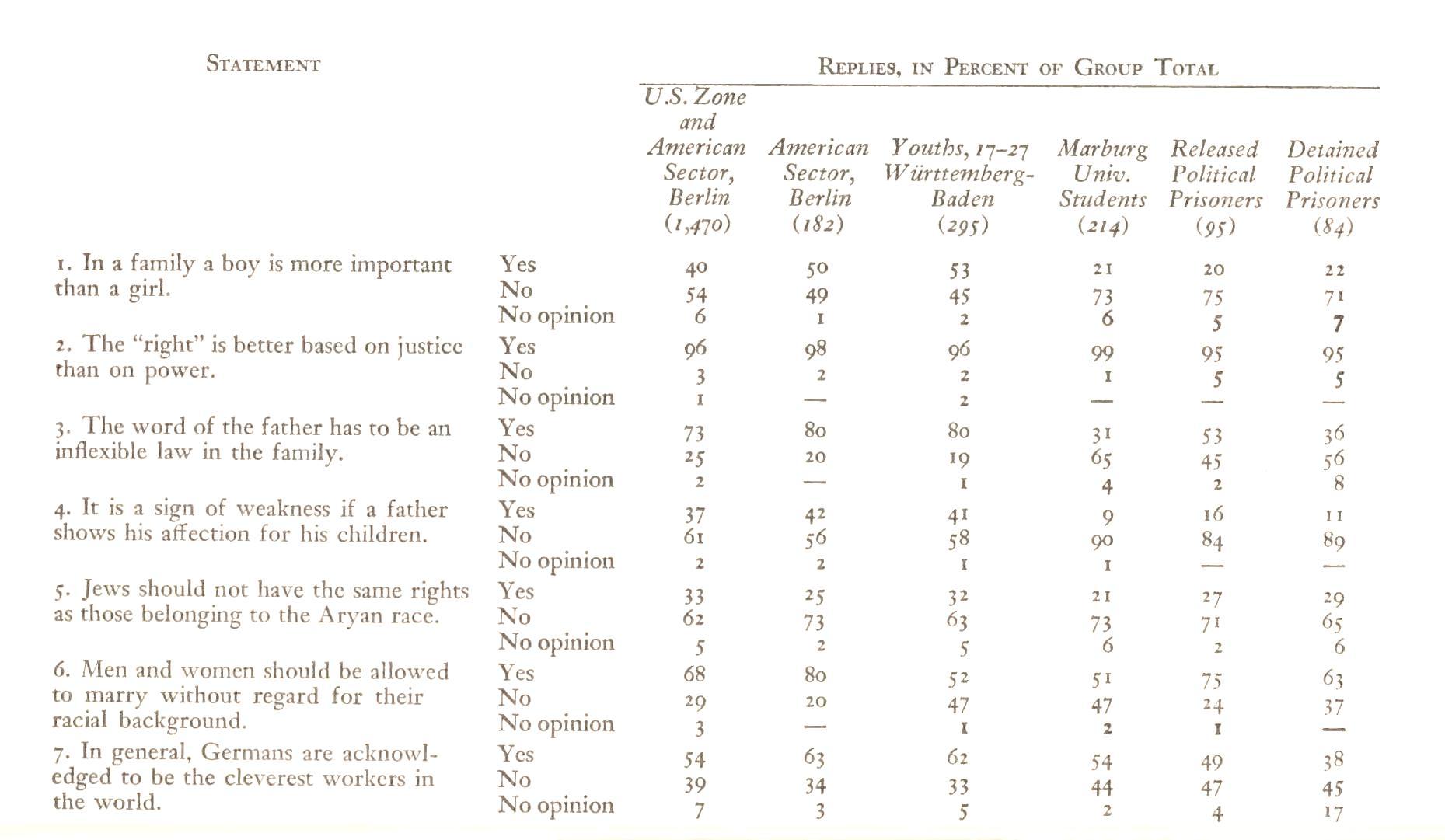
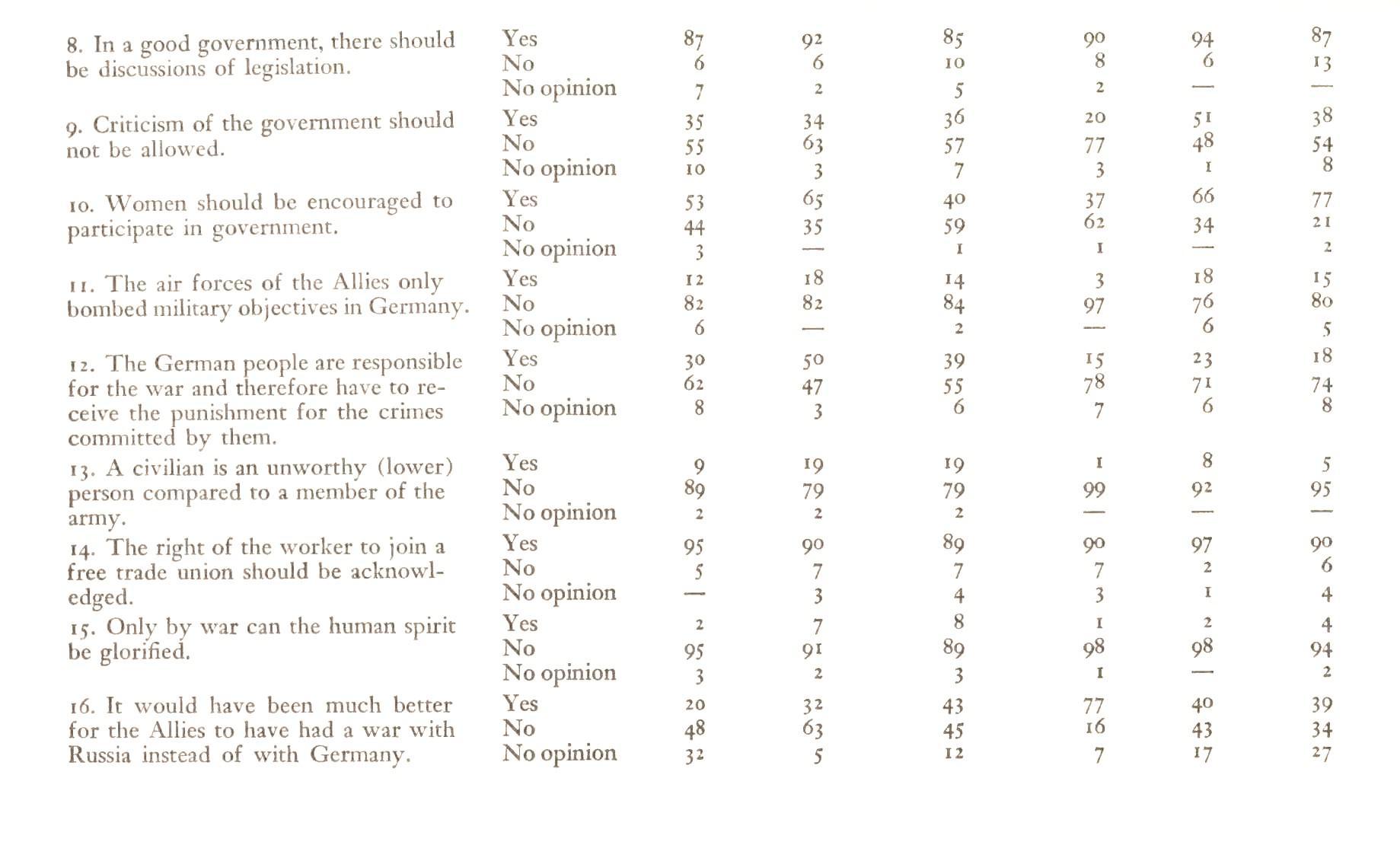
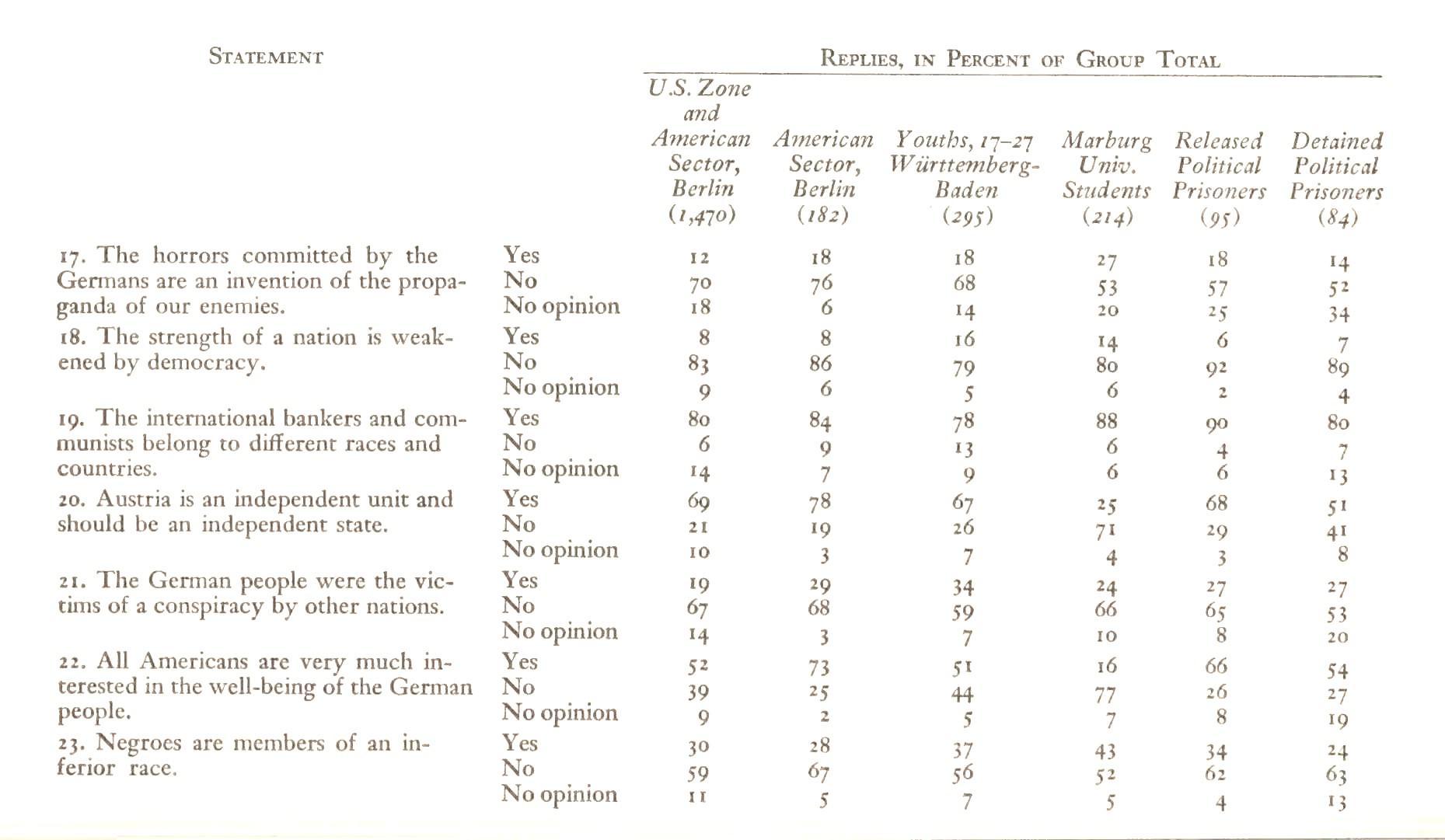
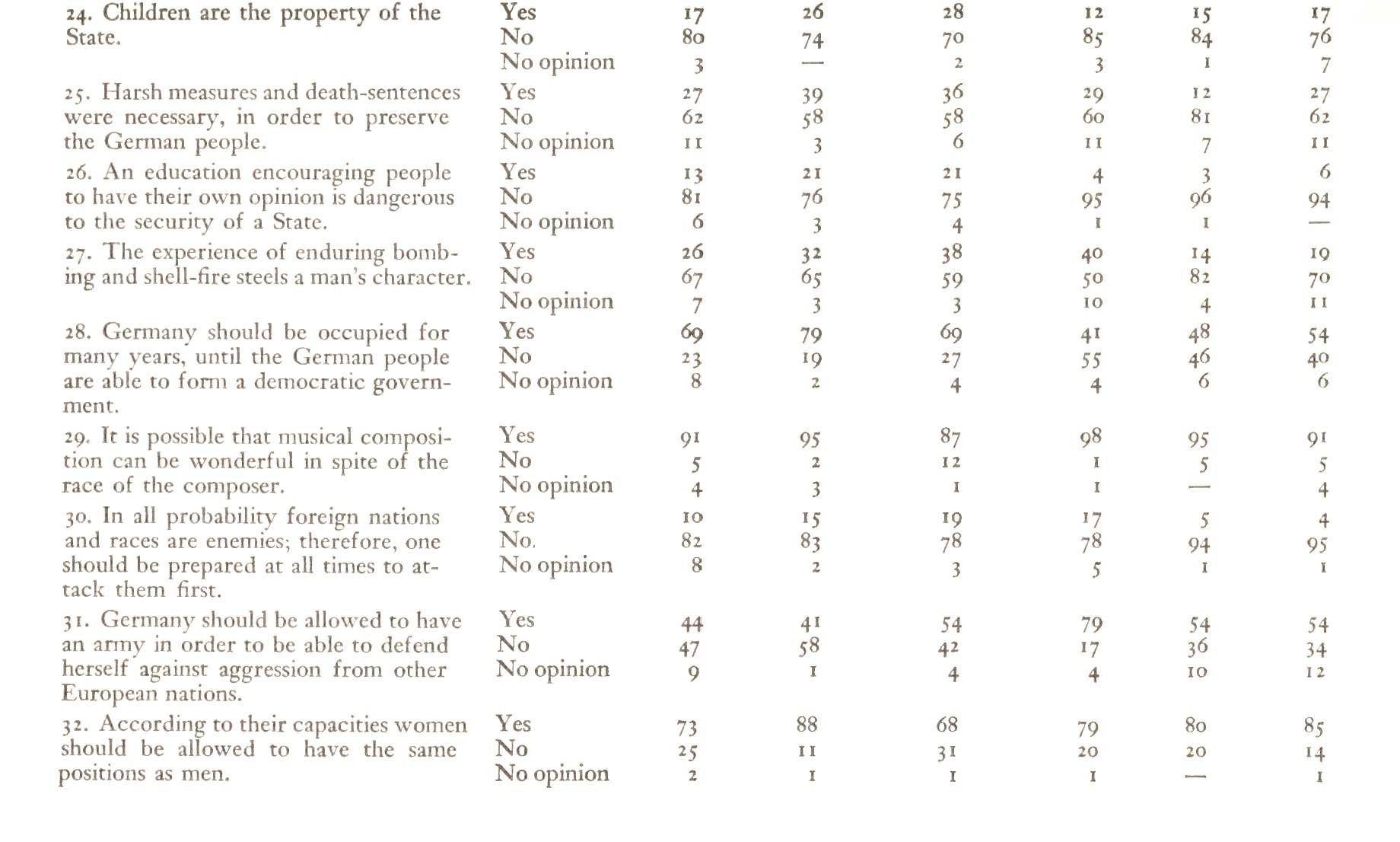
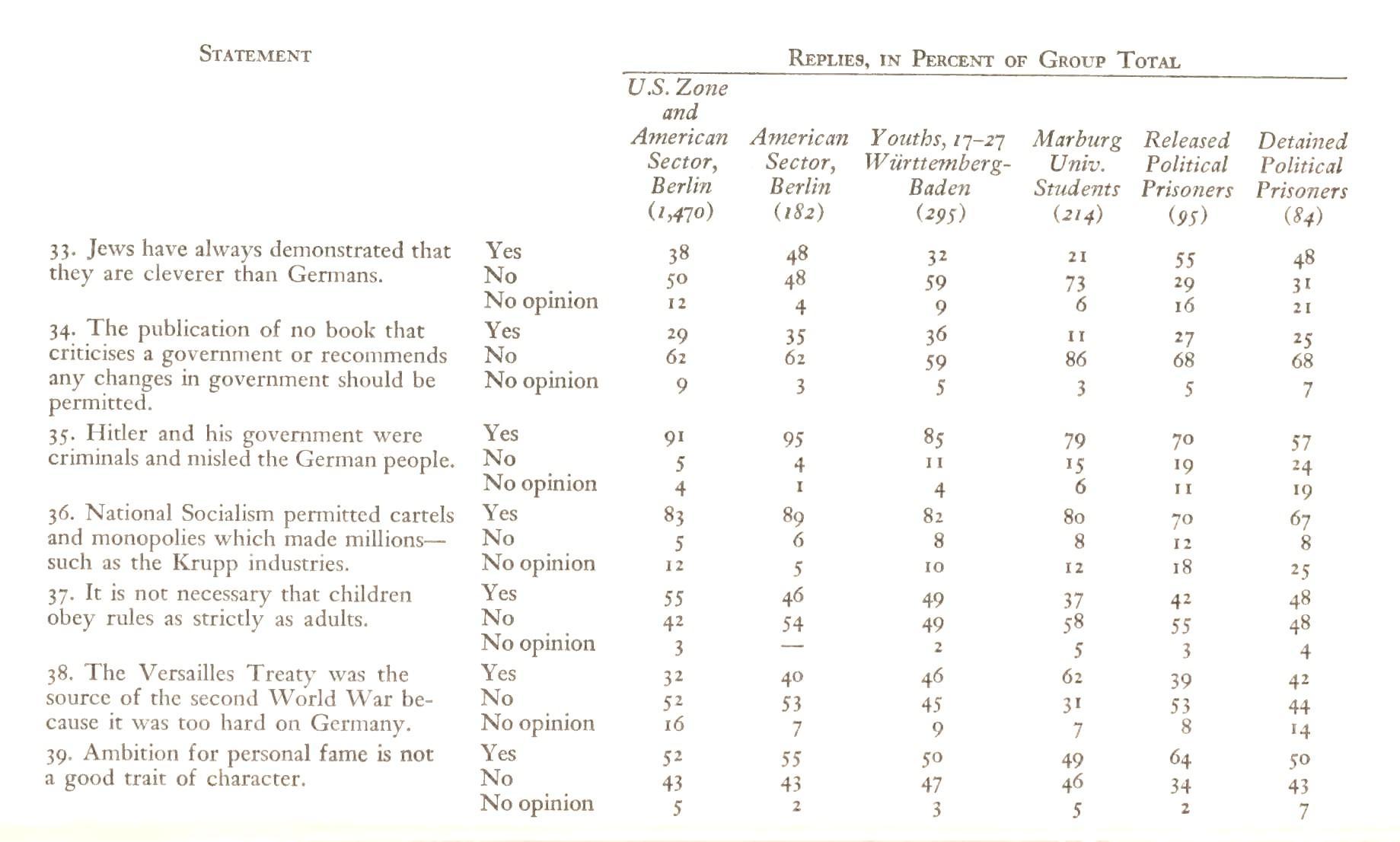
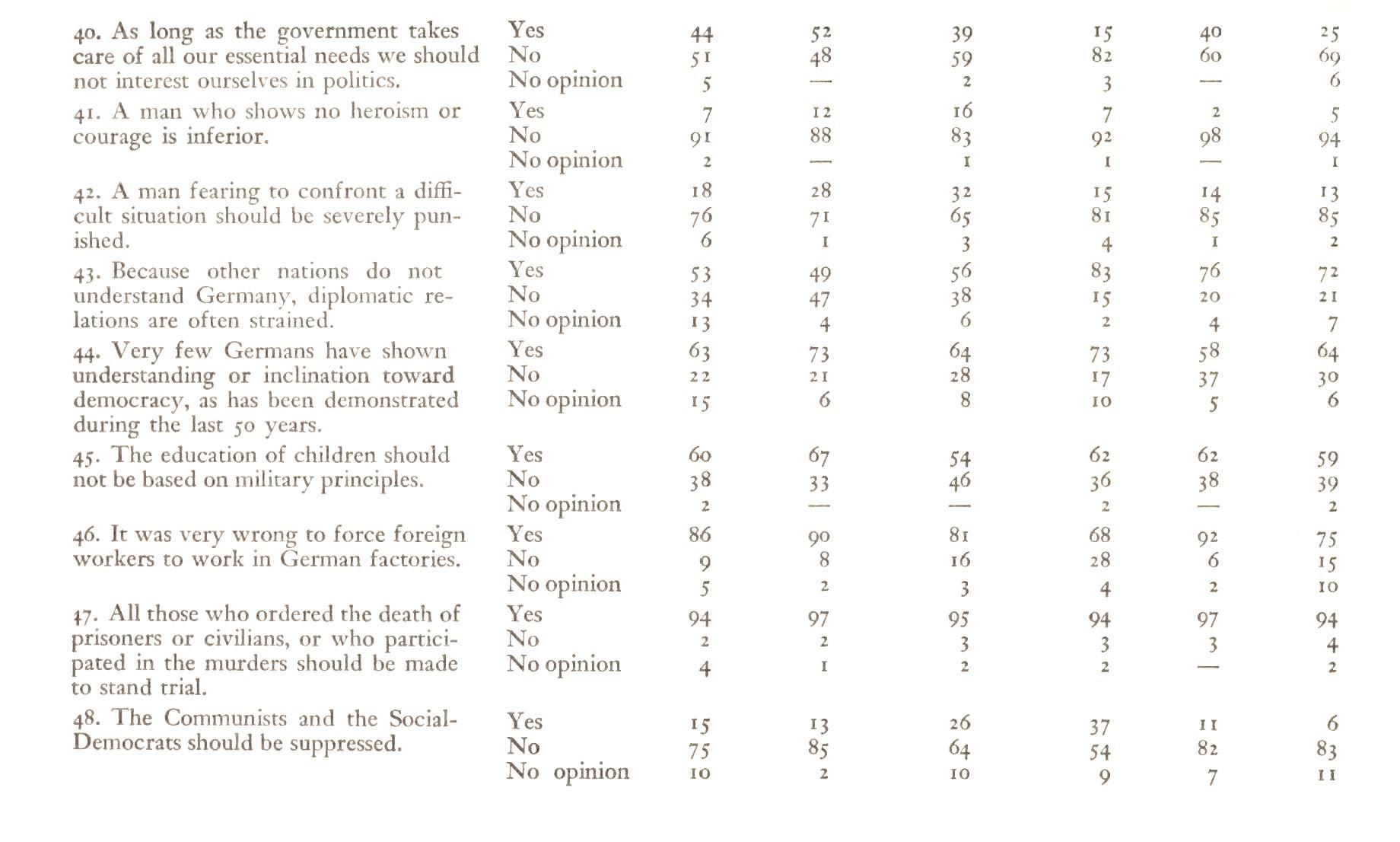
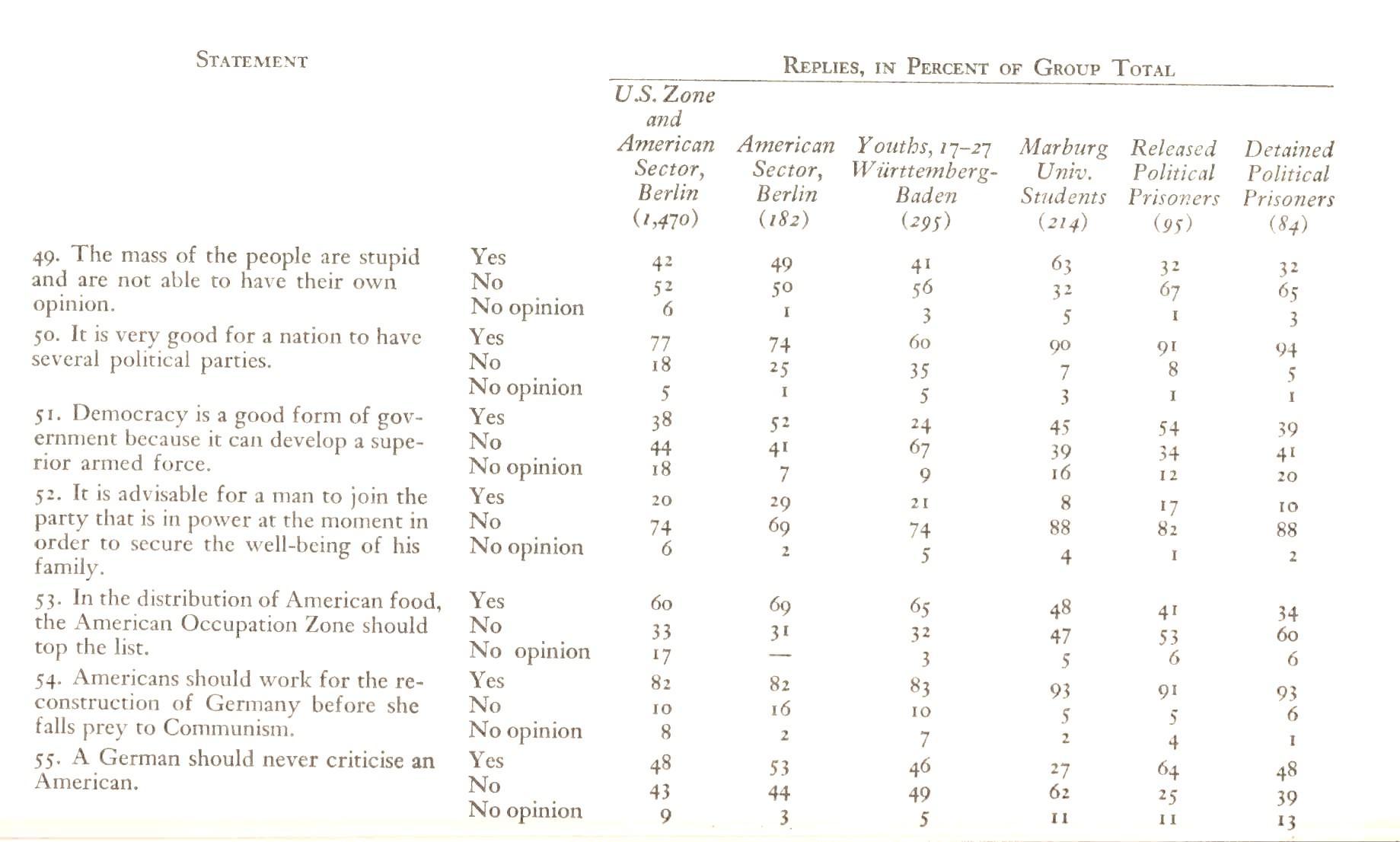
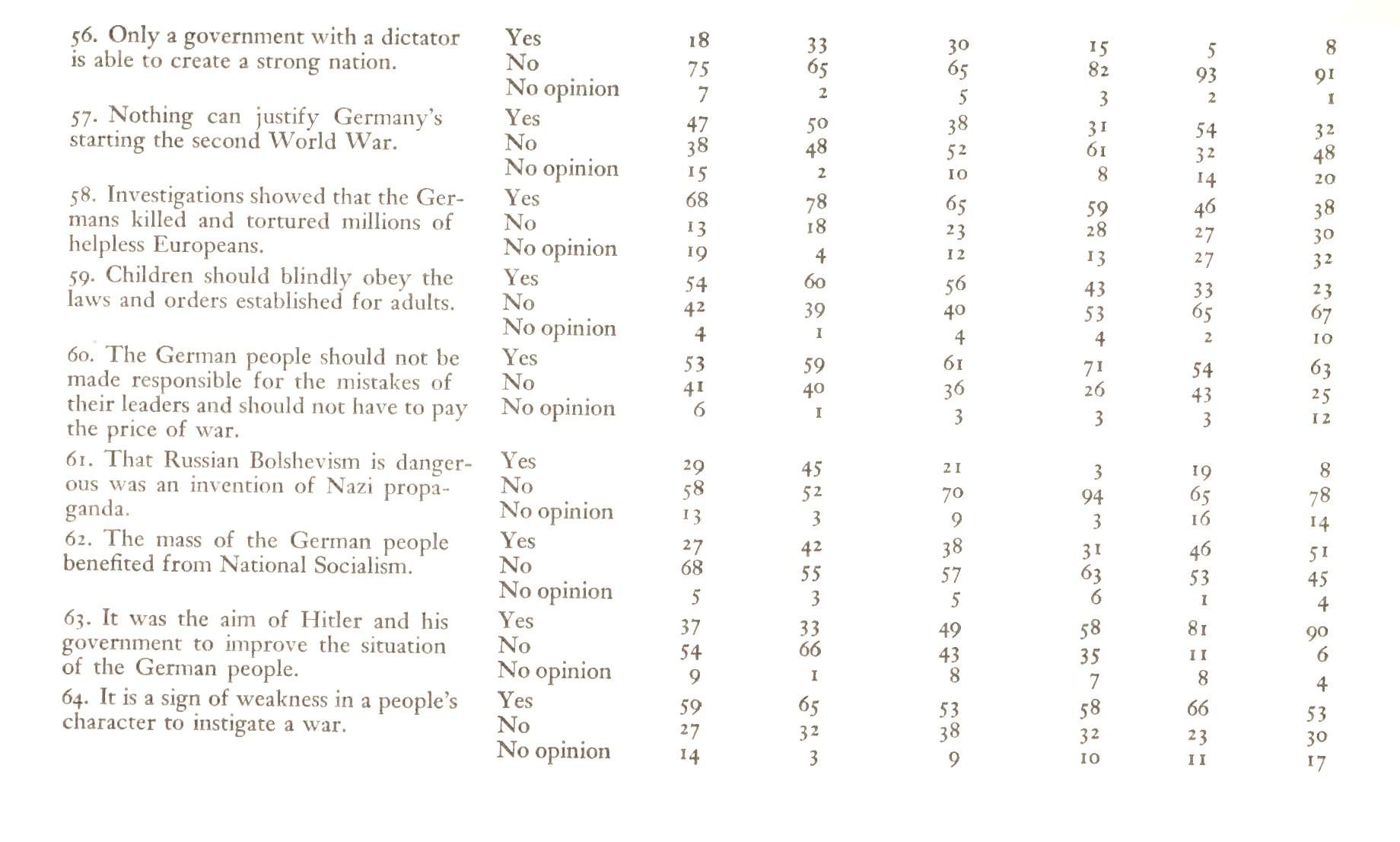
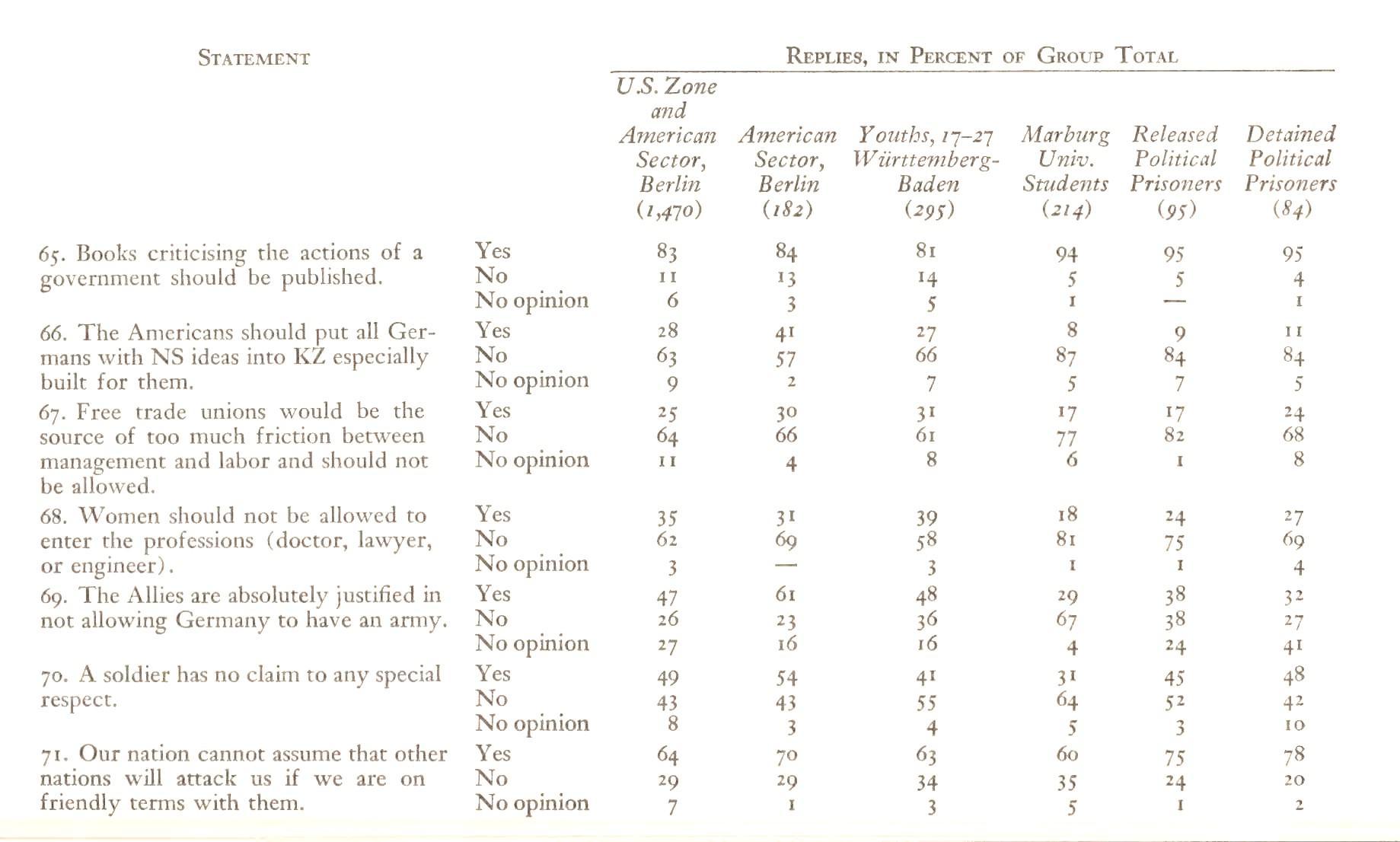
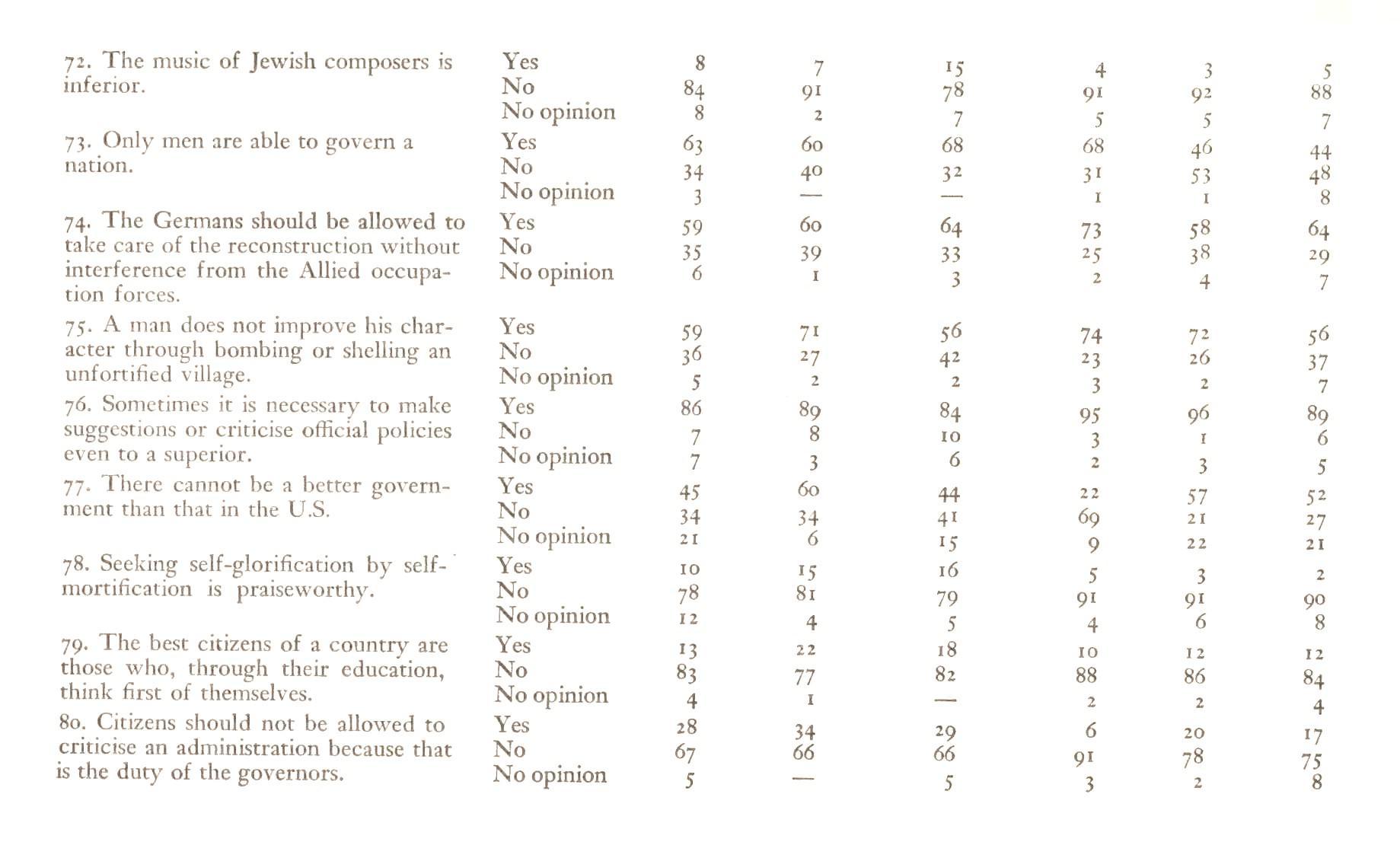
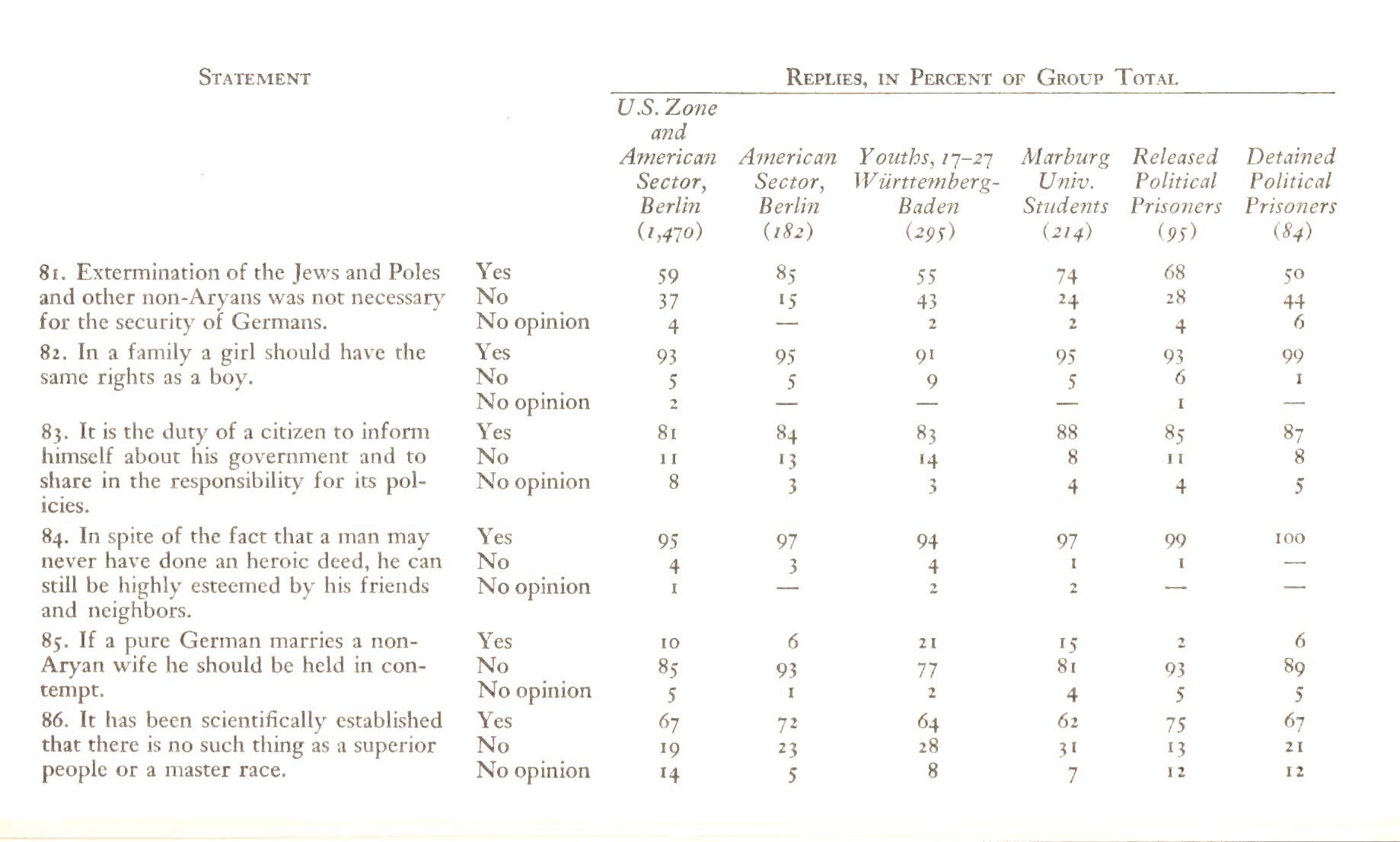
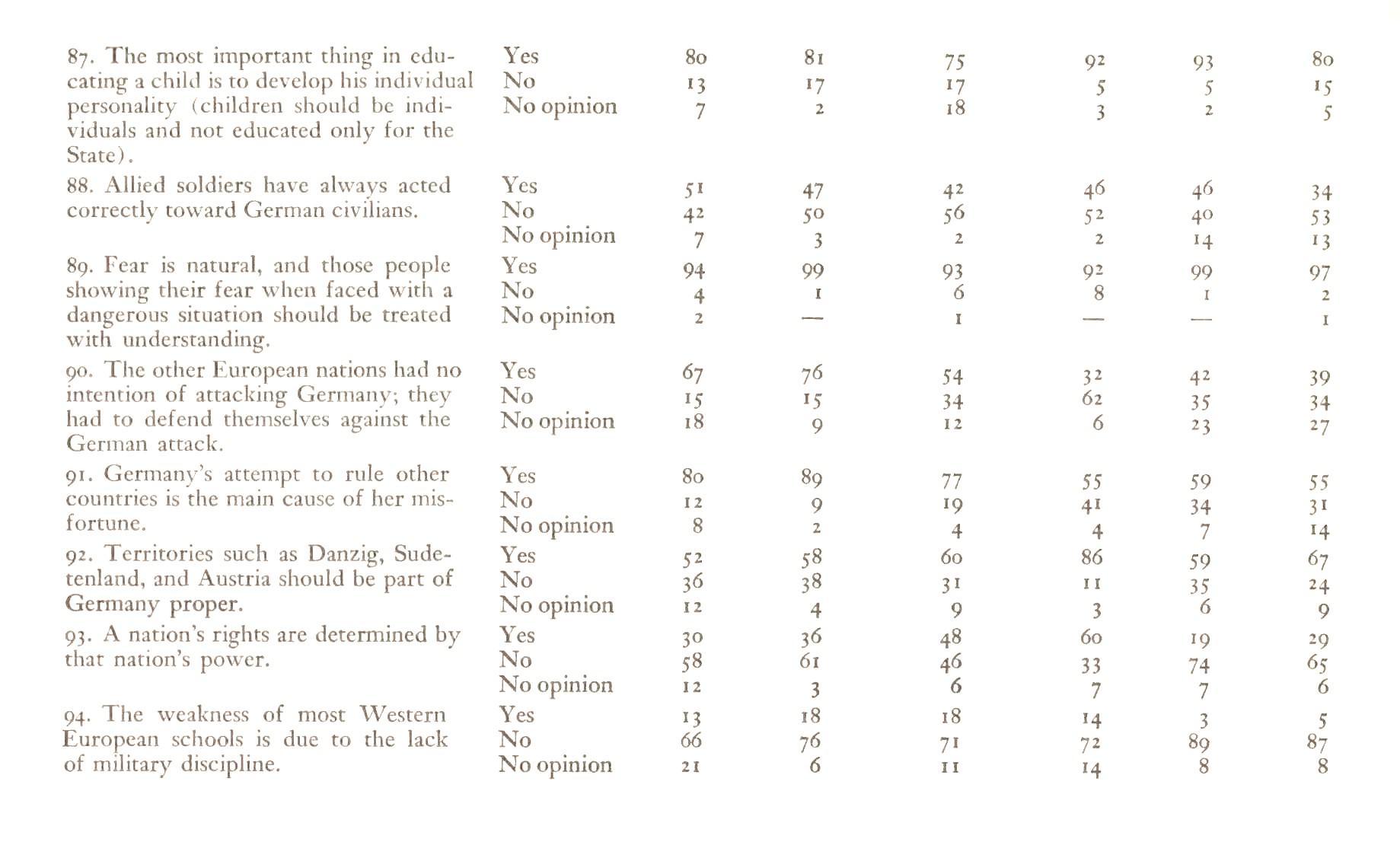
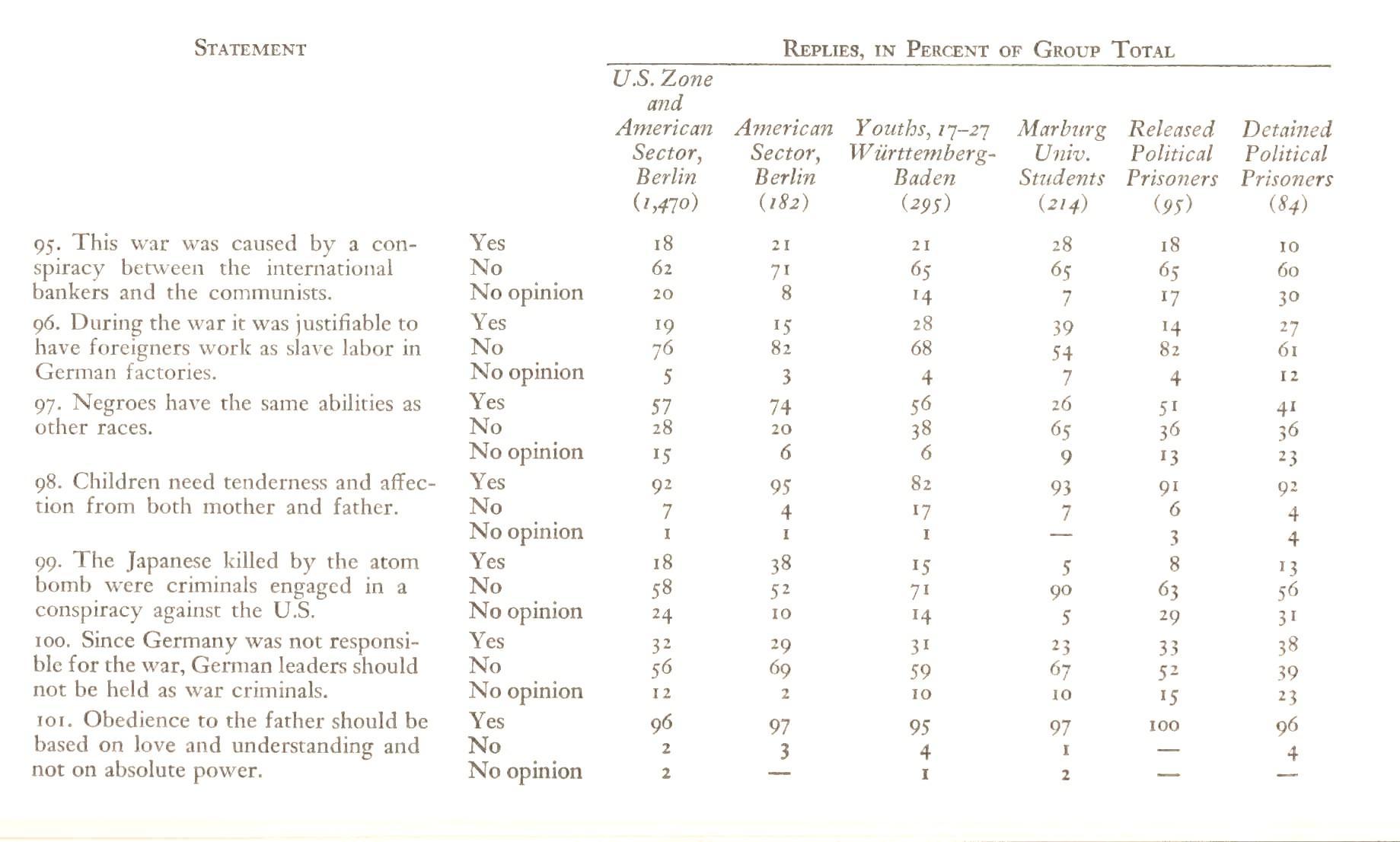
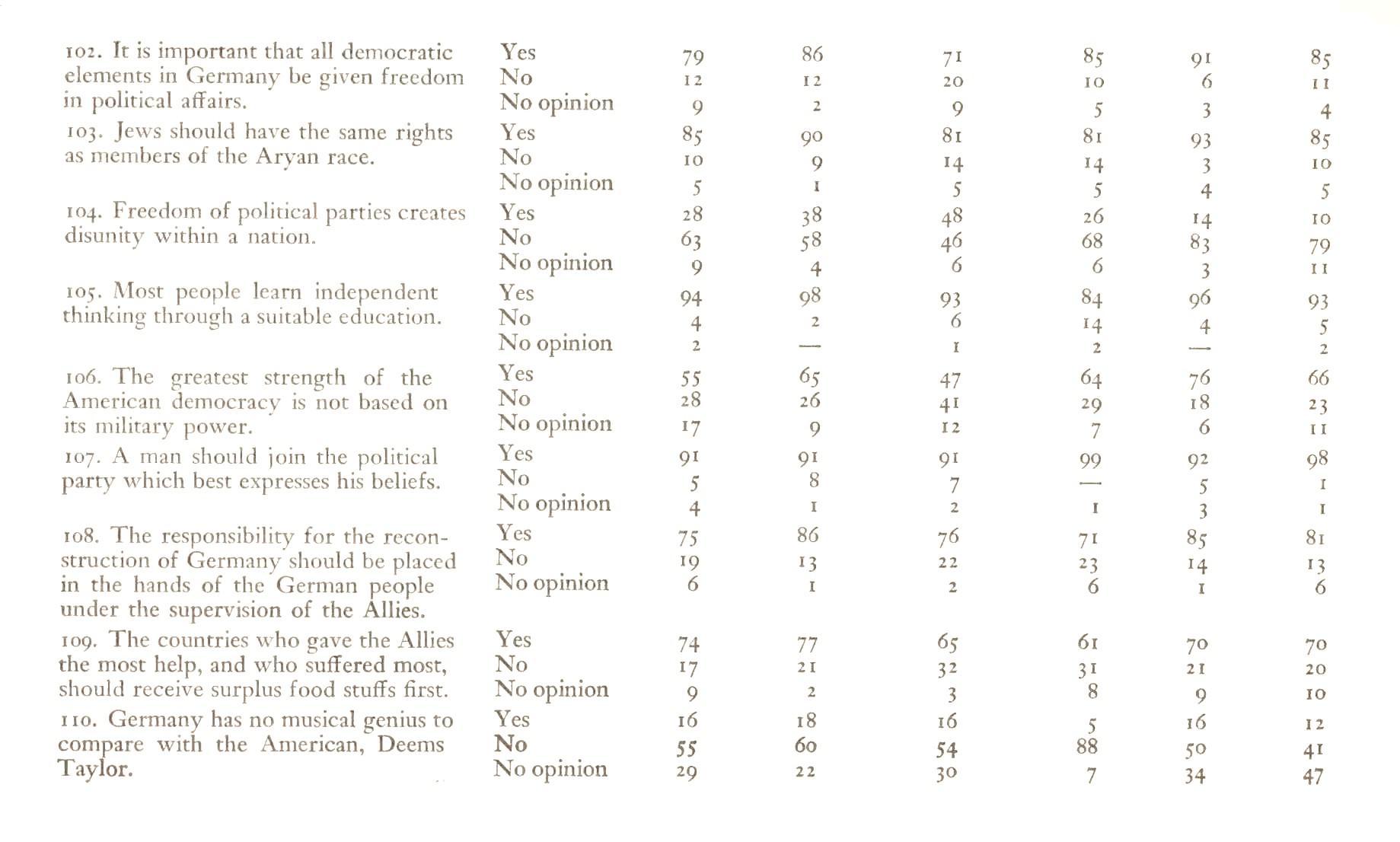
Appendix IV: Typical Histories and Statements of Candidates Examined at the ICD Screening Center in 1946
Classification “White A”
(clear-cut anti-Nazi, who suffered at the hands of the Nazis)
Background as Revealed in the Psychiatric Interview
A. was 65 years old at the time of examination. He was an illegitimate child of a Protestant mother and a Protestant, Regular Army officer. His father could not marry his mother because of Army regulations, but supported her and their only child, and finally married her when he left the Army; at that time, A. was 33 years old. The father visited the family from time to time, but A. grew up under the influence of his mother alone, until he was about 20 years old. In fact, he did not meet his father until he was about 7. He bears his mother’s name.
He describes his mother as pretty and intellectually very much alive, interested in the arts; she took him to the theater beginning with the age of 7, explaining it thoroughly, to him. She was fairly religious, and encouraged him to believe too. She was not strict, but punished him from time to time, and “suffered herself after she punished me.” She was not especially demonstrative, but the son felt that she was always good and kind.
A.’s father was a rebel against Regular Army traditions. He became disliked in the Army because he called in a Jewish reserve officer, turned against the Army and resigned, shortly before World War I; however, he was recalled to help train soldiers during the war. He was always against the “Prussian spirit” and even wrote articles against it in 1910—1911. A. states that his father was faithful to his mother, despite the 33 years he had to wait to marry her.
A.’s childhood was an unhappy, solitary one. He suffered socially from his illegitimacy, always dreading to be asked the question, Who is your father?” He felt oppressed, was very reserved, reflective and meditative. He stated, “I lived mentally and inwardly.” He read widely in philosophy and literature, but did little work in the exact sciences. He was always nervous and had a severe speech difficulty (stammering). He never behaved impulsively and emotionally, but began to write very early, feeling that he had creative talent. He never became depressed enough to think of suicide. He felt that he would never leave his mother, but she encouraged him to become independent and he left home earlier than most of his contemporaries. He engaged little in sports before he was 18, and then mostly in tennis and automobile racing.
He attended the Volksschule, and subsequently received private instruction at his father’s expense to prepare him for a university, but at his mother’s suggestion he tried a year of civil service before entering the University of Berlin at the age of 20. At 24, he decided to become a journalist on a Berlin newspaper. Both his father and mother wanted him to have a broader point of view, and with their support, he went abroad for 3 years, living chiefly in England but also in France. There he wrote dramatic criticisms and also occasional political articles. He felt at home in England, studied the English government; he liked France too, but found the French democracy less representative than the English, and the French too self-centered in their thinking. Before World War I, he also traveled to Russia for a Finnish newspaper, and after the war, he visited Spain, Italy, Holland, Switzerland, Hungary, Rumania.
In World War I, he was rejected for military service because of his general nervous state and his speech difficulty. He never served as a soldier or held any military post. He traces his antimilitarism to his father’s attitude toward the Army.
When World War I ended, he founded the German Democratic Party, which was “left of center,” and in 1919 he began to write for two liberal newspapers in southwestern Germany. In 1923 he published a book on the origins of the German republic. At that time he married a Jewish woman 3 years younger than himself, with whom he found real intellectual companionship in their common interests in social problems and in writing. They had no children.
A. voted for the Democratic party in 1932; in 1933, when the Nazis came into power, he stopped casting his vote. He was automatically taken into the National Board of Writers (Reich-schrifttumskammer), but was expelled in 1939 because of his anti-nazi views and because he was a freemason. At the same time, he was forbidden to do any writing or publishing of any kind. He retired into complete obscurity, to protect not only himself but his wife. Their radio was taken from them, their house was confiscated, his wife was forced to do menial work, he himself was under constant surveillance by the Gestapo. In 1944, his wife was sent to Theresienstadt, and he was sent to Organization Todt, the forced labor battalion which did construction work for the German Army. He was released by the U.S. Army.
At the time that he was examined at the ICD Screening Center, he was writing a novel while waiting for a license to begin publishing a magazine of liberal thought. His ultimate plan is a new plan of political organization for the German people.
At the present time, he is not allied with any existing German political party. He rejects both the Christian Democratic Union and the Communist party as totalitarian, and feels closest to the Social Democrats. He is staunchly anti-militarist. He detests dictatorship and any one-party system. A. firmly believes that “there must be opposition.” Although he is very patriotic, he sees a future danger in nationalism. More than any other candidate interviewed at the Screening Center, he was aware that Germans do not have sufficient knowledge of or tolerance for foreigners and foreign points of view. He despairs even of the possibility that Germans will learn to tolerate one another and to form a unified, modern state. Above all else, he is against the use of force, violence, and compulsion in human beings’ treatment of one another.
On the debit side, A. showed considerable rigidity and intolerance in his own thinking. He is inclined to be authoritarian in his handling of younger people, to dismiss them if they disagree with him. At a Youth meeting (see p. 83), he aligned himself with the older generation. It is not likely that he would be able to accept ideas or suggestions from persons younger than himself.
The “Incomplete Sentence” Test
-
The National Socialists came into power in 1933 because the German people had no other clearcut political platform offered to them.
-
If every nation were composed of people of the same race, the same religion and the same culture, there would be no progress, no thinking. Humanity would stagnate or enter a decline. History teaches us this.
-
The authoritarian state has the advantage that those who are governing have it easy.
-
Hitler’s peace policy failed because it was a lie, in fact it never existed.
-
In the future, German youth should be organized under the leadership of ethical human beings, who respect the value of other human beings and have had political experience.
-
The good points in the National Socialist program are unknown to me.
-
The anti-Semitism of the National Socialists was not only a crime, but also a political mistake.
-
The marriage of people of differing nationalities is only advisable if they have come to know one another very well; there must be spiritual compatibility between them.
-
The greatest political personality in Germany’s history was not Bismarck, but Crown Prince Frederick, because he had the conception of a parliamentary empire.
-
The task of a free Germany in Europe is to be the bridge between the East and the West, as the future demands.
-
The democratic countries were not prepared for war because they did not believe in war and had too much confidence in Germany’s political sense.
-
Hatred of the Jews was due to prejudiced opinions, such as belief in their corruptness.
-
Present-day measures for the control of the press should consist of careful selection of personnel and then trusting them.
-
In the new Germany that kind of art and literature should be allowed which is not conceived for propaganda purposes; art must be free.
-
The weaknesses of democracy are lack of unity in details, lack of clarity and experience.
-
The demonstration of maternal affection by kissing and hugging is 1 cannot evaluate it.
-
That Germany had lost the war, became apparent in the year 1940, since England’s strength was underestimated and Germany should have known that the world could never allow the Nazis to win the war.
-
The revolt of a young man against his father shows a lack of character.
-
The reason the German underground was so weak was the fear of the power of the State and worry about the effect on one’s family.
-
The bombing of the open cities in Germany was a defense against total war.
-
A mother who interferes when a father is punishing his son is perhaps too soft-hearted.
-
The reconstruction of the Wehrmacht should be prevented.
-
If the world were indoctrinated with German culture, then Germany would be understood. But it would have to be true culture.
-
If the father uses no corporal punishment on his children, it would in my opinion be good.
-
To keep the church from abusing its power, its councils must be kept free from party politics. They should only preach human ethics; this can then be used against the State, if the State becomes immoral.
-
The third World War will come, unless the nations stop thinking in terms of power.
-
Horst Wessel was a man who came from the lowest part of society.
-
Hitler would have won the war, if he had never started it.
-
The problem of antisemitism can best be solved through understanding.
-
If a father does not inspire Ehrfurcht in his son, he is a poor father.
-
The right of women to vote, to take up a profession, in general the right to earn their own living, has been well deserved through their own efforts.
-
The best way to protect oneself during the Nazi period was firm determination without fear.
-
In the new Germany, people who were put into concentration camps because of their resistance to Hitler should be compensated according to the degree of their abilities.
-
Actors and writers, who were members of the Nazi party, should only be allowed to work under restrictions, and only then, if they were not merely opportunists.
-
For young men, military service is not good when the military spirit is aroused.
-
The creation of Lebensborne shows ... I don’t know what they are.
-
When a man expresses his political opinions, his wife should be allowed to have her own.
-
Nazi profiteers, who are now under arrest, should be carefully examined and not go without punishment.
-
In connection with the second World War, all those should feel guilty who accepted everything and aided the war effort.
-
The occupation of Germany should last until the other nations see clearly how Germans react politically, and until Germans prove that they have a democratic point of view.
Essay: My Feelings during the Nazi Period
Since I have always been deeply concerned with the problem of human liberty, restricted only by one’s concern for one’s fellow man, I was one of the unhappiest people in the world from the years 1933 to 1945. Not only because I was not allowed to use my professional abilities (I was excluded from the Reichs-schrifttumskammer because of my political “unreliability”), but also because I deplored the whole return to barbarism. At first I just could not believe it possible that any group of men could rule others without any consideration for the feelings of others. The only comfort was that it was primarily a physical mastery, not a spiritual one. However, it was a control that I had never even been able to imagine previously. They were creating fear and terror, in order to stamp out all opposition. The Nazis could not tolerate any opposition, because it would have shown up their hollowness, vulgarity and lack of human dignity. Every tyrant has to think that way, in order to hide his own inner sense of unreality. Recognizing this was very depressing to a person like me, and bearable only because I believed there would have to be a change. Whenever my spirit was humbled, my resistance grew higher. Therefore, I saw all the more clearly, that there would have to be a change. The question was whether I would live to see it. I made no concessions, was not disloyal to myself for one moment, and that made my position particularly difficult. Besides, my wife is of Jewish descent. That increased the troubles my wife and I had to go through. The Gestapo । watched me constantly, took my wife away, transported her to Theresienstadt, took my radio away, took my house, and would ’ not allow me to work in any position. I would have rotted away,. had it not been for my small savings. Words cannot describe the spiritual torture I went through; they can only be understood: by some one who has been in a similar situation. Only my firm i belief in the victory of good over evil kept me alive. My dearest wish was that Hitler’s enemies would be the victors. I could not allow myself for one moment to doubt their victory. When; the first Americans came into Frankfurt in March, 1945, it was; a day of real joy for me. A few days before I learned that my wife had been able to get out of Theresienstadt. We have lost many friends and much in a material way, but we have also won a lot, especially in our belief that goodness is still the last and highest truth and will always remain so, a confirmation of every man’s belief when he has a concept of humanity in his heart.
Essay: The Collective Guilt of the German People
The question of the collective guilt of the German people can only be answered if one establishes whether this is a legal or a political question. There is legal guilt on the part of those who took an active part in crimes against humanity, who by their sympathy showed agreement and thereby encouraged the commission of such crimes. An example of this would be membership in the Nazi party, since no one voluntarily joins an organization which he considers immoral and directed against the liberties of mankind. It is different if a man is taken in against his will, and refrains from carrying out the immoral aims of the party. For example, the Kulturkammer, into which the members of previously purely commercial organizations were forced without being asked to give their consent; those who were considered undesirable and unreliable by the Nazis were able to leave, or were expelled, only after they had been forced to join.
In the political sense, the question must be answered differently. There is collective guilt; every member of a nation must share guilt for what was done in the name of that nation. He bears a moral responsibility and should be punishable for the material damage which his government has caused. Just as no person can be considered to be living outside of a community, no human being lives outside of his State. In the political sense, every German has a moral obligation and has no right to complain that his country must obey the will of foreigners today. The world has not only the right to see that wars like the last one cannot take place again, but the duty to do everything which will lead to a lasting peace. If the idea of eternal peace were not already in existence, it would have certainly come into men’s minds now. Merely the fear of another war should be enough to force a search for a new system in the community of mankind. Nobody knows how far it is possible for men to realize this ideal. Faith, which can move mountains, must strengthen the will here.
Penance for its collective guilt will consist of political helplessness for many years to come. For a once great people, this is not an easy thing to bear. Nevertheless, it must be borne, there is no other way. This period of loss of liberty will end only when a new kind of thinking penetrates the German people, which is in tune with that of the democratic nations. Only then will there be security for Germany and for the rest of the world, and defense against demagoguery and lies. If political liberty is given us too soon, there could be a dangerous reversion. It is hard for a German, who loves his fatherland, to admit that. But he must admit it, because he loves the fatherland and hopes for a future for his people. This political observation should, however, have nothing to do with free cultural activity. The spirit must be free, in the sense that it does not wish to harm its fellow men. Art and science are beyond the State; they do not divide people, but bring them together.
Story Told at the Social Session
My wife is Jewish. One day in 1944 we received a notice that she was to report at the railroad station at a certain time “to go on a trip.” We knew what it meant, and we felt that we would never see each other again. I felt as if my wife were dying ahead of me. When I took her to the station, I saw what horrible freight-cars, usually reserved for animals, the people were being put into. I helped her into one of the cars. There were armed guards there, but not the dreaded SS troops. On an impulse, I asked the guard to look after my wife, and the guard said he would, even though I had nothing to give him to bribe him. Just at that moment, a single American plane flew over, low; there was no place to run to for protection and the platform was filled with people. For some reason the plane did not fire a single shot; perhaps it had just dropped its load of bombs somewhere else. It would have been a perfect strafing target. I turned to my wife and told her I knew this was a good sign for both of us. Not very much later, the Americans freed my wife and we were reunited.
Rorschach Summary
There is evidence, in this record, of superior intellectual endowment, with facility in handling abstract problems. A.’s interest lies in the fields of generalizations; he ignores minute details. The record indicates that he has lost much of his former intellectual grasp and understanding; today his thinking is highly stereotyped. He shows little creative fantasy. However, he still possesses a very considerable amount of intellectual energy, remarkable for a man of his age. Although he thinks in conventional channels, he tackles intellectual problems with vigor, and wishes to keep alive mentally.
The emotional picture shows sensitivity to the feelings of others, with adult social adjustments. Nevertheless, there are indications of neurotic conflict, subtle and hidden. There is probably a deeply buried conflict which has been overcome on more superficial levels; although the neurosis persists, it does not cripple him. One finds indications of depression in the record.
Official Screening Center Report
Political Review
-
A. belonged only to a professional organization, the RSK, from which he was expelled in 1939.
-
In 1930 A. quit the editorial staff of a newspaper as he was beginning to become a successful novelist. However, only two of his novels were published after 1933, as the contracts had been signed previously. After 1933, he was not able to get any new works published, even while he still belonged to the RSK. Since his novels did not follow the Nazi directives, no publisher could accept them.
-
A. was then out of public and literary life. In 1936 he got a newspaper job with the Tobis Syndicate, but was dismissed four months later, because of his political attitudes and because his wife was Jewish. His wife was forced to do compulsory labor at the age of 59, they were evicted from their home and deprived of a radio; in 1944 his wife was sent to Theresienstadt and he got orders to report to the Organization Todt.
-
In 1931, A.’s income was 11,000 marks. During the Nazi period his income dropped steadily until 1938, when he had no income at all. He and his wife survived on small dividends from stocks.
-
A. never made compromises with the Nazis in his professional career as a writer. However, he remained a passive anti-nazi, probably because of constant surveillance and resultant fear, together with anxiety lest his activities endanger his wife. He should be considered a victim of the Nazis.
Psychological Review
-
A. is a broad-minded, sympathetic, honest man of high intellectual endowment. An intellectual, he is adept in handling abstract and conceptual problems, though somewhat hazy on practical details. He is independent in his thinking, a serious idealist, a moderate rather than an extremist. Though he has suffered from nervous tics and stammering all of his life, these do not interfere with his professional abilities. His liabilities are his age and rigidity. The Rorschach indicates some restriction and deterioration, but also a degree of mental energy and drive rare in a man of his age. He is unfortunately far removed from present-day youth in his thinking and approach to problems.
-
A. scored moderately well on the political attitudes test. He is definitely anti-Nazi, strongly anti-militarist, and an enemy of State authoritarianism. He did, however, reveal certain blind-spots for authoritarianism in personal relations. On the whole, he has been faithful to the democratic ideal during his whole career. Though he has certain nationalistic tendencies, these are counter-balanced by knowledge and appreciation of nonGerman nations.
Recommendation
A. can be classified as “White A,” a clear-cut anti-Nazi, who was in opposition to the Nazi regime and suffered at the hands of the Nazis. He is recommended for a license as an editor, but he should be co-licensed with a younger man who is less authoritarian in his handling of people.
Classification “White B”
(anti-Nazi, who did not actively oppose the Nazis)
Background as Revealed in the Psychiatric Interview
B. was the youngest of four children born into a middle-class Lutheran family; the other three children were girls. He states that he was the favorite child, not only because he was the youngest but also because he was the only boy; he says that according to all reports, he was “spoiled” by his parents. He describes his family atmosphere as very harmonious and his childhood as very happy. He felt closely attached to his parents.
B.’s father taught mathematics and physics in a high school; he was well-liked by the students, and he knew how to deal with children. He was a man of great tact and diplomacy. He told stories well and added his own variations to the standard fairy-tales. Although he did not attend church regularly, he was very religious. He was warm, generous and sympathetic in his dealings with people. “He did not have to be strict with us; we were well-behaved children.” B. had great respect for his father. B. described his mother as a very kind person, solicitous for her children. She came from a simple background, and adjusted well to her husband’s modest income. After the children grew up, the father got a better position as Privy Counsellor in the German Ministry of Culture.
B. was sociable and had many friends, among both boys and girls, and these friendships have persisted. He liked sports, especially long-distance swimming and marathon running and racing. He usually won. He always liked mountain-climbing, and later in life enjoyed scaling dangerous peaks. He suffered a brain concussion in a fall in his youth, but had no ill effects from it. However, he has always had a “nervous heart.” He is rather sensitive, and overreacts. He is conscious of many inhibitions, especially in relationship to other people. He has considerable feelings of inferiority and insecurity in groups, which did not disappear until he married. Although his sex life began when he was 21, he could never take sex relations casually. He felt he must take a very responsible attitude toward women and their feelings and was afraid of hurting them or “using” them. While away from home on summer vacations, he had a somewhat freer attitude, but in his own milieu he was very embarrassed with women. He finally married at the age of 37. His wife was a musician; the couple have one child.
B.’s sister, an artist, was the strongest influence on him in his young manhood. She introduced him into the art world, especially modern art. For many years, he read widely in literature and studied the fine arts under her guidance. His ambition was to become an actor. He attended every available play, produced and acted in amateur plays, took the basic courses preparatory to a career in the theater. When he went to a university, he earned money on the side by taking on roles as an “extra.”
However, he did not go ahead with his theater plans because he doubted his own ability. He began to consider journalism. His maternal grandfather had been a book-dealer and he knew the bookshops well, so he decided to become a book-dealer. After a year of this, he went to the university to fill certain gaps in his education and, at his father’s suggestion, decided to study law. He soon discovered that he was not interested in law, but waited until his father’s death to leave. The inflation of 1923 then forced him to earn money, and he apprenticed himself to a publishing concern for two years. Then he worked with another publisher, doing advertising, and subsequently with a different publisher, working on children’s and art books off and on for two years. He moved again to another publisher of textbooks for two years, and then went to Berlin to publish a magazine of his own. Finally in 1929 he went to a German Book-of-the-Month Club organization, and settled there, specializing in production. Here he worked for a Jewish proprietor.
In 1918 he had six months’ military training, but never fought in any battles. He was 17 at the time of the revolution of 1918, but took no part in it, merely returned home and waited till it was over, though he attended several political meetings to learn what was happening. He was never actively interested in politics, though he had read political papers and discussed politics with some interest under the influence of a certain teacher in the Gymnasiuzn, but afterwards describes himself as having been “passive to events, preoccupied with my professional interests.”
He was twice invited to join the Nazi party, but refused for the following reasons: 1. He disliked Hitler after having heard him speak in 1927 at the Sportpalast. 2. He could not condone the Nazis attack on churches, Jews, and on other political parties. 3. He felt Nazism could only lead to a reign of terror and catastrophe for Germany. 4. The warlike aspects of Nazism were repulsive to him. 5. He had worked for Jews in the past, and felt no anti-Semitism. 6. He felt that his whole past life was contradictory to the aims and methods of the Nazis.
He and his father had both belonged to the conservative Bavarian People s Party, believing in Bavarian separatism, and he voted for it in 1932 and 1933. However, he and his father did not endorse the local patriotism of the Bavarians; they were interested, rather, in the anti-communistic policy of the party.
-
impressed the examiners at the Screening Center as honest, capable, tolerant, reliable; he was described by the other candidates as upright, one who never tries to force his point of view on others, well-balanced, with a tendency to vacillation and excessive adaptability.
The “Incomplete Sentence” Test
-
The National Socialists came into power in 1933 because the German Nationalist party voted for them and thus gave them a majority.
-
If every nation was composed of people of the same race, the same religion and the same culture, the situation would be ideal; however, this is not necessary to preserve world peace.
-
The authoritarian state has the advantage that .... it has no advantage.
-
Hitler’s peace policy failed because he never intended peace and his domestic policies from 1935 on were based upon preparations for war.
-
In the future, German youth should be orgtmized under the leadership of .... should not be organized.
-
The good points in the program of the National Socialist party are .... I know of no good points in it; I rejected it completely.
-
The anti-Semitism of the Nazis was a crime.
-
The marriage of persons of different nationalities is to he welcomed, provided there is a basis of love and understanding. It is usually a good combination.
-
The greatest man in Germany’s history was perhaps Charles V, because at that time there was no German State and Germany thought in terms of all of Europe.
-
The task of a free Germany in Europe is to become a bridge between East and West.
-
The democratic countries were not prepared for war because they were pushed into a defensive position and did not take active measures as far back as 1938.
-
Hatred of the Jews was due to reputedly perverted minds, anti-nationalist point of view, and international conspiracy.
-
Present-day measures for the control of the press should consist of positive training of the masses to democracy and democratic ways.
-
In the new Germany, that kind of art and literature should be allowed which .... all art forms should be free. Only true art productions really last; temporary styles can be stimulating, however.
-
The weaknesses of democracy are due to the slowness in coming to decisions. This is also an advantage, in that the opinion of the majority finds expression.
-
The demonstration of maternal affection by kissing and hugging is natural and instinctive.
-
That Germany would lose the war, was apparent in the year 1941, when Germany attacked Russia, because of the injustice of it, and because of the similar situation in 1914–1918. A more experienced person could have seen the eventual defeat as early as 1939.
-
The revolt of a young man against his father is natural, because fathers are conservative and young men revolutionary.
-
The German underground was so weak because there was
no unity, no political line; fear and terror also kept many from coming into the open or from protecting others.
-
The bombing of open cities in Germany was revenge for the actions of the German High Command.
-
A mother who interferes when a father is punishing his son, is the kind intermediary.
-
The reconstruction of the Wehrmacht was intended to further Hitler’s purposes (cf. Mein Kampf).
-
if the world were indoctrinated with German culture, .... this would be completely undesirable.
-
If the father does not use corporal punishment on his children, he follows the path of reason. He should set a good example, teach and love his children.
-
To keep the church from abusing its power, church and state should be separated. The teaching of Christianity should be free.
-
The third World War will come, unless reason, love and willingness to compromise prevail.
-
Horst Wessel was in my opinion a criminal.
-
Hitler would have won the war if .... he had to lose the war, otherwise Europe would have gone down into chaos.
-
Anti-Semitism can best be solved by far-sighted clarification. It is based on ignorance of the facts. Palestine should at last become the home State for the Jews.
-
If a father does not inspire Ehrfurcht in his son, it is usually due to the way the father behaves.
-
The right of women to vote, to take up professions, or in general to earn their own living, is desirable; every human being should have this right.
-
The best way to protect oneself during the Nazi period was to keep in mind the true Germany in Goethe’s sense of the word.
-
In the new Germany, people who were put in concentration camps because of their resistance to Hitler should absolutely be helped to get into leading positions, as far as their capacities permit.
-
Actors and writers, who were members of the Nazi party,
should not be allowed to appear or to write for some time. Naturally each one should be examined on an individual basis.
-
For young men, military service is not at all necessary; athletics can be substituted for it.
-
The creation of Lebensborne shows .... I don’t know what they are.
-
When a man expresses his political opinion, his wife should quietly think it over, but establish her own point of view.
-
Nazi profiteers, who are now under arrest, should be punished, or else be forced into work in the meantime.
-
In connection with the second World War, all those should feel guilty who supported Hitler.
-
The occupation of Germany should last .... this cannot be definitely predicted, it depends on the maturation of the German people.
Essay: My Feelings during the Nazi Period
During a visit to Berlin in 1927, a friend and I were walking near the stadium. We ran into a surging crowd, numbers of police, with flags and standards, S.A. men. We learned that Hitler was speaking for the first time since he had been forbidden to lecture. We quickly decided to hear for ourselves what he had to say and learn how he attracted so many thousands of people to his way of thinking.
We stood up on a balcony behind the rows of seats. There were huge red flags, swastikas on the walls, a large S.A. section with military insignia; high party functionaries were gathered on the stage. The horrible political smearing party began with this background. A man, perhaps Goebbels, screamed a few sentences, introduced Hitler. Hitler arrived, then new to us, in a brown shirt, with the crooked forelock and the comical mustache, stood with his arms clasped, threatening hellfire. He spoke—half truths, half nonsense, miserable non-sequiturs, lies. He yelled, complained, wore out his voice, gesticulated like a bad comedian.
I rebelled against all of it, I thought it was silly, but I got gooseflesh all over my body. Suddenly he screamed to the audience, “And who is guilty? The Jews!” People began rising in their seats, with wild faces, shouting out “Destroy .... wreck ....”
I felt dazed, momentarily paralyzed, indignant, disgusted, unable to think logically; we got away from this dirty mess.
Sad and depressed, we walked home without a word, trying to breathe in some fresher air, cool our brows. We knew instinctively that this was the beginning of a very black tragedy.
I once described this terrible experience in a letter. I wrote: “If the Nazis succeed in coming to power, we will be living in Hell until we shake them loose.” Later, I thought the danger was over. But worse things took place (I am thinking of the morning in Prague when I saw for the first time a woman wearing the yellow star the Jews had to wear, thinking of the partings from friends and acquaintances, thinking of the inquisitions of the Gestapo, thinking of the reports about the war and the military service which I received from friends and younger people) and I had to fight against deep depression.
There was quiet, inner resistance; in our little circle we helped one another out. This developed real feelings of comradeship, based on our being able to rely on one another; this was positive and good. I am free to admit that I still feel shame and sadness when I realize that this madman, Hitler, was able to control Germany for twelve long years and bring confusion to the entire world.
Essay: The Collective Guilt of the German People
Does it exist? Does it not exist? Is there such a thing as collective guilt on the part of an entire nation? If we answer Yes, should not the children, who have to keep absolutely quiet, be excluded from the guilt?
The serious and difficult problem is not yet clear to me; neither in discussion with friends nor with foreigners have I found any final decision on the matter.
I was at first inclined to reject collective guilt for the German people. But lately I am inclined to revise my opinion.
I believe the German people have a collective guilt, but this includes also those innocent ones who by an accident of fate also belong in our nation. This is based on the concepts of Christianity and other beliefs in this world, which include a recognition of responsibility of all mankind in the religious sphere.
For myself, I prefer to believe that we have to differentiate in holding people responsible: we should not include children, and the racially and politically persecuted. Let us take the large group of those who did not want Hitler and did not support him. I consider them guilty of neglect or indifference, because they did not actively fight for the preservation or restoration of the Republic. They just let things happen and were themselves overwhelmed.
A second group is made up of those simple people, without capacity for understanding, who voted for the Nazis; they are even more guilty of indifference.
The third group includes the rest, who really supported Hitler; they are primarily responsible.
This is an outline along very broad lines, giving the skeleton of my attitude toward collective guilt.
Story Told at the Social Session
One evening I was downstairs in the street, saying good-bye to a girl friend, when I suddenly heard shooting and weeping in a near-by house. Instinctively I rushed into the house; on the way upstairs, I passed some one who tried to bar my way. I broke into one of the rooms where I found a man pointing a gun at a family. Quietly and calmly I went up to the man and took away his gun. Then I quieted the family by talking to them, fixed them some tea, and saw that everything was settled back to normal before I left. On my way out, I met a policeman coming up, and told him everything was all right. The next day the family came to visit me, and thanked me.
Another time I was at the sea-shore. Suddenly a woman ran up to me, saying her child had disappeared. Without thinking, I jumped into the water near by. The water was very deep there, but I found the child and pulled it out to safety.
Rorschach Summary
B.’s original intellectual endowment was very high, probably superior. He is still facile at handling abstract problems, possesses great mental energy and good generalizing ability.
However, he is saddled with a severe neurosis. His thinking is stereotyped, he is obsessively concerned with fine details. His grasp of outer reality and his ability to make objective judgments are severely limited. Any intellectual problem he faces arouses emotional conflict and anxiety; therefore he vacillates, cannot make decisions easily, and he takes much more time to do a job than is necessary. His affect is very immature. Emotionally he is impulsive, socially he is ill at ease. There is considerable imagination and fantasy, but it cannot serve as an adequate outlet for his inner emotional strains.
The general personality constriction is of a high degree. To guard against his immaturity and emotional liability, B. has straight-jacketed himself. His intellectual range is narrowed to the conventional, but he is not emotionally strong enough to maintain this control. Strong depression and generalized anxiety are always present.
Official Screening Center Report
Political Review
-
B. joined a professional organization, the Reichsschrifttumskammer, in 1939; he applied in 1937 when he became manager of his firm, and received his membership card in 1940. He also joined the National Socialist Club and the German Red Cross.
-
B. became associated with the Deutsche Buchgemeinschaft, a publishing house which owned Germany’s largest “Book Club”; he also operated a printing press, of which he had been co-manager since 1937. The Buchgemeinschaft had many subscribers in foreign countries (approximately 40,000 in Switzerland). The Propaganda Ministry did not exert much pressure on the firm, since its foreign sales were a useful source of foreign currency for Germany. Therefore the firm was able to remain free of any Nazi taint. The director was not forced to become a Nazi, but the government did appoint a Nazi trustee for the firm, since the founder and principal owner of the firm was a Jew, who died in 1934. In 1935, the trustee was also made advisor on publications for the firm. B. states that the advisor actually had no influence on what the firm published; a review of the books published confirms B.’s statement.
-
B.’s income rose steadily. He earned 6,000 marks in 1932, but earned 3 0,000 marks in 1944 (part of this represented his profits since 1938). As co-manager of a firm considered important (it employed 1,200 people), he was deferred from military service.
-
B. was chief of production, and handled internal problems in the business; he was not a policy-maker. Therefore he did not come into contact with the Nazi organizations and did not have to make compromises. Besides, his firm was relatively free from political pressure because of its usefulness in bringing in foreign exchange, and because a change in policy toward more Nazi attitudes might have driven away the foreign subscribers. Therefore, B. was able to avoid joining Nazi organizations, except harmless ones like the National Socialist Club. He is essentially unpolitical; he is conservative through his background and education.
Psychological Review
-
B. is a pleasant, rather passive person of high intelligence. He is warm and kind in personal relations, but somewhat inhibited and fearful of harming others. There is considerable hesitation, self-doubt and a high degree of adaptability. He is an interested onlooker rather than an aggressive fighter. His interests have been in art, literature, and publishing, rather than in politics. He is cautious and diplomatic.
-
He scored moderately well on the political attitudes test, though some of his answers were noncommittal, others even superficial. His general trend is anti-authoritarian and toward the freedom of the individual. He is moderately anti-nationalist and anti-militarist. He is essentially conservative, and for this reason, as well as because of his dislike of attacks upon the church and his Jewish business associates, he resisted invitations to join the Nazi party. He is not a profound thinker on political questions.
Recommendation
B. is classified White B; his record is clearly anti-Nazi, though passive. There is no objection to the granting of a license to publish.
Classification “Grey, Acceptable”
(non-Nazi, compromised by concessions to the Nazis)
Background as Revealed in the Psychiatric Interview
C. was an only child in a fairly religious, Lutheran home. His father was a publisher, described by C. as an autocratic Respektsperson (a person to be treated deferentially and formally). The father was lively, ambitious, energetic; he was capable and a hard worker. He was very conscious of his Pflicht (duty) and his goals. Building the publishing house was his life’s work; he was an “example to the profession.” He was unable to delegate work or authority to others, and he was not tolerant. He was interested in his home and garden, in history and horse-back riding. He was a reserve officer in the German army, and belonged to the Freemasons. He was strict and spanked C. from time to time during his childhood and youth, but was not a frequent punisher. C. states that he tried to be obedient and submissive to his father’s wishes at all times.
C.’s mother was sickly and very quiet. She came from the country, was a good housekeeper, shared to some degree her husband’s interest in history. Neither one enjoyed company or social functions. Though they had many relatives, they rarely visited them or invited them to the home. C.’s parents took no part in public life or in welfare work. Their interest was primarily in the business and the home. She deferred to her husband in all matters. She was rarely demonstrative toward her husband or her son.
C. states that he was definitely closer to his father, “probably because my father had such a hard time during World War I; my mother was always sick.” He describes his childhood as being an ordinary, happy one until his father went to war when C. was 13. C. was a solitary person, with almost no friends until late adolescence, when he went to the technical high school. Outwardly he was very quiet, but inwardly he was always tense and nervous, easily excited, definitely anxious. He was reserved and seclusive, and was very slow in making any personal contacts. He still enjoys social life only to a very limited degree, and then only when the group is small. He made his first real friendships when he went away to the university at the age of twenty.
His health was generally good. He enjoyed sports like tennis, but never felt ambitious to compete or to win. He felt that he lacked endurance, and he played mostly with his teachers. He has continued to resent competition in later life (“I prefer peaceful ways”) and has felt especially insecure over thoughts of survival in the business world. He states that he doesn’t exactly shy away from a fight, but definitely does not enjoy one. “I fought hard over going into the Army, but I don’t like to fight against people.”
C. has always been conventional. It was hard for him to leave home, and when he finished his university studies, he decided to return to his home town and follow the family pattern. He has no drive to do original or creative work. His personality is drab and colorless. He is even more self-centered than his father. His reading is confined almost entirely to business articles and occasional light reading. In the past ten years, his wife has done most of the reading with which he is at all acquainted. His publishing house became his primary fixation point; even there, he attends only to the business affairs, leaving the editing to subordinates. He has always remained in the field of the experimental sciences, never venturing into the social sciences. He does not pretend to more than a superficial familiarity with the material that he publishes.
Since the age of 22, C. has traveled abroad on vacations, chiefly to Switzerland because of the mountains; he has also been in Austria, France, and Italy for very short periods. He did not go abroad after 1931 because he felt embarrassed as a German when questioned about Hitler.
At the age of 24, he spent four weeks in voluntary military training, “because I was traveling with a group of certain political leanings, and I’d heard a lot about military life at home. I enjoyed it for those few weeks, but it was no romance.” He has often discussed with his friends ways and means of replacing military service in the future, but finds it an insoluble problem. He does not understand how great nations like England and the United States ever became great without compulsory military service. He has a prominent scar on his left cheek from duelling while he was in the university.
After his student days, he spent two years working in other publishing houses to get experience. At the age of 25, he married the sister of the owner of one of these firms, and brought her back to his family fold. They have two children. His son, who was 18 years old in 1946, is as close to him as C. was to his own father; the son avoided close contact with the Hitler Youth by becoming active with German air corps as an anti-aircraft gunner. He was never drafted into the Army because all the military files were burned during Allied air raids.
In 1932, C. belonged to the Deutschnational Partei, a political party on the extreme Right. However, he did not vote in the 1932 or 1933 elections, when the Nazis came into power. He concentrated on his business, stayed out of all public affairs, and hoped to “get by,” keep his publishing house going and his family intact, by whatever means possible.
The “Incomplete Sentence” Test
-
The National Socialists came into power in 1933 because they got a majority of votes, with the help of other parties on the Right, who didn’t realize that in the long run they would be excluded from the government.
-
If every nation were composed of people of the same race, the same religion and the same culture, then theoretically there would be eternal peace.
-
The authoritarian state has the advantage that .... with our experiences, in the long run it has no advantage.
-
Hitler’s peace policy failed because, we see now through the Nuremberg trials, it was basically dishonest.
-
In the future, German youth should be organized under the leadership of churches, ethical and moral institutions.
-
The good points in the program of the Nazi party are unknown to me, unless perhaps the goal of general employment, which should not have been achieved through armament industry.
-
The anti-Semitism of the Nazis was one of their basic evils and mistakes.
-
The marriage of persons of different nationalities is quite possible, if the two people are free of nationalism.
-
The greatest man in Germany’s history was Luther, because he brought the German language to everybody. However, his Reformation created political complications in Germany’s subsequent history.
-
The task of a free Germany in Europe is to bring about cultural and economic unity among peaceful, cooperating European states.
-
The failure of the democratic countries to prepare for war was disastrous; they could have prevented the war, or at least its spread.
-
Hatred of the Jews was due to their alleged exploitation of other races, also their alleged responsibility for any individual acts of sharp business practice.
-
Present-day measures for control of the press should consist of supervision and education for real democracy, especially tolerance and humanitarianism.
-
In the new Germany, that kind of art and literature should be allowed which shows or arouses true art feeling. Not only art, but all the cultural activities should be brought into the foreground of the thoughtful life.
-
The weaknesses of democracy are its having to depend on getting a majority, which may be accidental, and in Germany certainly the danger of the government being broken up into tiny fractions.
-
Demonstration of maternal feelings through kissing and hugging is natural.
-
That Germany had lost the war, was apparent in the year 1941, actually from the beginning.
-
The revolt of a young man against his father is understandable, as the beginning of independent thinking.
-
The reason the German underground was so weak was the lack of opportunity to organize under the dragon-like mastery of the Nazis.
-
The bombing of open cities in Germany was a regrettable result of the declaration of total war, which put every man and woman right in the front lines.
-
A mother, who interferes when a father is punishing his son, is inept in her choice of methods.
-
The reconstruction of the Wehrmacht should not even be considered.
-
If the world were indoctrinated with German culture, there would be an improvement and collaboration with international culture. The emphasis should not be on “indoctrination” but on “collaboration.”
-
If a father does not employ corporal punishment on his children, circumstances may bring about strange results, e. g., the Hitler Youth. You can’t generalize about this question.
-
To keep the church from abusing its power, there should be a separation of religion and politics, even though ethical and moral problems are so intimately connected with the church.
-
The third World War will come, unless the United Nations succeeds.
-
Horst Wessel was a man who was of no significance whatsoever, but was glorified by the Nazis for political reasons.
-
Germany would never have lost the war if it hadn’t been for the unity of the Allies, in which Hitler apparently did not believe.
-
Anti-Semitism can best be solved by tolerance, or politically by strengthening the Zionist movement, about which I really don’t know very much.
-
If a father does not inspire Ehrfurcht in his son, it is a basic error. The lack of Ehrfurcht is the origin of many mistakes, especially in German developments of the last twenty years.
-
The right of yeomen to vote, to take up professions, in general to earn their own living, is necessary, if only for the reason for that they actually outnumber the men today.
-
The best way to protect oneself during the Nazi period was to withdraw from public and community life. Of course this was a rather unsatisfying solution.
-
In the new Germany, people who were put in concentration camps because of their resistance to Hitler should receive compensation for what they suffered, and get first chance at jobs and positions for which they are fitted.
-
Actors and writers who were members of the Nazi party should be allowed to work again, provided they were not active members and really worked only in their own fields of art, science, culture, etc. It goes without saying that they should not work if they don’t have something worthwhile to contribute.
-
For young men, military service is a school of discipline. However, as education in free democratic states shows us, it can produce other effects; German military training leads to the famous Kadavergehorsam (excessive, submissive obedience).
-
The creation of Lebensborne shows .... I can’t answer because of ignorance of what they were.
-
If a man expresses his political opinion, his wife should take part, providing she happens to be interested in politics. The majority of women know nothing about politics and never will.
-
Nazi profiteers who are now under arrest, should be made responsible for their acts and any deeds committed under their direction.
-
In connection with the second World War, all those should feel guilty who did not see that a dictatorship necessarily leads to war.
-
The occupation of Germany should last until Germany is really truly democratic and freed from Nazi ideas, in order to prevent a regrowth of these ideas, which are a danger for the whole world and would lead to complete destruction of the inner life.
Essay: The Collective Guilt of the German People
The fundamental question is whether any nation can really have a collective guilt. It must be considered from the juridical as well as the moral angle. The former must be eliminated for discussion here as too complicated and technical. The moral issue is also difficult to explain in a few words. It implies that the entirety of a nation is or must feel guilty in some way. Such an encompassing guilt, if it applies to such a large nation, must be based on some fundamental moral corruption, which can hardly be demarcated at the borders of one country, and which must be present in all the rest of the world. Thus the question becomes primarily a theological one, removed from political judgment. Real guilt or responsibility of such an extent can hardly be accepted; there must be exceptions. There remains the possibility of a passive guilt, for having permitted or tolerated culpable deeds and crimes, for not having prevented them, or for not having done anything about them.
From this broad point of view, there is no general collective guilt of the German people. The number of active opponents of Nazism, who fought against the Nazis’ rise to power, who risked life and fortune against the deeds and crimes of both big and small Nazis, is larger than we were once inclined to believe. Proof of this are the political prisoners, the deaths in the concentration camps and other institutions, those who died on the 20th of July, 1944, and the churches.
It is true, the greater part of the German people have a passive guilt. Out of cowardice, desire to preserve their own comfort, or other reasons, they quietly tolerated the regime, perhaps without knowing all the details; they may never have thought about the regime as a whole, its actions or their consequences, and put up no resistance whatsoever, even when it might have been possible. The German people are primarily responsible for this kind of indolence, and now they have to bear the consequences. But can we enlarge this to the concept of collective guilt on the part of the entire nation? Should we not enlarge this group to include people all over the world, who had the opportunity several times to help the German people in their need, to give them prompt, thorough aid in overthrowing the Hitler regime? And aren’t there other countries who have committed crimes for which they should feel collectively guilty, e. g., in the East? It all goes to show that this question is above man’s ability to comprehend, and I wouldn’t set myself up to decide it. Certainly large circles in Germany cannot free themselves from passive guilt, but regarding collective guilt of the German people, or of the German people alone—we are all to some extent dependent upon our environment—we cannot speak.
Essay: My Feelings during the Nazi Period
In the short time available to write this essay, I would prefer to give a short outline of my attitude toward the Nazi regime, instead of my own personal, emotional experiences, which do not seem to me to be very characteristic.
Two things which happened before 1933 stand out as my first critical stand against Nazism. One was the deep concern about and criticism of the National Socialist party in Switzerland in 1931, especially regarding the possible effects of Hitler’s views on international political and economic developments. I was not at all active politically and it hadn’t even occurred to me then that Hitler would ever come into power. The second was a speech by Gottfried Feder in the National Club of Dresden, where we had political speakers of high quality and of different political affiliations. His speech on the domestic policies of the Nazis aroused my deepest skepticism, like a warning on the wall. I saw how unworkable and dangerous the theories were. This was in 1931 or 1932.
The eventual joining of the Nazis and the Communists to destroy the Weimar republic proved that I was right in thinking the Nazis would use any means they could to achieve their aims.
Shortly after they came to power, they showed their true selves. The so-called “Potsdam Day” revealed the lies they had used in their propaganda. In the Gleichschaltung (equalization) policy, they began applying pressure on the German people, which did not let up for thirteen years. The knowledge that one could not organize human beings in every personal, professional and cultural way along military lines, was little comfort. Many let themselves be persuaded because of the “national emergency. People who resisted soon stood alone. People who had “something to lose,” such as a position, didn’t resist at all. Everybody was isolated, and felt safe only until the monster began to touch his own life.
Through many foreign connections (although I could not travel abroad to see for myself) with authors whose works we published, and through international congresses, I was always able to have a somewhat larger picture than most Germans.
One of the most painful and critical moments came when the government reestablished the Wehrmacht, even though the vast majority of the misled nation voted for it. It was a great disappointment to me that the Munich Pact of 1938, which allowed the rest of the world to breathe easily again, did not lead to anything. Apparently the rest of the Powers were not yet able to apply the necessary kind of pressure to prevent further lust for expansion (this would have been the only permanent way of stopping the dictatorship).
I was never politically minded nor politically active. I had to build up my business and keep it going through all the vicissitudes of the Nazi regime. Their pressure on me increased all the time, year by year. Attempts to work against them became less and less possible, and had to be confined to small details. Everybody felt, “You can’t swim against the stream,” “You have to howl when the wolves howl.” I was successful in keeping anybody in my business from using the Hitler greeting, Heil Hitler. They didn’t appoint a party supervisor in my business until the last years of the regime. I was able to ignore the Deutscher Arbeiter Front (National Workers’ Front); only on one May Day did my workers participate in parades, and then against my wishes. I never hung a Nazi flag on my home, since the one on my business was enough; I never put a Winter Relief contributor’s certificate on my door. These are of course unimportant compared to the efforts and sufferings of active fighters against the Nazi movement. But they are examples of my “feelings” during the Nazi period.
Even though I remarked in my conversations that the whole
thing would come to a black and bitter end, both for the German people and for myself, and even though I have lost everything and have to start all over again, I must state that for the first time in thirteen years, I feel free from a heavy pressure and have breathed freely again, ever since the moment my family and I set foot in the American-occupied zone.
Story Told at the Social Session
When I was a little child, two other boys and myself were smoking together. It was the first time we had ever smoked. We were caught, of course. The other two boys were whipped by their parents, but for some reason I was not punished, which very much surprised me. After that, the parents of the other two boys would not allow them to associate with me any more. In this way, I lost my two friends.
Rorschach Summary
-
is of good average intelligence, but limits its use to the most practical and obvious aspects of life. In the test he failed to do even simple generalizing or abstraction. This seems to be a personality-imposed limitation.
-
is “lost” among people. He is not able to understand them or commonly accepted, everyday behavior. Real interchange between himself and others is unlikely. He has much difficulty in joining others for discussion or group activities. Interestingly enough, there is no indication that C. has compensated for this difficulty in making human contacts, by developing any extensive inner life. His fantasies are meager and not creative.
The large number of anatomical responses suggests a high degree of concern with his own health and body.
As a result of finding himself emotionally estranged from people, and with little inner resource, C. is depressed. He has attempted a solution by devoting himself to the external aspects of life, the everyday and the practical, the least controversial and demanding facets of life. He seems to want to “get by,” making himself as inconspicuous as possible.
Official Screening Center Report
Political Review
-
C. belonged to the Reichschrifttumskammer and Reichspressekammer as a publisher of periodicals and medical books.
-
In his student days, C. was a member of the Student Corps Borussia in Tuebingen, 1921—22. When he left Tuebingen, he had to leave the active organization, and joined the parent one, “Union of old Tuebingen Prussians,” to which he belonged until 1936. He was automatically a member of the National Club of Former Corps Students, and a member of the Dresden branch of this club. This club was dissolved by the Nazis in 1936, and its members had to join the National Socialist Student Union. Since 1928, C. had also belonged to the “National Club of Saxony, ’ a club whose members listened to speeches on politics and economics. Both Hitler and Feder came there to speak. The name of the club indicates a strongly nationalistic trend. C. also belonged to an association of former Army officers. He states that his father had belonged to it and asked C. to join too; however, he was only an honorary member since he had never been a regimental officer.
-
C. accepted a small post in the Reichschrifttumskammer from 1943 to 1945; he was head of the subdivision for physical sciences and mathematics. This position was actually unimportant, and was probably not connected with any political activity.
-
C. entered his father s publishing house as an employee in 1927. He was made a partner in 1930, head of the medical publications section. Two of the books he published can be considered as propagating Nazi pseudo-science, Verchuer’s Pathology and Wagner’s Race Hygiene for Everybody. These were brought out in 1933, the first in two small editions, the second in three. His medical periodicals continued to report foreign medical advances until 1944, through the aid of a Swiss physician. C.’s publishing house was small, with only fifteen to twenty employees.
-
C. was deferred from military service throughout the war, as essential to his firm. Although he completed one period of military training in 1924, he never served as a soldier. He firmly denies that he ever belonged to the secret, illegal Reichswehr which was training an army contrary to the Treaty of Versailles. He states that he took the military training, along with other students, to help fight against an expected revolution by the Left. These training groups were discovered by the Allied Control Commission, which promptly dissolved them. C.’s story is reliable; if he had actually belonged to the illegal Reichswehr, he would more than likely have joined one of the Nationalist Socialist organizations somewhat later. Neither his behavior nor his character fit this supposition.
-
C.’s income has consisted chiefly of dividends from securities, and other property belonging to his wife. Therefore there was no great increase in his income between 1932 and 1939. As in the case of other publishing houses, his firm’s income was affected rather late by the world-wide depression of the 1930s. The firm was re-organized in 1936: his father took two-thirds of the amount of profits set aside for living expenses, he took one-third; the balance of the profits was divided equally between them. In 194 2, his income rose to 12 0,000 marks, and in 194 3 to 13 0,000 marks; this was not unusual for German publishers during the war. Other publishers, with a more favored position in relation to the government, made much more.
-
Although C.’s record would make him appear to be a strong nationalist, he actually is not. He joined nationalistic organizations because the family traditions called for it. He used every means he could think of to avoid military service, including compromises with the Nazis. By becoming head of the department of medical publications, he was in charge of publishing books on health for the Wehrmacht, and was thereby deferred from military service.
Psychological Review
-
C. is an ultra-conservative, conformist individual of average intelligence. He is timid, shy, and weak. He is the product of a tradition-bound family background; he has followed the traditions faithfully. His autocratic father made him fearful, obedient, passive. Due to his hesitancy and shyness, he feels estranged from other people, avoids close contact with others, lives an isolated life, pretty much restricted to his own family. He tries to get along by being as inconspicuous as possible. He is probably reliable and trustworthy, among other reasons because he is afraid of the consequences of dishonesty.
-
C. scored relatively low on the political attitudes test. He shows himself to be a conservative man of business, believing in “order,” “unity,” fearful of changes. He is a mild nationalist, believes in the necessity for military training (though he would avoid it personally); he is authoritarian in principle, though he himself is not authoritarian in his personal life. He considers women “unpolitical,” but admits they will have to be allowed some role in political and economic life, especially because of their present numerical superiority in Germany. Though he was not too far removed from the National Socialist point of view on most issues, his character, personality, and family traditions kept him from becoming involved with the Nazi party.
Recommendation
C. is not suitable as a licensee. There is no objection to his being employed by a reliable licensee. He may continue publishing, but only medical writings.
Classification “Grey, Unacceptable”
(non-Nazi, who profited through the Nazis and cooperated with them)
Background as Revealed in the Psychiatric Interview
D. was the oldest of four children born into a Bavarian Catholic family. His childhood was a happy one, he was very much attached to his family. D. was a rather nervous child, in comparison with his younger brother, who developed a less dependent, calmer personality (his brother became a professional Army officer). D. denies that there was any favoritism shown him or his brother by their parents, although “really my brother got treated preferentially, I should have had the better things because I was the older child, but we were treated alike.” He has never been a solitary person.
D. describes his father as a typical “bourgeois.” He was a solid, practical citizen with definite ideas about things. Because D.’s grandfather was court choirmaster, D.’s father went into the music business and D. followed suit. D.’s father was extremely careful about spending money, made the family deliberate before anything was bought. There were never any luxuries. His father insisted on obedience and always got it, “but I wouldn’t call him strict.” He was not demonstrative of affection, “for example, he would never think of kissing us goodnight.” He occasionally punished the children with an Ohrfeige (box on the ears) but rarely with a spanking. D. feels that his father was not strict, by comparison to some families where children had to use Sie (the formal “you”) in addressing their parents.
D. looks back upon his mother as the truly strong one in the family, the “soul of the family.” While D.’s father managed their store, she really supervised it, made all the business contacts, helped build music sales by singing the songs for the customers. She was a driving, energetic, happy creature, and an efficient housekeeper as well. She took an active interest in politics that were in keeping with her strong Catholicism. In discussing politics, D. always refers to her point of view and gives it as his. They voted for Bruning because he was Catholic and he represented the middle classes. She liked the nationalism in National Socialism but not the socialism, and after Hitler’s victory in 1933, she dropped out of politics. She resented the German political lethargy of 1925–1930, tried to arouse people, and later felt that what the Germans really liked about the Nazis was their great energy and talent for organization. Both D. and his mother believed the German women were more ardently Nazi than the men. D.’s mother was left a widow when D. was 16.
She made both her sons sleep in the same room with her, so that she could watch them more closely. D.’s brother escaped from her supervision by joining the Regular Army, but until he married at the age of 35, D. was under his mother’s domination, and when he came home at night, received a “catechism” from her. She was always a strict disciplinarian, and punished much more quickly and severely than his father.
D. was not a good scholar. His marks were never outstandingly high or low. He says that he had good teachers, but he was not ambitious. He did even less well in high school, and blamed this on the greater emphasis on the religious aspects of the teaching in the secular school. He particularly disliked the “abstract Catholic thinking.” His father, being a “practical” man, did not especially care about higher education, and D. stopped school when he was 18. He was then drafted for military service in World War I, and became a lieutenant. From that time on, he was in business.
He married at 35; he and his wife have one child. He regrets that his business keeps him from having more time at home to supervise the education of his child, and he is planning to send him to a boardingschool, so that the child will have more practical experience. He wants to avoid a too strongly Catholic slant.
In personality, D. is loquacious, sociable (“My wife is always afraid that I will be bringing guests home to dinner”), inquisitive. He is deeply sentimental, and often illogical or inconsistent in his thinking. His conversation always deals with the practical and the concrete. He is a “joiner,” not only for the sake of his business, but because he likes to join clubs and to fraternize.
D. has traveled but little outside Germany. He took vacations in Italy (1933), Switzerland (1934), and Austria (1937). He is strongly nationalist, and dislikes foreigners. A staunch Bavarian separatist, he feels that refugees from other parts of Germany especially those of Prussian origin, must be expelled from Bavaria, because “the mixture of Prussians and Bavarians will never produce anything good.” He is also a firm believer in military training for young men at the age of 18. He thinks the recent military experience of young Germans was not good because they were spoiled by the Nazi regime. He feels the Hitler Youth supported stubborn, selfish traits in the young men which former military training drilled out of them. He remembers that he disliked the tone of voice used by military officers and feared soldiers of higher rank, but thinks that this was unusual. He believes that living together in comradeship, learning to subordinate oneself, learning to use an instrument to defend oneself are the valuable things one learns only through the training period experience. He scorns professional Army officers because they talk glibly about dying for the Fatherland, but really do not want to die at all. He sees no threat to future citizenship in compulsory universal military training. He himself served again in the Army in 1940–1945, but did not see front-line duty. He is frank to confess that he is not brave, and that he suffered terrific fear, severe cramps, diarrhoea, and palpitations during air raids on Munich.
The “Incomplete Sentence” Test
-
The National Socialists came into power in 1933 because the other parties were found wanting and the Nazis knew how to produce an economic crisis.
-
If every nation were composed of people of the same race, the same religion, and the same culture, then there would be stagnation.
-
The authoritarian state has the advantage that it is easier to lead than a democracy.
-
Hitler’s peace policy failed because he himself never seriously wanted peace.
-
In the future, German youth should be organized under the leadership of young democratically inclined persons, who obtain and use the experience of older men.
-
The good points in the program of the Nazi party are ... their plan to build a unified Reich, but their method of carrying it out was wrong.
-
The anti-Semitism of the Nazis was stupidity and a crime.
-
The marriage of persons of different nationalities is partly desirable in order to reconcile nations to one another, but partly undesirable since it can lead to economic difficulties.
-
The greatest man in Germany’s history was … this cannot be answered very easily. In my opinion, I would prefer to talk about this in person. Perhaps Charles IV.
-
The task of a free Germany in Europe is to take over the job of connecting business and cultural circles.
-
The democratic countries were not prepared for war because it was just negligence.
-
Hatred of the Jews was due to racial reasons. Of course, for political reasons there always has to be some one to blame things on.
-
Present-day measures for the control of the press should consist of supervision, particularly of the activities of the political parties. Preferably as little supervision as possible.
-
In the new Germany, that kind of art and literature should be allowed which brings true art even to the simplest people. In general, I believe in doing away with all controls.
-
The weaknesses of democracy are the constant changes in administration, with the consequent insecurity and switches in policy. It also encourages useless opposition.
-
Demonstration of maternal feelings through kissing and hugging is something natural.
-
That Germany would lose the war, was apparent in the year 1941 (the attack on the Soviet Union). I doubt if the war could ever have been won. Germany, because of its geographical position, can hardly win a war.
-
The revolt of a young man against his father is a natural step in human development and maturation.
-
The German underground was so weak because it lacked any cohesion. I knew the Bavarian resistance movement from working with it, but it would take more time and space to tell about it than I have now.
-
The bombing of the open cities in Germany was not a civilized act.
-
A mother, who interferes when a father is punishing his son, is imbecilic, unless there is real mistreatment.
-
The reconstruction of the Wehrmacht should be prevented, except for a police force.
-
If the world were indoctrinated with German culture, then it would become one-sided; however, a greater influence of German culture on the rest of the world would be very desirable.
-
If a father uses no corporal punishment on his children, the children are either already very well behaved, or the father, by refusing to use it when the children disobey, is not bringing his children up right.
-
To keep the church from abusing its power, the church must be excluded from all temporal problems. A well-conducted church would keep itself from such abuse.
-
The third World War will come unless our one-time enemies develop insight and unity.
-
Horst Wessel was a man who I prefer not to express myself about a man who bullies prostitutes.
-
Germany would never have lost the war if see my answer to #17. In my opinion, the war could never have been won. I can explain more in person.
-
Anti-Semitism can best be solved by mutual understanding. There is a Jewish problem, but no problem about anti-Semitism.
-
If a father does not inspire Ehrfurcht in his son, he is either a poor educator or a very modern teacher.
-
The right of women to vote, take up professions, or in general to earn their own living, is recognized. Because of economic conditions today, women will have to earn their own living in the future for some time to come.
-
The best way to protect oneself during the Nazi period was to keep one’s opinions to oneself and keep from being noticed.
-
In the new Germany, people who were put in concentration camps because of their resistance to Hitler should be closely examined. Most of the people from the concentration camps are criminals. When there is actual proof of resistance to Hitler, they should be rehabilitated.
-
Actors and writers who were members of the Nazi party should be denazified and then allowed to work again. No pettiness!
-
For young men military service, when carried out in the Swiss way, is a very good kind of education.
-
The creation of Lebensborne shows that swinishness and lack of respect for marriage dominated the Third Reich.
-
When a man expresses his political opinion, his ‘wife should either be quiet, or express her opinion. In a good marriage, husband and wife have exactly the some point of view.
-
Nazi profiteers, ‘who are now under arrest, should be put to compulsory labor in reconstruction. Ditto for the professionals; they shouldn’t be put in police troops.
-
In connection with the second World War, all those should feel guilty who deserted peace for personal or material gain.
-
The occupation of Germany should last as short a time as possible. Germany should be brought along in the construction of a democratic world, especially because of her high level of intelligence.
[Essays on “The Collective Guilt of the German People” and “My Feelings during the Nazi Period,” and the spontaneous story told at the Social Session are not available.]
Rorschach Summary
-
is of average intelligence, with very little evidence of conceptual thinking in his record. He produces only the most stereotyped responses; there is little originality.
On the emotional side, there is reason to believe that he has a considerable amount of uncontrolled affect, making for irritability, impatience, and occasional emotional outbreaks. He is capable of establishing adequate rapport with others, but it is doubtful if it is ever long-lasting or on a mature level. The record is that of a very self-centered individual. There is a generally depressed tone.
There is either a very narrow cultural background, or a general indifference to his environment and experiences. The large number of sexual and anatomical responses suggest a preoccupation with sex and with his physical health.
Official Screening Center Report
Political Review
-
D. was a member of the Reichsmusikkammer (National Council of Music). He was for 3 years a contributing member of several National Socialist organizations of a professoinal nature. He belonged altogether to some 17 professional and 15 other associations, because he had a ticket agency for all sorts of public affairs. In 1939 he became an officer and political advisor to an organization of Bavarian music dealers, and also held the position of custodian and treasurer of a welfare society. His own story is that the president of the National Council of Music preferred a non-Party member.
-
D. was the owner of his father’s music publishing house and ticket agency. All through the war, he was allowed to publish and sell music, and the business was very profitable. In his official dealings, he was always aided and supported by the Oberbuergermeister (Lord Mayor) of Munich, an old school friend and an important Nazi.
-
During the war, he was an officer in the Army, though he performed his services chiefly in Munich. He was not a reserve officer, and had not gone through training periods prior to the war.
-
His income rose from 4,000 marks in 1931 to 40,000 marks in 1943.
-
D. is an opportunist. He gives as his reason for not joining the Nazi party that his wife, who had Jewish friends, had asked him not to do so; otherwise, he would have joined. He contributed to several Nazi organizations to maintain their favor. He is strongly militaristic, and the real reason he did not participate in training periods prior to the war was that he felt he could not be away from his business. He was deeply impressed by the Nazis, and attended most of their open meetings. Only two of the musical compositions he published were frank Nazi propaganda. One, the Badenweiler Marsch, originally published in 1925, was sold to another firm in 1933, and only became profitable after 1933 when it was adopted by the Nazis. The other, Marsch ins Jahrtausend (March into the Next Thousand Years), came out in a small edition; it was commissioned for a Nazi performance in Passau. D. cannot actually be considered a propagandist of Nazi music.
Psychological Review
-
D. is a rather typical, middle-class German businessman, of average intelligence. He has a very narrow cultural background, only high school education; his thinking is limited to the concrete, practical, and useful. His intellectual trends are conventional for his group, and uncritical. He is gregarious, a fair judge of people, but emotionally immature. He is loquacious, obsessively detailed in his speech, inquisitive, sociable, but not a leader.
-
On the political side, he has one of the lowest scores of any one examined in the Screening Center. His replies show him to be militaristic, nationalistic; he relies on the leadership principle, organization, discipline, order, Kultur as historically used by the Germans. He has no understanding of the democratic theory. He considers the majority of anti-nazis to have been criminals, does not really understand what denazification means. He has no concept of the freedom of speech. He is quite authoritarian. He was an opportunist during the Nazi period.
Recommendation
D. cannot be licensed as a publisher. He is classified “Grey, unacceptable.”
Classification “Black”
(non-member of the Nazi party, who nevertheless believed in its principles and worked for official Nazi organizations)
Background as Revealed in the Psychiatric Interview
E. was the older of two sons born into a middle-class Protestant family. His father owned a small textile mill and was active in community life, especially in the affairs of the nationalist Deutsche Volkspartei. E.’s father, a successful public figure, was honored by President Hindenburg in 1926 for patriotic services.
E. describes his father as extremely talented and able, thorough and profound, of a good disposition. He was so busy that he had little time at home for his wife and children, but he was “undisputed master in the house.” He was strict, punished with head-blows or spanking, but the children did not fear him except when he got angry. He gave his sons little real liberty except when they came to choosing their professions, and he did not object when E. decided to become a writer and E.’s brother took up landscape painting.
E.’s mother was an unhappy woman, “all soul,” now broken in spirit. She felt a strong need for intellectual life but saw herself becoming “only a servant” to her very demanding, energetic, extrovert husband. She complained to E. that she had lost her own individuality through her marriage. She confided in this son, thereby creating a strong conflict in him. It made him prematurely serious, and always ill at ease in the presence of both parents. E.’s brother, who did not learn of his mother’s unhappiness, grew up less sensitive, more secure, and wrapped himself up in his own studies and pursuits.
E. felt that he was his father’s favorite child, not only because he was the older child and looked like his father, but because he behaved the way his father wanted him to. E. feels that he has exactly the same attitude toward life as his father.
There was definite competition between the two brothers. E. disliked his brother, whom he considered too rough. There was no question as to which was in authority; E.’s greater age automatically made him the “boss.” However, as the brother developed his own independent life and went to Munich to study painting, E. became frankly jealous of him. Nevertheless E. began to live through his brother’s reports of life in Munich, to meet his brother’s friends and to make them his own. Through these common friends, the two brothers finally became closer when they were in young manhood.
H. was a very solitary child. He found his first companionship in the Wandervogel movement at the age of 14. He looks back upon the outdoor living and hiking as the happiest time of his life. His sports were mostly solitary, swimming and very occasionally he played group sports, such as football. He felt that he had never had the natural joy of youth. Like his mother, he began to prefer the “inner life” to all externals, and read widely among the German philosophers and poets.
He served in World War I until 1917, when his knee was injured. After the war, he felt extremely unhappy over the political division of the German people. He detested the riots, the attempted putsches, the youthful Spartakus movement, the political murders. His bitterness over the eleven-year occupation of his home town by French troops, including Senegalese Negroes, was the most potent single factor in determining his future attitudes in international relations. He decided to shun politics because he could not tolerate the idea of his country divided, weak, and leaderless, and retreated into his studies at the university. At this time he lived on a small farm in the hills near the university, with two other young men who felt equally lost in this unsettled period.
He stated that he thought of trying a few years of life away from Germany’s troubles, but except for a few months in Belgium and France as a soldier in the first World War, he has never traveled beyond Germany’s borders. He raged inwardly against the French, feeling that they went out of their way to annoy the Germans, especially by imposing Negro occupation troops. He never again went to his family’s country home after eighty Moroccans had been stationed there. He felt somewhat relieved when the French were replaced by English, because the latter was an invisible occupation.” He tried reading foreign literature, enjoyed the English most, but read the Russian with misgiving, “I wouldn’t let it transform me.” In German literature, he stated, “I strongly preferred Kant with his categorical imperative to the more romantic Hdlderlin.” He found his ideal in Goethe’s Einsamkeit (isolation).
He began writing, and produced a number of books, The Art of the People (1935), The Book of Fate, Joy in Reading, The Word of Action; in 1941, he wrote a book called The Book and the Sword, at the request of the Reichsschrtfttumskammer. Later he produced The Poet and His People, criticisms and evaluations of Hdlderlin and Jakob Grimm. His last book before the end of the war was called The Place and Task of Culture.
He married at the age of 34. He and his wife belonged to the same political party as his father, and voted for it in 1932 and 1933. So far as is known, he was never invited to join the Nazi party, but there is no doubt that he served it in several useful ways. He frankly admits that in the eyes of other German writers, he is subjectively connected with the Third Reich.
He is now very conscious of the fact that the rest of the world feels hate and scorn for Germany, and tries in various ways to exonerate the German people for such Nazi policies as religious persecution; he claims that the German people as such never hated Americans, Englishmen, Frenchmen, but only feared the Russians. He quotes Hindenburg’s will, calling on the German people to perform an act of atonement, states that he hoped Hitler would bring this about but was not “big” enough to do so. He feels the greatest present danger for the Germans is that they will lose all pride. “In consciousness of guilt and sin, of being disliked everywhere, they will have no wish to rise or build again. Even my own will would be paralyzed.” In contrast to this, he feels that political parties were restored too early in the American Zone, as there were no new leaders ready to take over. “What we had in 1918, forty-nine different parties, could never be democratic. There couldn’t be any power in the government. It was too inefficient.” He believes there were so many parties because of strong individualism in Germany, “the smallest difference in point of view causes a complete separation of people.” He is disappointed because the occupation authorities are not placing responsibility for teaching democracy in the professional class, “the real leaders.”
He despairs of present-day German youth because it has not yet found a leader or ideas. His belief in the leadership principle is so strong that he would even prefer a foreign leader to no leader at all. He has apparently no concept of self-government or self-direction.
Regarding the Nuremberg trials, he feels that the degree of hatred against Germany is already too great, that Germans cannot bear any further pointing out of guilt, and that the trials should not be reported.
Regarding the future, he sees it only in terms of what is happening to Germany. Apparently unaware of the disruption and destruction outside Germany’s borders, he thinks only in terms of “good, strong support from the outside.” He believes that if the occupation were to end, Germans “would hack each other to death, in the name of politics, but really because of hunger.”
As for collective guilt, he distinguishes between feeling guilty for what one has done and for what one was, i.e., one could have been different. However, he excuses himself of all guilt by adding that, without a wrong intention, there is no reason to feel guilty. He goes even farther, saying that the collective guilt idea is really only a revival of an old Jungian idea, and wonders why it should be brought up now.
At the time of his examination in the Screening Center, he was writing another book, “for intellectual Germans,” called The Secret Germany. He believes that intellectuals have never really been allowed to feel at home in Germany; Germany’s future, he says, depends upon the intellectuals finding their proper place.
The “Incomplete Sentence” Test
-
The National Socialists came into power in 1933 because the other parties couldn’t unite. The majority was defeated by the power of a single party.
-
If every nation were composed of people of the same race, the same religion, and the same culture, there would be more internal peace, but the world would be poorer due to lack of productive tensions.
-
The authoritarian state has the advantage that its decisions are clear and are quickly made, but the disadvantage that it very easily becomes arbitrary.
-
Hitler’s peace policy failed because, in the drunkenness of power, it became a war policy.
-
In the future, German youth should be organized under the leadership of men to whom nothing is more sacred than the right of the individual to have freedom and independence.
-
The good points in the National Socialist program were distorted by bad people, e. g., the wish for national unity was turned into a fight against Jews and the church.
-
The anti-Semitism of the Nazis was never really popular among the German people.
-
The marriage of persons of different nationalities is no danger to a nation, since it enriches their conception of mankind.
-
The greatest man in Germany’s history has not yet appeared, since the nation has never faced a task like the present one. Otto the Great preserved and enlarged the country, but did not found an empire of the kind we need.
-
The task of a free Germany in Europe is to give the rest of the world an example, through its own cruel fate and its changes.
-
The democratic countries were not prepared for war and this caused the war to last longer.
-
Hatred of the Jews was due to their alleged racial character, deep-seated destructive tendencies and desire for power.
-
Present-day measures for the control of the press should consist of prohibiting anything which will prevent Germany from being accepted once more by the rest of the world.
-
In the new Germany, that kind of art and literature should be allowed which is a true expression of the soul of the people in their present fate. None should be verboten (forbidden). There is no judge or police for art.
-
The weaknesses of democracy are small and harmless compared to the great dangers and the inhuman violence of dictatorship.
-
Demonstration of maternal feeling through hugging and kissing is unhygienic, and probably not good pedagogy, though apparently quite natural.
-
That Germany would lose the war was apparent in the year 1942, as Churchill predicted.
-
The revolt of a young man against his father is the greatly exaggerated “law of the generations” of our time.
-
The German underground was so weak because it lacked inner unity and because the police-nets were so thorough.
-
The bombing of open cities in Germany was the worst thing that any people in the world ever had to go through.
-
A mother, who interferes when a father is punishing his
son, is probably not very smart, but she does show where her heart lies.
-
The reconstruction of the Wehrmacht should not take place within the next generation; there should only be a militia, as in Switzerland.
-
If the world were indoctrinated with German culture, the world would not be worse off, perhaps poorer; certainly there would no longer be a world culture.
-
If a father uses no corporal punishment on his children, he must have unusual strength of mind and soul, and a kind of logic that compels his childrens’ will.
-
To keep the church from abusing its power, all authority should be taken from it, and it should be restricted to questions of belief and conscience.
-
The third World War will come, unless the idea of the United Nations changes from a theoretical concept to a powerfully compelling reality.
-
Horst Wessel was a man who did not deserve fame and shows the power of propaganda in our country at that time.
-
Germany would not have lost the war if Hitler had not started it. Instead of fighting the world, he should have fought his own unbiological traits and atoned for his mistakes, which of course he was constitutionally unable to do.
-
Anti-Semitism can best be solved through the recognition that it is really no problem, just a practical task to solve.
-
If a father does not inspire Ehrfurcht in his son, he will soon feel the effect of it himself and he harms more than one generation.
-
The right of women to vote, to take up professions, and in general to earn their own living, is indisputable.
-
The way to protect oneself during the Nazi period was to remain true to oneself, to value one’s conscience more than possible advantages, possessions or power.
-
In the new Germany people who were put in concentration camps because of their resistance to Hitler should be examined as to their motives, and if approved, should be treated with honor and compensated.
-
Writers and actors ‘who ‘were members of the Nazi party, should be handled like any one else; they should not be judged only by party records or their artistic ability. They should be examined to see if they were traitors.
-
For young men, military service is good schooling, especially in a country like Switzerland. In military states, it is a danger.
-
The creation of Lebensborne shows .... I don’t know the word.
-
When a man expresses his political opinion, his wife should, before agreeing with him, listen to his reasoning and then freely decide for herself.
-
Nazi profiteers, who are now under arrest, should be examined as to whether they voluntarily harmed others; if so, they should be heavily punished. If not, they should be permanently prohibited from taking any part in political life.
-
In connection with the second World War, all those should feel guilty who inwardly approved of Hitler’s aims, which was actually not the case with many soldiers and even generals.
-
The occupation of Germany should last until our Fatherland clearly shows its ability to lead a peaceful life, and is worthy of and capable of becoming a subject rather than an object again.
[Essays on “The Collective Guilt of the German People” and “My Feelings during the Hitler Period,” and the story told at the Social Session are not available.]
Rorschach Summary
E. is a man of superior intelligence, with definite creative ability and originality. He has remarkable facility in handling abstract and conceptual thinking. The latter however seems to have precluded him from making a practical, realistic approach toward every-day life. His head is “in the clouds” most of the time. His responses were very frequently connected with the mythological, mystical, and legendary.
E. shows a wide variety and number of nuances of affect, ranging from extreme ecstasy to quite controlled, mature responsiveness. Undoubtedly he can establish good rapport with other people. His creative originality appears to stem from both his large capacity for emotional responsiveness and a free expression of inner fantasy.
The absence of realistic appraisal of life may be related to the indications of a strong anxiety and inner conflict, the source of which is not clear. His replies indicate that he tends to be a mystical dreamer along highly abstract lines, with an impractical approach to living.
Official Report of Screening Center
Political Review
1. E. was a member of the Reichsschrifttumskammer, and belonged to three minor National Socialist organizations: he was automatically a member of one of these as a soldier wounded in World War I.
2. In 1935, E. was appointed chief of the 125 free-lance writers in his province. In 1936, he was named deputy to the regional head of the Reichsschrifttumskammer, and in 1937, he became the regional head himself. It is odd that he was able to achieve this position without actually belonging to the National Socialist party; evidently he was considered politically very reliable.
3. E. states that he conducted his work as Landesleiter in the province on a very high level. He claims that he never excluded anybody from the provincial organization of free-lance writers while he was in office, and that he did not force stores to close because they sold religious literature, and that he did not order any publishing-house or bookshop to go out of business until August, 1944. Two of his assistants have recently been licensed by American Military Government; it is possible that he selected some assistants among anti-Nazis.
4. When the war broke out, E. was assigned for three years to serve with the local militia, a trouble-shooting organization and subsidiary of the Nazi party. This probably would not have happened if he had not been held in high esteem by the Nazis. However, in 1942 he was released from this assignment, when he became vice-president of the Grimm Gesellschaft, a literary society whose purpose was to popularize and glorify German writers.
5. His income was never excessive, ranging from 4,000 to 7,500 marks per year. His position as Landesleiter was honorary, bringing him only 45 marks per month.
6. Careful study of E.’s speeches and publications between 1935 and 1945 shows that he was at all times strongly nationalistic, a definite opponent of the German Republic and of all “foreign” trends in art, literature, architecture. There was always excessive emphasis on the superiority of German mentality and character. He used the same metaphors as the Nazis, and even if he had not been pro-Nazi, few if any Germans could have known from his language that he was not completely in sympathy with the Nazis. He is reported to have bowed before a Nazi Gauleiter; in our opinion, this is not nearly as significant as quotations from his own writings. These tendencies were clearly seen, and even repeated, in his speeches from 1937 to 1944. Certainly the absence of any, even remotely, anti-Nazi sentiments is also notable. In his own profession, he devoted most of his writing to worshiping Germany’s great men and to perpetuating German history and traditions.
Psychological Review
-
E. is a highly intellectualized, gifted writer, inclined toward abstract, mystic formulations. Although he makes bold statements along political lines, he is primarily a philosopher, aesthete, and occasionally a sophist. In his social relations, he is dogmatic, tense, and suffers from strong feelings of inferiority. When he identifies himself with a mystic “Germany,” he becomes domineering, aggressive, proud.
-
E. scored higher on intelligence tests and lower on the political attitude tests than any other candidate examined at the Screening Center. He showed extreme, sentimental nationalism. He firmly believes in the leadership principle, and has no feeling for democracy. He desires national unity so strongly that he cannot grasp the party system. He is strongly authoritarian. He has marked religious, national and racial prejudices. As for political reliability, he is opportunistic and unpredictable.
Recommendation
E. is classified “Black.” He should not be given any position within the information media.
Bibliography
Bateson, Gregory. “An Analysis of the Nazi Film Hitlerjunge Quex.” Unpublished manuscript, 1942.
——— “National Character and Morale.” In Civilian Morale, 2d Yearbook of the Society for Psychological Study of Social Issues, ed. Goodwin Watson (Boston and New York, Houghton Mifflin and Co., 1942), pp. 71–91.
Benedict, Ruth. Patterns of Culture. Boston, Houghton, Mifflin and Co., 1934. 291 pp.
Brenner, Anita. Idols behind Altars. New York, Harcourt, Brace and Co. 1st ed., 1929; 2d ed., 1935. 359 PP-
Brickner, Richard M. “The German Cultural Paranoid Trend.” American Journal of Orthopsychiatry, Vol. XII, No. 4, October, 1942.
——— Is Germany Incurable? Philadelphia, J. B. Lippincott Co., 1943.
Brickner, Richard M., and L. Vosburgh Lyons. “A Neuropsychiatric View of German Culture.” Journal of Nervous and Mental Disease, Vol. XCVIII, No. 3, September, 1943.
Chisholm, G. D. “The Psychiatry of Enduring Peace and Social Progress” (William Alanson White Memorial Lecture), Psychiatry, Vol. IX, No. 1, February, 1946.
Dicks, H. V. German Political Attitudes. German Personnel Research Branch Memorandum. British Army Publication; restricted.
——— The Ten Categories. German Personnel Research Branch Memorandum. British Army Publication, 1945; restricted.
Ebenstein, William. The German Record: a Political Portrait. New York, Farrar and Rinehart, 1945. 334 pp.
Erickson, Erik H. “Hitler’s Imagery and German Youth.” Psychiatry, Journal of Biology and Pathology of Interpersonal Relations, Vol. V, No. 4, 1942.
Fenichel, Otto. Psychoanalytic Theory of Neurosis. New York, W. W. Norton and Co., 1945. 703 pp.
Fromm, Erich. Escape from Freedom. New York, Farrar and Rinehart, 1941. 305 pp.
“Germany after the War, Round Table.” American Journal of Orthopsychiatry, XV, No. 3 (1945), 381.
Kecskemeti, P., and N. Leites. Some Psychological Hypotheses on Nazi Germany. Library of Congress, Experimental Division for the Study of War Time Communications, Document No. 60. Washington, July 30, 1945.
Lasswell, Harold. Psychopathology and Politics. Chicago, University of Chicago Press, 1930. 285 pp.
Levy, David M. “The German Anti-Nazi: a Case Study.” American Journal of Orthopsychiatry, July, 1946.
——— New Fields of Psychiatry. New York, W. H. Norton and Co., 1947. 171 pp.
McGranahan, Donald V. “Comparison of Social Attitudes among American and German Youths.” Journal of Abnormal and Social Psychology, Vol. XLI, No. 3, July, 1946.
Mead, Margaret. Coming of Age in Samoa. New York, William Morrow and Co., 1928. 299 pp.
———Growing Up in New Guinea. New York, William Morrow and Co., 1930. 372 pp.
——— And Keep Your Powder Dry. New York, William Morrow and Co., 1942. 274 pp.
“Report of the United States Education Mission to Germany.” Mimeograph, released by the U.S. Department of State, October, 1946.
Rodnick, David. “Some Frustrations in German Culture.” Unpublished report to the Intelligence Section, ICD, Military Government of Germany, 1946.
Toombs, Alfred. “A Report on Our Problem in Germany.” Unpublished manuscript, 1946.
Index
Affection, demonstration of, attitude toward, 24 ff., 32, 49, 56
Aggression, caused by enforced passivity, 48
Allies, German estimates of, 102
American Military Government, political questionnaire, 6f.; German reaction to life under, 67 f., 98 f.; denazification program, 77 f.; youth meetings sponsored by, 82 f.; youth group meeting at Bad Homburg, 82 ff.; privateofficer relationship compared with German concept of, 95 f.; behavior of U.S. soldiers in Germany, 97 f.; and Hitler Youth, 91 f.; the soldier as educator, 94 ff.; difficulties in teaching democracy, 100 f.; economic problems faced by, 101
Americans, German view of, 102
American Zone of Occupation, 6, 9, 10
Anti-Nazis, German characteristcs of, 81 ff.; psychologic findings re, 82; group meeting at Bad Homburg, 82 ff.; concentration camp survivors, 86 f.; emigres, 87 f.
Anxiety, overcome by industry and attention to detail, 44; overcome by compliance, 47; fear of contamination, 53 f.; over group status, 60 f.
Apprenticeship, pattern of, 64
Army life, an extension of a familial authoritarian pattern, 64 f.
Authority, of the father and fathersurrogates, 17 f.; minority viewpoints re, 18; respect for, based on superior force, 22; fear of, 43 ff.; attitude toward usurpation of, 48; hierarchy of, according to vocation or profession, 62 f.;
German attitude toward the Army of Occupation, 98 ff.; desirable change in pattern of, 111
Baden-Wurttemberg, 10; responses to tests, 19, 129 ff.; responses re blind obedience, 23
Bad Homburg, youth group, 82 ff.
Bateson, Gregory, “Analysis of the Nazi film, ‘Hitlerjunge Inex,’” 35 n
Bavaria, reinstatement of corporal punishment in the schools, 109 f.; responses to tests, 129 ff.
Beamte, 29, 63
Behavior, polarity of, 26 f.
Benedict, Ruth, 2972; Patterns of Culture, 109
Berlin, American sector, 10; population sampling, responses to tests, 19, 129 ff.; responses re blind obedience, 23; response re superiority of German workers, 60; responses re governmental problems, 67 f.
Bolschewismus, Hitler’s use of as threat, 74
Brickner, Richard, xiii
Brutality, as a retaliatory mechanism, 48
Candidates for employment by ICD; method of screening, 6ff., ii7ff.; lack of resistance to psychiatric examination by Americans, 8; social and economic strata, 8 f.; views on political affiliation, 68 ff.; case histories, 144 ff.
Caste system, see Social caste system
Character traits, German, orderliness and rigidity, 52€; cleanli-
Character traits (Continued) ness and fear of contamination, 53 f.; manliness and militarism, 54#.; family pride and nationalism, 57 ff.; personal status and army rank, 62 f.; choice of political affiliation, 66 ff.; possessed also by anti-Nazis, 81 ff.; effect of residence abroad on, 92 f.; approaches to modification of, 105 f.
Childhood, adult nostalgia for, 41
Children, traditional attitude toward the father, 16 f., 47; trained in obedience, 23; demonstration of maternal affection toward, 24 ff.; atypical opinions re, 26’, mother’s care and training of, 35 f.; training, 41 ff.; restrictions upon, 46 f.; passivity and aggression, 47 f.; identification with father or mother, 51; new goals for education of, 111 f.
Cleanliness, 53 f.; extension to “racial impurity,” 74
Concentration camps, attitudes among survivors, 86 f.
Contamination, fear of, 53 f.
Corporal punishment, 21 ff.; less common responses re, 23; in German schools, 47, 109 f.; and manliness, 56
Daughter, customs concerning marriage and dowry of, 28 ff.; premarital relations of, 29
Democracy, difficulty in teaching principles of, 100 ff.; difficulties of transplantation, 108 f.
Denazification, principles and failures of, 77 ff.
Discipline, 41 f.; pattern of coercion and harshness passed on from father to son, 47; case history, 47 f.; see also Punishment
Dowry, 28 ff.
Dueling, and manliness, 56
Duty (Pflicht), obsession re, 44 f.;
and militarism, 57
Ehrfurcht, 16 ff.; inspired by Hitler, 75; principle of, demonstrated at youth meeting, 84; and the AMG, 100
Eisenhower, General, 98
Emigres, German, 87
Encirclement, Hitler’s view of, 75
English, the, German view of, 102 f.
Erikson, Erik H., “Hitler’s Imagery and German Youth,” 7472
Failure, punishment for, 42; fear of, 43..
Family life, 15–71; continuity of the cultural pattern, 12 ff.; basis of Nazi authoritarian ideal, 73; reeducation to alter concept of, 105 ff.; see also Children; Father; Mother
Family pride, related to nationalism, 57 ff.
Family relationships, German attitudes vs. American, 32
Father, the, preeminence in the family pattern, 15 ff., 34 ff.; a model for his children, 15; attitude toward his authority, 15 f., 17 ff.; responsibilities of, 16, 17; children’s attitude toward, 16 f.; test questions, opinions, and statements on attitudes re, 17 ff.; modes of punishment for rebellion or disobedience, 21 f.; attitude toward respect vs. love, 24; relations with his children, 24 f.; relationship wtih the mother, 27 f.
Father-figure, 48; the group leader as, 60; Hitler as, 75 f.; search of present-day German youth for, 91; occupation authorities in lieu of, 102
Father-son relationship, compared to that in the U.S., 18
Fenichel, Otto, Psychoanalytic Theory of the Neuroses, 45 n
Freedom, associated with lawlessness, 46; in atypical or nonauthor-
itarian home, 49; influences that foster, 50; case history, 50 f.
French, the, German attitude toward, 102
Germans, brutality toward “outsiders” and “racially inferior groups,” 48, 60, 92; reaction to denazification, 77 ff.; attitude toward Army of Occupation, 98 f.
“Germany after the War,” 50, 7972 Gestapo, 79
Government, lack of participation in, or feeling of responsibility for, 66 ff., 92; German dislike for republican form of, 73
Group consciousness, 58 ff., 109; basis in family group, 61; definite group labels, 73; see also Organizations
Himmler, Heinrich, 27
Hitler, Adolf, as the supreme parent of all Germans, 14, 75 f.; promises to the German people, 73 f.; appeals to “racial purity,” 74; re Bolschewismus, 74 f.; Encirclement, 75; policies in line with cult of manliness, 75 f.; emotional dominance of Hitler Youth, 89 f.
Hitler Youth, problem of reeducation of, 89 ff.
Husband-wife relationship, 49 f.; see also Family life
Identification with father or mother, 51; in screened groups of candidates, 70; case history, 70 f.
Incomplete Sentences Test, 7, 127ff.; re relations with the father (Ehrfurcht), 17 ff.
Individual, the, polarity of viewpoints in, 26
Information Control Division, screening procedure, to weed out Nazis and the Nazi-minded,
6ff., ii7ff.; screening of candidates, by group, from “Black” to “White A,” 69 f.
Interviews, psychiatric, 7, 144 ff.
Laziness, intolerance toward, 42
Levy, David M., xiii, 6f., 92, 118;
Foreword, ix-xiii
Love, concept of, 24; German vs. U.S. concept, 27; not a primary requisite to marriage, 30
Love poems and Lieder, 30
McGranahan, Donald V., “A Comparison of Social Attitudes among American and German Youth,” 59, 67 f.
Manliness, cult of, 39, 54 ff.; case history, 55 f.; Hitler and, 75
Marburg, University of, students, 10; responses to tests, 19, 129 ff.; responses re blind obedience, 23; responses re government, 67 f.; successful political discussions, 85 f.
Marriage, a legal rather than sentimental contract, 29 f.; husbandwife relationship, 27 f., 30; parental consent to, 28; dowry, 28; success based on the husband’s predominant role, 36; effect of parental disagreement, 37; harmonious, effect on the children, 49 f.
Mead, Margaret, xiii; Preface, v-vii Mitgift, see Dowry
Militarism, and the cult of manliness, 54 f.; German ritual of, 95 f.
Military training, questionnaire responses re, 65 f.
Mother, the, demonstration of affection, 25, 32, 49; and the nonconforming child, 28; secondary status of, 34; duties and responsibilities, 34; husband takes precedence over children, 35; the father’s rival for the children’s love, 36; political opinions of, 37 f.; intellectuality in, not ap-
Mother (Continued) proved, 38 f.; pride in homemaking, 39; adjustment to her role in life, 40
“Mother-love,” 36
Nationalism, an extension of family pride, 57 if.; German use of term, 72 f.
National Socialism, German definition of the term, 72 f.; reasons for successful appeal of, 72 if.
National Socialist party, and denazification, 77 f.; “good Germans” and, 78 f.
“Nazi and Anti-Nazi: Criteria of Differentiation in the Life History,” 722
Nazi state, basis in authoritarian family ideal, 73
Nonconformist, the, attitude toward, 14, 48; banishment, 28; rebellion against the authoritarian pattern, 50
Obedience, early inculcation of habit of, 23; of wife to husband, 31 if.; an obsessive duty, 44 f.; emotional satisfactions derived from, 46 f.
Obsessive traits, 43 ff.; classical psychiatric formulation of, 45
Occupation, Army of, see Allied Military Government
Ohrfeige, see under Punishment Orderliness, 52 f.
Organizations, pride of membership in, 58; leader as father-substitute, 60; anxiety over status in, 60 f.
Outsiders, German attitude toward, 60, 92
Pflicht, see Duty
Political affiliation, attitudes toward, 66 if.; derived from father’s views, 69; reeducation to alter ideologies re, 105 ff.
Political attitudes test, see Incomplete Sentences Test
Political opinion, German, ICD surveys of, 94 f.
Psychoanalytic Theory of the Neuroses (Fenichel), 4572
Punishment, parental, modes of, 21; Ohrfeigel, 21; Priigel, 21; mother’s role re, 31 ff., 34 f.; for failure, 42; see also Corporal punishment; Discipline
Quarreling, suppression of, 3822
Questionnaire, for sampling of opinion, 9 f.
Rebellion, against the father’s authority, 19 ff., 71
Reeducation, problem of, 82; of Hitler Youth, 89 ff.; U.S. State Dept, policy on, 101; goal of, 103 ff.; to alter concept of family life, 105 ff.
Regularities in German National Character, ygn
Respect, see Ehrfurcht
Rigidity, 52 f.
Rodnick, David, 91
Rorschach tests, 86, 144 ff.
Rott, Ernest, 722, n8ff.
Round Table Conference, “Germany after the War,” 50, 7922
Russians, German view of, 102
Schaffner, Bertram, “Analysis of a Spontaneous Story in Postwar Germany,” 822; background for this study, vi-vii, ix, 10 f.
Schmidt, Dana A., 109
Social caste system, status considerations, 62 ff.; compared with AMG, 96; reeducation to alter, 105 f-
“Socialist,” Nazi meaning of the term, 72 f.
Subservience, to established form, 14; rewards for, 17; outward, with inner reservations, nof.
Titles, as mark of social prestige, 63 f.
Treaty of Versailles, 48
Underground movement, question re, 79 f.
U.S. State Department, policy on reeducation of Germans, ioi
University students, dueling, 56; see also Marburg
Vocation, social status and, 62 f.
Weimar Republic, ban on corporal punishment in the schools, 47, 109 f.; ban on dueling, 56; popular attitude toward, 73
Williams, Frederick W., 10
Womanliness, cult of, 39 f.
Women, German, attitude toward higher education of, 39; sexual freedom of, 39; desirable change in status of, 111
Work, habit of, and attitude toward, 41 f.
‘Workers’ Party,” Nazi meaning of the phrase, 72 f.
Youth groups, 58; incident at Bad Homburg, 82 if.; see also Group consciousness; Hitler Youth; Organizations
Book Advert
$5.00
EUROPE
ON THE MOVE
War and Population Changes, 1917–47
EUGENE M. KULISCHER
Europe on the Move presents a new approach to the question of the origins of World War II. It is based on the thesis that migratory movements, caused by over-population, are the major causes of warfare on this earth. It traces demographic evolution and population shifts in Europe and the U.S.S.R., showing their connection with political and economic events that led up to the war. The author, a prominent demographic authority, concludes by developing his theme that regulated migration is absolutely necessary as a war preventive.
Europe on the Move analyzes, in terms of population problems, such phenomena as Germany’s gradual barbarization under pressure of migration from the East, the westward turn in Russian expansion, and the growing danger of over-populated Germany. Here is the first up-to-date picture of population shifts in Europe during and after World War II. A large section on Russia, with a discussion of how population shifts affected the Civil War, collectivization, industrialization and the Second World War, is particularly good.
Europe on the Move is an important book, shedding light as it does on the too often neglected relation between the world’s problems and its people.
COLUMBIA UNIVERSITY PRESS
NEW YORK 27, N. Y.
From Dr. Margaret Mead’s Preface to:
FATHER LAND
A Study of Authoritarianism in the German Family
This book “... is a modest attempt to organize a selected body of data and bring it to bear upon one aspect of the hypothesis — that concerning German authoritarianism. Dr. Schaffner asks how we may understand the attitudes which the Germans display towards authority, attitudes different in kind from our own, and crucial to the future of government forms in Germany, and therefore crucial to the future of Europe and the world. Taking the hypothesis developed by psychiatrists and anthropologists, that early family life may be the key to the understanding of culturally regular character, he examines material on family life.”
“Experience has shown us that understanding about peoples and among peoples can be promoted by the clear statement of some of the very simple distinctive themes that run through their lives; without an enormous paraphernalia of documentation from the library and the clinic. This is such a statement, giving to the lay reader briefly a set of working ideas about Germany, in terms of which the news of our occupation policy, the fate of German elections, the whole question of the future of Germany, should become clearer and more intelligible.”
COLUMBIA UNIVERSITY PRESS
NEW YORK 27, N. Y.
[1] Am. J. Orthopsychiatry, XV, No. 3 (July, 1945).
[2] “Nazi and Anti-Nazi: Criteria of Differentiation in the Life History.” Report to the Intelligence Section, Information Control Division, Military Government in Germany, September, 1945.
[3] Devised by Dr. David M. Levy of New York and Mr. Ernest Rott of Paris, France. See Appendix II.
[4] Bertram Schaffner, “Analysis of a Spontaneous Story in Postwar Germany,” Am. J. Orthopsychiatry, XVII, No. 1 (January, 1947), 172, describes the principles underlying the “social sessions.”
[5] The details of the operation of the ICD Screening Center have been described by the writer in the Intelligence Summary, Information Control, Office of Military Government for Germany (U.S.), No. 43, 25 May 1946, which is reproduced in Appendix I of this book.
[6] By Morris Krugman, Simon H. Tulchin, Henry Hansberg, Morris Spivak and Nathan Altrowitz, for use in PW camps in the United States. See Appendix III.
[7] According to Cassell’s New German-English Dictionary, Funk and Wagnalls, 1936, Auflehnen means “opposition, resistance, revolt, and mutiny.”
[8] The German word Pietat includes devotion to tradition, which all persons are expected to possess.
[9] Personal communication from Dr. Ruth Benedict, Department of Anthropology, Columbia University.
[10] Gregory Bateson, “Analysis of the Nazi Film ‘Hitlerjunge Quex,’ ” 1942; unpublished manuscript, Institute for Intercultural Studies, American Museum of Natural History, New York City.
[11] This situation provides fertile soil for the development of either latent or overt homosexuality in the male children.
[12] An English psychiatrist and student of German interpersonal relations has expressed the opinion that German families try to avoid quarrels and suppress them immediately because they fear the intensity of the reaction that might ensue. He believes the hostility between two Germans, or between a German husband and wife, is so great that unless controlled, they might injure one another. Therefore, the injunction to silence represents a prevention of catastrophe.
[13] Otto Fenichel, Psychoanalytic Theory of the Neuroses (New York, W. W. Norton and Co., 1945), pp. 273–279.
[14] American Journal of Orthopsychiatry, XV, No. 3 (July, 1945), 391,
[15] Curiously enough, Germans tend to be more concerned with the cleanliness of externals, which show, than with personal cleanliness. Streets, houses, and furniture are kept immaculate, with less emphasis on personal hygiene, in contrast to the French.
[16] Dr. Jacob F. Leistner, Associated Press, Oct. 17, 1946.
[17] Hartschlagigkeit is not the only word used in Germany to express this idea. The same concept is described in different words in various localities.
[18] After the face was cut, university students did not report for medical care, but went to barber-shops to have their wounds packed with cotton. In this way they could prevent the healing of the cut without a scar, and insured the formation of a thick, prominent, welt-like line across the cheek.
[19] Donald V. McGranahan of Harvard University, “A Comparison of Social Attitudes among American and German Youth,” Journal of Abnormal and Social Psychology, Vol. LXI, No. 3, July, 1946.
[20] The size of each group is not to be taken as representative of the size of similar groups in the German population as a whole, since the candidates were a selected group sent to the Screening Center as potential licensees, and the majority of those sent were previously judged to be antiNazi.
[21] This is well described by Erik H. Erikson in his “Hitler’s Imagery and German Youth,” in Psychiatry: Journal of Biology and Pathology of Interpersonal Relations, Vol. V, No. 4, November, 1942. Erikson says in part, “Hitler replaced the complicated conflict of adolescence as it pursued every German, with a simple pattern of hypnotic action and freedom from thought ... diverting all their adolescent energy into National Socialism.” As a matter of record, the Nazi youth ideal was compounded of both desperate adolescent idealism and disciplined, mature conformity to pattern.
[22] The theoretical basis for this statement had already been clearly formulated in Regularities in German National Character, prepared by the Round Table Conference on “Germany after the War,” 1944.
[23] “Some Frustrations in German Culture,” March, 1946 (unpublished manuscript).
[24] Ruth Benedict, Patterns of Culture, New York, 1934.
{1} Lebensborne was the name given originally to rest-camps for SS officers, to which young girls were sent for the pleasure of the officers. Later the name came to be applied to the camps where these girls bore their children. Generally the girls returned to their homes, leaving the babies to be raised in the Lebensborne by the Nazi state.